If I were planning a 50,000-layer farm in Indonesia, I would not start by asking for the cage price.
I would first want to know where the farm will be built, how much land is available, whether the poultry houses already exist, and what the local electricity and water supply is like.
There is a practical reason for this. Once a layer farm reaches 50,000 or 100,000 birds, the cage is only one part of the project. Feed has to reach every row. Water pressure has to remain stable. Manure has to leave the houses. Eggs have to be collected every day. Fans, pumps, motors and conveyors all need power.
Indonesia already has a substantial commercial poultry industry. BPS-Statistics Indonesia publishes annual statistics covering commercial poultry establishments, including poultry numbers, employment and production costs. For a new farm investor, this means you are entering an established poultry market. The harder part is getting the house and equipment configuration right for your own site.
I Would Decide the Cage Type After Looking at the Farm
For a layer project, A-type and H-type cages solve somewhat different problems.
An A-frame layer cage is relatively straightforward. If land is not particularly tight and the owner wants to keep the first-stage investment under control, it can still be a sensible choice.
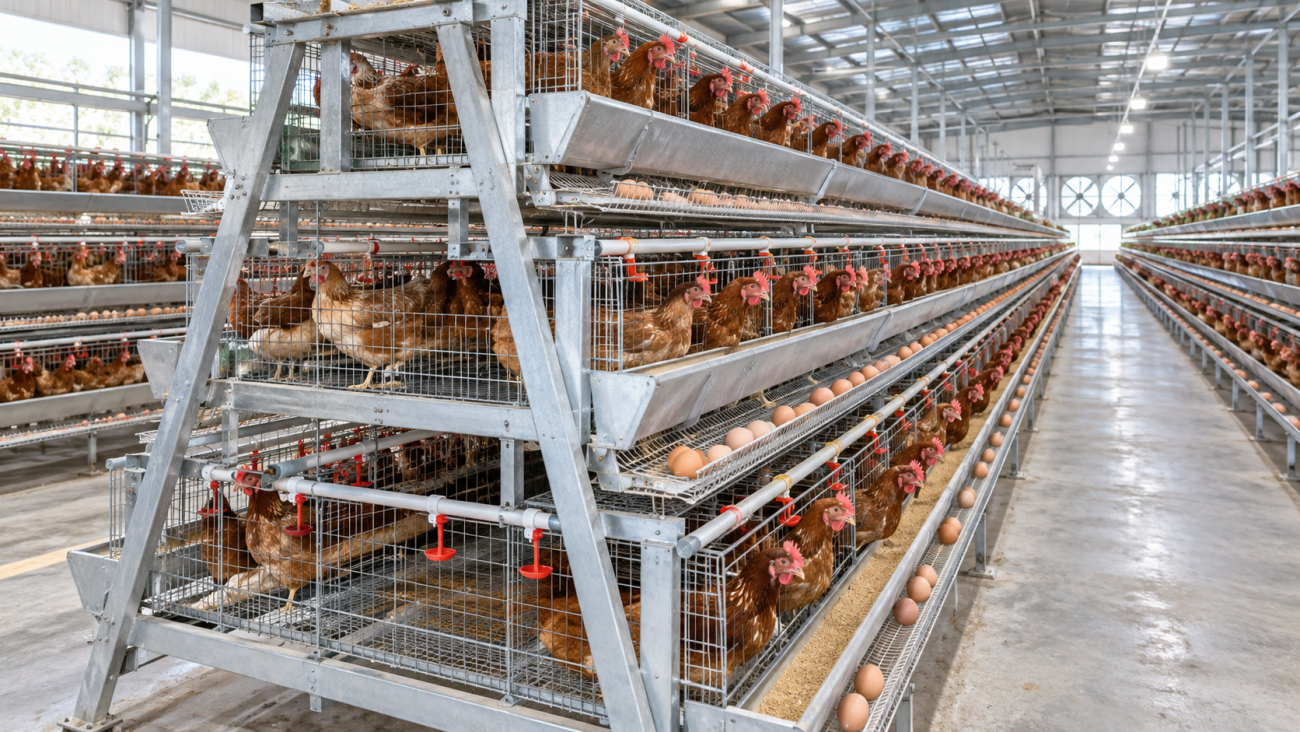
H-type cages become more interesting when the project gets larger. The stacked arrangement uses the height of the poultry house and can integrate feeding, drinking, manure belts and egg collection.
That does not mean every 50,000-bird farm in Indonesia needs H-type cages.
I would look at the available building width and height, labor, power supply and expansion plan first. A farm that has plenty of land but unreliable electricity may make a different decision from a farm near a major production area where land and labor are more expensive.
This is why simply asking a supplier, “Which cage is better?” rarely gives a useful answer.
The better question is: Which cage arrangement makes sense for this particular farm?
Check the Equipment Layout Before Pouring Concrete
This is one of those things that sounds obvious but still causes problems on real projects.
Sometimes we receive a house drawing after construction has already started. The customer has decided the length and width, structural columns are fixed, and only then do we begin fitting the cage rows into the available space.
We can work with an existing building, but it gives everyone fewer options.
For a new project, I prefer to work backwards from the planned bird capacity.
First work out how many cage rows are required. Then look at the passages, feeding route, manure outlet and egg collection route. Fan and cooling-pad positions can be checked at the same time.
Outside the house, there still needs to be space for:
- feed storage;
- water tanks;
- manure handling;
- vehicle access.
If the first stage is 50,000 layers but the owner eventually wants 100,000, tell the equipment supplier at the beginning. The first house does not have to carry the cost of the entire future farm, but the site should not be arranged in a way that makes the second stage unnecessarily difficult.
Indonesia’s Climate Cannot Be Treated as a Footnote
For equipment used in Indonesia, I pay particular attention to moisture and corrosion.
A poultry house is already a difficult environment for steel and electrical equipment because of manure, dust and ammonia. Add a humid tropical environment and long-term protection becomes even more important.
This affects fairly ordinary details:
- galvanized cage components;
- exposed steel parts;
- motors;
- cable connections;
- the position of electrical cabinets.
Drainage outside the house matters too. During periods of heavy rain, water should move away from the building rather than sit around the foundation or equipment areas.
Ventilation needs the same project-specific approach.
I would not specify a certain number of fans simply because another 50,000-bird farm uses that number. House length, width, bird density, air inlet design and cooling arrangement all affect the final configuration.
A poultry house environmental control system can operate fans and cooling equipment according to the settings, but it cannot correct a poultry house that was poorly laid out in the first place.
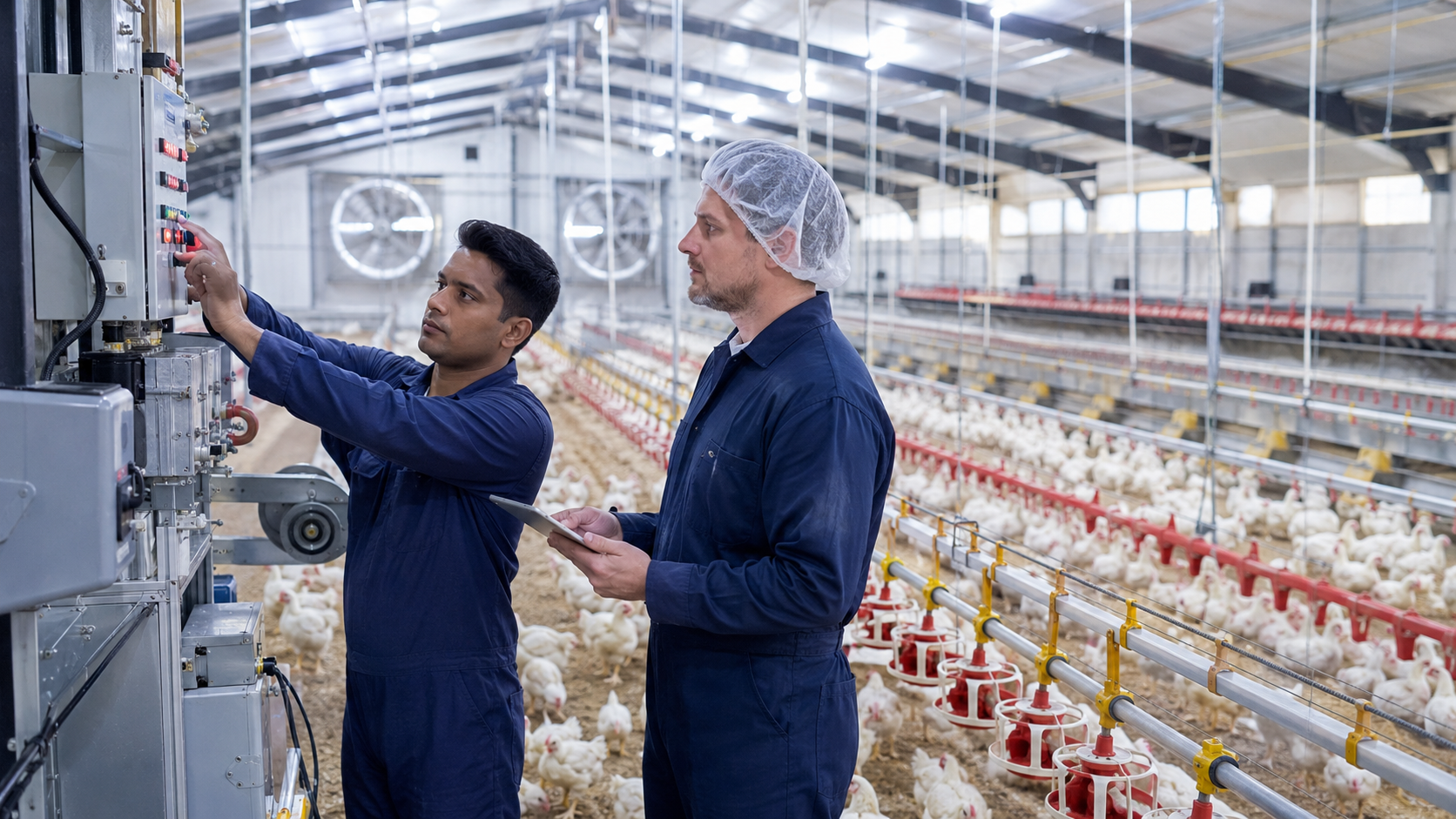
Power is another question worth asking early. The more automated the farm becomes, the more equipment depends on electricity. If the local supply is unstable, backup power needs to be considered during planning rather than after the birds have entered the house.

Feeding and Water Look Simple Until the Farm Gets Bigger
Carrying feed is not a serious issue on a very small farm.
Doing it every day for tens of thousands of birds is different.
On a larger project, feed storage and automatic feeding can remove a lot of repetitive movement inside the farm. But I would size the system from the actual project rather than copy another farm’s configuration.
- How many houses are there?
- How often will feed arrive?
- Where can the silo truck reach?
- How far does feed have to travel?
Those questions affect the equipment.
Water deserves the same treatment. Nipple drinkers are only the visible part inside the cage. Behind them are the storage tank, filtration, pressure regulation and pipe network.
For a long poultry house, we need to make sure birds at the far end of the line are not treated as an afterthought.

Where Will the Manure Go?
This is a question I would ask before the first cage is installed.
With H-type cages, manure belts can move manure out of each tier. That solves the problem inside the cage system, but not outside the poultry house.
The manure still needs somewhere to go.
Some farms remove it regularly. Others reserve an area for temporary storage or further treatment. The right arrangement depends on the farm, but there needs to be an arrangement.
Otherwise, a clean equipment layout on paper can turn into a poor traffic layout once tractors, workers and manure transport begin moving around the site.
Eggs create a similar planning issue.
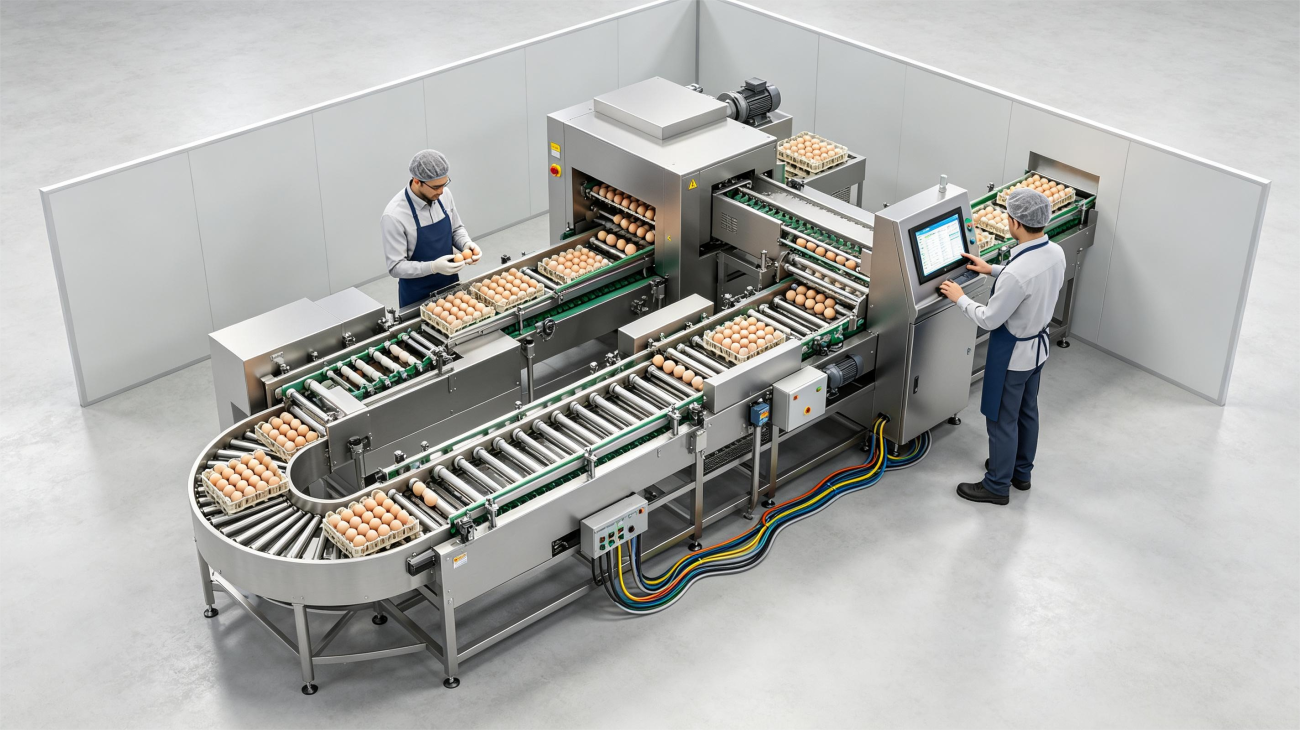
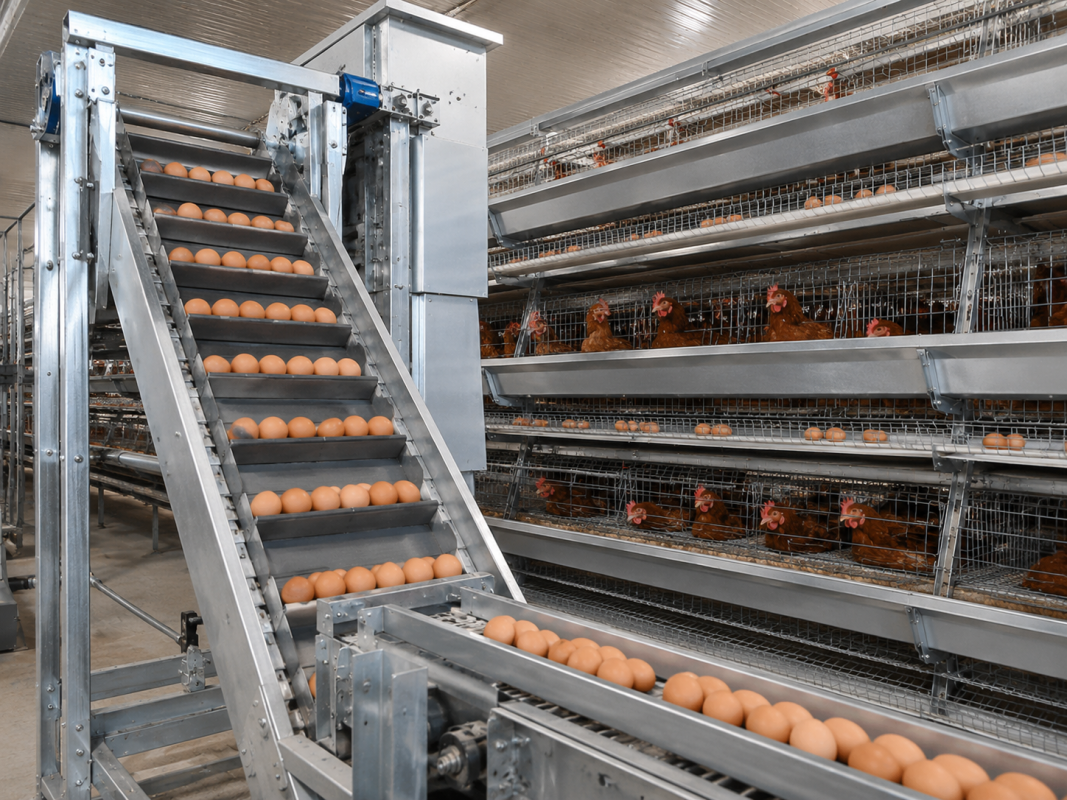
At 50,000 layers, egg collection is already a daily handling job. If several houses are eventually built, it may be worth planning how eggs will move from each house toward the collection or packing area instead of treating every house as a separate island.
What I Would Ask Before Quoting a 50,000-Layer Farm
A customer does not need to send us a complete engineering package for the first discussion.
For an Indonesian project, these details are usually enough to get started:
- project location;
- planned number of layers;
- available land dimensions;
- poultry house dimensions, if already built;
- preferred A-type or H-type cage, if already decided;
- available electricity and water;
- required level of automation;
- whether another construction phase is planned.
Photos and a simple hand-drawn site plan can also be useful.
With that information, we can have a much more useful conversation than simply quoting a price for “50,000 chicken cages.”
It also makes supplier quotations easier to compare. One quotation may include only cages and drinking lines, while another includes feeding, manure removal, egg collection, electrical controls and installation accessories. Looking only at the final price can therefore be misleading.
A Large Project Needs More Than a Cage Manufacturer
For this size of farm, I would also check whether the supplier has experience putting the different systems together.
Guangzhou Guangxing Poultry Equipment Group manufactures A-type and H-type layer cage systems as well as feeding, drinking, manure removal, egg collection and environmental control equipment.
Our manufacturing capacity is not limited to a small assembly workshop. Guangxing’s published production information shows more than 40,000 m² of standard production workshops at the Guangzhou headquarters and more than 100,000 m² at the Shaoguan Xinfeng production base.
More relevant to a farm investor, however, is whether the supplier has handled large integrated projects.
One example is the Guiyang Agricultural Investment project in China. It was put into operation in December 2023 and currently houses approximately 313,000 laying hens, with reported production of around 210,000 eggs per day.
I would not use those figures to promise the same production result for a farm in Indonesia. Bird performance depends on breed, feed, health, management, climate and many other factors.
What the project does show is experience coordinating cage systems with the equipment around them at commercial scale.
An Indonesian farm still needs its own configuration.
Planning a Layer Farm in Indonesia?
If you are still working with an empty piece of land, that is actually a good time to contact an equipment supplier.
Send us:
Project Location + Layer Capacity + Land Size
If the poultry house is already built, send:
Project Location + Layer Capacity + House Length × Width × Height
A drawing, sketch or a few site photos will help as well.
We can then look at the cage arrangement and basic equipment configuration before you move on to a detailed quotation.
Guangzhou Guangxing Poultry Equipment Group Co., Ltd.
WhatsApp: +852 4609 0144
Phone & WeChat: +86 178 7666 8787