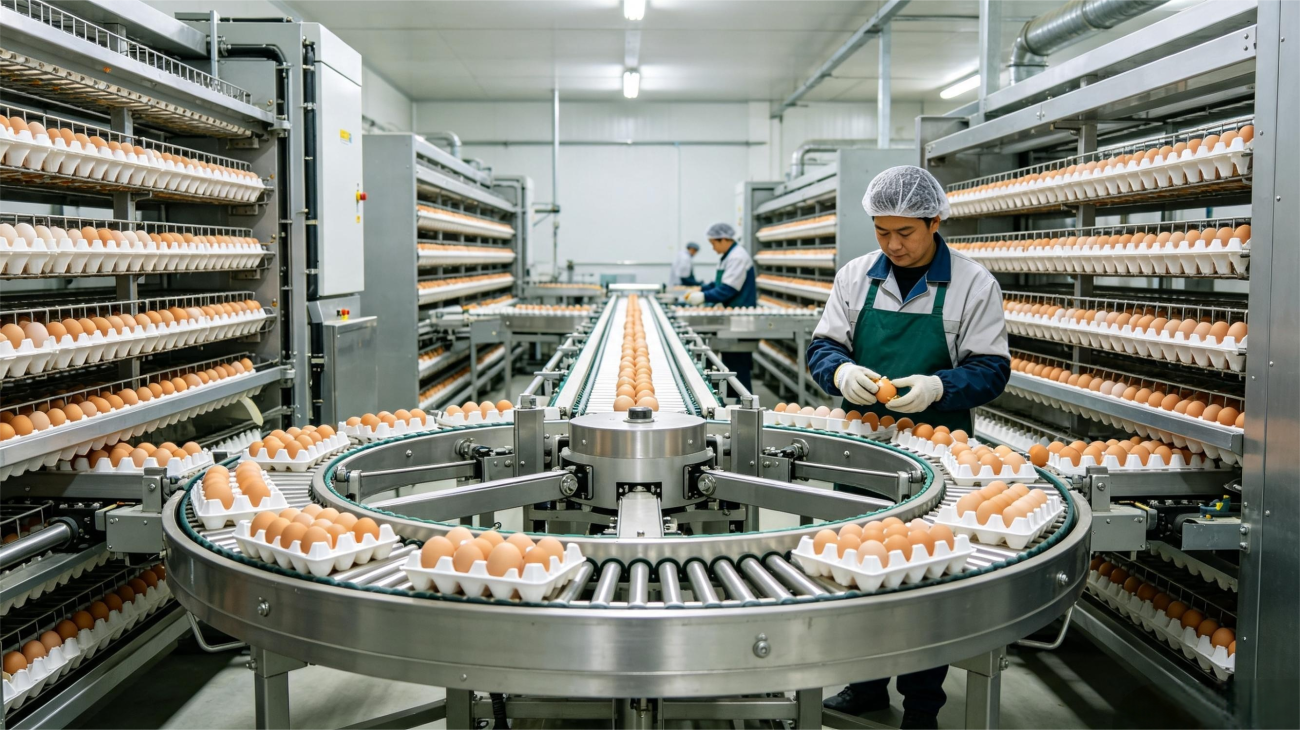
For a small poultry farm, sorting eggs by hand is usually manageable.
But once daily production reaches several thousand or tens of thousands of eggs, manual sorting starts to become slower, less consistent and more expensive.
That is when many farms begin looking for an egg sorting machine for poultry farm use.
The first question is often price. In practice, capacity and workflow matter more.
A machine that is too small will become a bottleneck. A machine that is too large may add cost without solving a real problem.
So before comparing models, it is worth looking at how eggs actually move through your farm.
What Does an Egg Sorting Machine Do?
Most egg sorting machines separate eggs by weight.
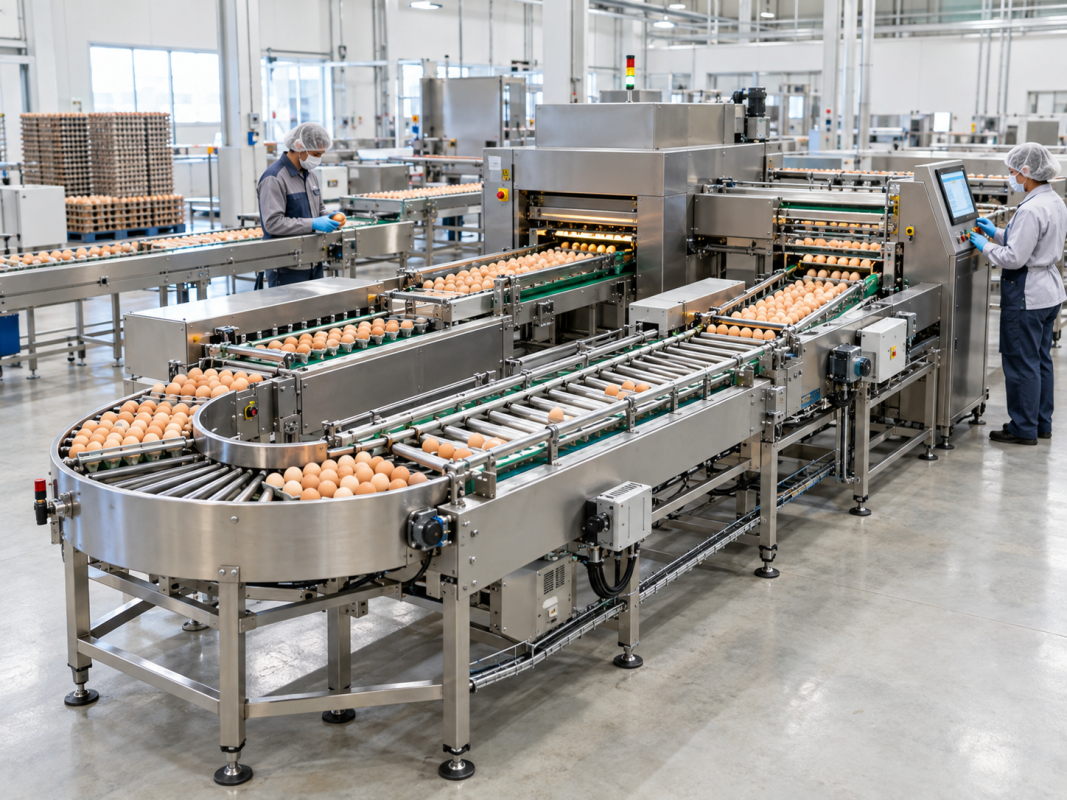
Each egg is weighed, then sent to the correct grading lane. Depending on the setup, eggs may be packed manually or transferred to an automatic packing section.
A more complete system may also include:
- Crack detection
- Dirty egg inspection
- Internal defect inspection
- Egg counting
- Automatic tray loading
- Carton packing
- Coding and traceability
For commercial layer farms, sorting is usually only one part of the process.
Eggs may first move from the poultry houses through an automatic egg collection system, then enter the inspection, grading and packing area.
This is why the full egg flow matters more than the machine alone.
When Does a Farm Need an Egg Sorting Machine?
There is no exact flock size that makes automation necessary.
Two farms with the same number of layers may have very different requirements.
One may sell eggs locally in trays. Another may supply supermarkets and need more consistent grading, better quality control and retail packaging.
Usually, automation becomes worth considering when:
- Manual sorting takes too much labor
- Egg sizes are inconsistent
- Breakage is increasing
- Customers require better grading
- Packing is becoming a bottleneck
At lower production volumes, workers can still inspect and pack eggs without much difficulty.
As output rises, the same work becomes repetitive and harder to control. Automatic grading can take over weighing and sorting while workers focus on packing and quality checks.
Start With Your Real Hourly Output
One of the most common mistakes is choosing a machine based only on the number of laying hens.
What matters more is how many eggs need to pass through the machine during the hours when grading actually takes place.
For example, if a farm produces 60,000 eggs per day and the grading room operates for eight hours, the average requirement is about 7,500 eggs per hour.
But buying a machine rated at exactly 7,500 eggs per hour is usually too tight.
There will be cleaning, short stops and uneven egg flow during the day.
It is better to leave some spare capacity, especially if the farm may expand later.
Commercial graders range from compact machines for smaller farms to large industrial systems. Manufacturers such as Moba offer different grading platforms for different production scales.
The important point is simple:
Choose capacity around your actual workflow, not just the biggest number in the catalogue.

Which Functions Are Worth Paying For?
Not every farm needs every option.
Weight grading
This is the basic function for most commercial farms.
If eggs are sold by size, automatic weight grading saves labor and gives more consistent results than manual sorting.
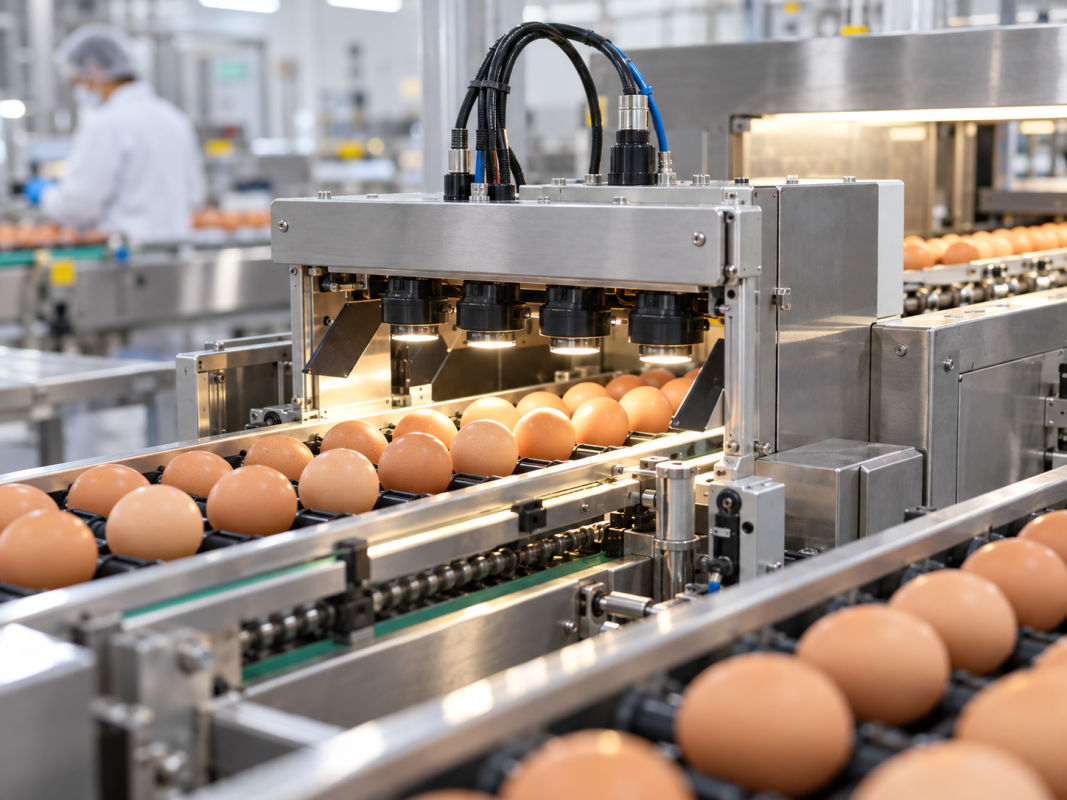
Crack detection
Crack detection becomes useful when shell quality matters.
Hairline cracks are easy to miss during manual inspection, especially at higher line speeds.
For farms supplying supermarkets or distributors, adding an egg crack detector may be worth considering.
For a smaller farm selling locally, the return may be different.
Dirty egg and internal defect inspection
These functions can improve quality control, but they also increase equipment cost.
Before adding them, ask whether your customers actually require that level of inspection.
More features are not always better.
Standalone Sorter or Complete Grading Line?
If the farm already has a good collection system and workers can still handle packing, a standalone sorter may be enough.
There is no reason to replace equipment that is still working well.
For a new farm, especially a larger H-type layer project, it often makes more sense to plan:
collection → inspection → grading → packing
as one line.
This reduces unnecessary transfer points and makes it easier to match conveyor speed, controls and production capacity.
If you are still comparing capacities and configurations, this egg grading machine guide can help explain how different grading systems fit different farm sizes.
Some commercial grading systems also support different feeding layouts. SANOVO egg grading systems are one example of how grading equipment can be configured for different processing setups.

Do Not Ignore Gentle Egg Handling
Buyers naturally look at eggs per hour.
But a fast machine is not very useful if eggs are being damaged during transfer.
Breakage often happens at:
- Conveyor junctions
- Sudden drops
- Sharp turns
- Packing transfers
- Poorly adjusted rollers
When comparing equipment, look at how eggs move through these points.
The goal is not simply to move eggs quickly.
It is to move them quickly without unnecessary impact.
For a commercial poultry farm, even a small reduction in breakage can matter over a full year.
What Should You Send to a Supplier?
If you want a useful quotation, do not send only:
“Please quote an egg sorting machine.”
Give the supplier enough information to size the system properly.
At minimum, send:
- Number of laying hens
- Approximate eggs per day
- Required operating hours
- Number of poultry houses
- Existing collection equipment
- Required grading sizes
- Packing method
- Whether crack inspection is needed
- Available room dimensions
- Voltage and frequency
For an existing farm, photos and a simple floor plan are also useful.
This makes it easier to judge whether you need a standalone sorter or a complete grading and packing line.
A Simple Example
Take a farm with 100,000 laying hens.
It would be easy to choose a large machine simply because the flock is large.
But that is not always necessary.
The better questions are:
How many eggs are collected during peak production?
How many hours will the grading line operate?
Are the eggs sold in trays or retail cartons?
Is crack inspection required?
How much packing work can the current staff handle?
Once these questions are answered, the right machine size usually becomes much clearer.
Final Thoughts
An egg sorting machine for poultry farm should solve a real bottleneck.
For one farm, that may be labor.
For another, it may be inconsistent grading, breakage or slow packing.
These farms do not need the same machine.
Start with your actual egg flow.
Work out how many eggs need to be handled per hour, how they move from the poultry house to the grading room, and what your customers expect from the final product.
Then choose the equipment around that process.
That is usually a better way to buy than starting with a catalogue.
FAQ
What is the difference between an egg sorting machine and an egg grading machine?
The two terms are often used for similar equipment. Most systems weigh eggs and sort them into different grades. Larger lines may also include inspection and automatic packing.
How do I choose the right machine capacity?
Use your daily egg output and actual grading hours as the starting point. Leave some extra capacity for peak production, cleaning and future expansion.
Can the machine connect to an automatic egg collection system?
Yes. This is common in larger automated layer farms. Eggs can move from the poultry house directly into the grading area through a central conveyor.
Does every poultry farm need crack detection?
No. It depends on production volume, customer requirements and quality standards. Crack detection becomes more useful when manual inspection becomes difficult or inconsistent.