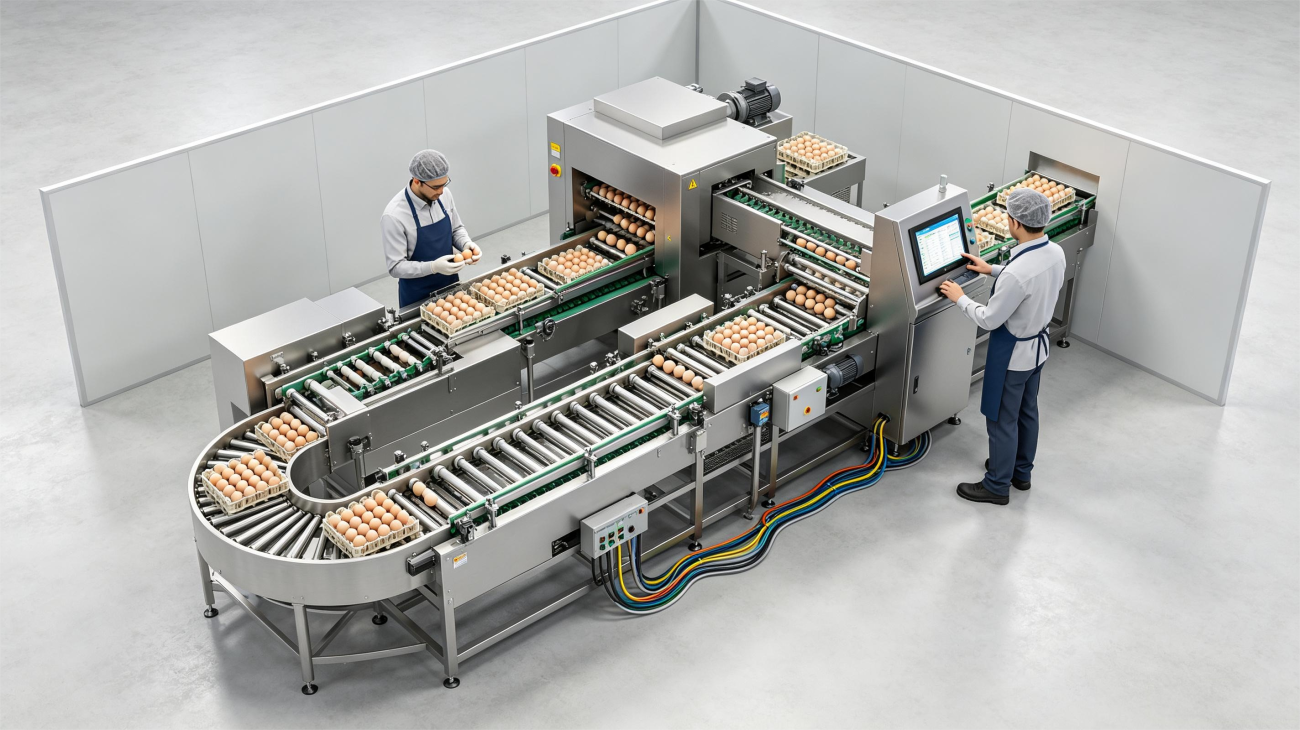
The poultry farm shed cost for 15000 birds is easy to underestimate when buyers confuse cage equipment prices with the cost of a complete poultry house.
One supplier publishes a reference price of US$26,100 for broiler cages, feeding and drinking equipment. Another lists approximately US$28,500 for a mid-scale equipment package. Neither figure represents a complete, fully automated H-type broiler farm.
A working cage house also needs manure removal, ventilation, heating, environmental controls, electrical installation and a suitable building.
For investors considering H-type cages, the real question is whether better use of building space and greater automation justify the additional equipment investment. That decision depends on local operating conditions, not simply the lowest price per bird.
1. How Much Space Do 15,000 Broilers Need?
H-type cages arrange broilers on multiple levels, allowing farmers to use vertical space rather than relying entirely on the building floor.
However, three cage tiers do not automatically mean the poultry house can be reduced to one-third of its original size. Service aisles, feeding equipment, manure conveyors and ventilation all need space.
Consider this preliminary calculation:
| Planning Item | Example |
|---|---|
| Farm capacity | 15,000 broilers |
| Housing system | H-type multi-tier cages |
| Target market weight | 2.2 kg |
| Planned total live weight | 33,000 kg |
| Illustrative cage tiers | 3 |
| Assumed usable-deck loading | 25 kg/m² |
| Calculated total cage-deck area | 1,320 m² |
| Theoretical deck footprint | 440 m² |
15,000 × 2.2 kg ÷ 25 kg/m² = 1,320 m²
Dividing this across three equal tiers produces a theoretical cage-deck footprint of 440 m².
The 25 kg/m² loading is a calculation assumption only, not a recommended stocking density. Actual capacity must comply with local regulations, animal welfare requirements and the selected cage specifications.
The building also needs additional floor space and sufficient height for maintenance access.
We recommend confirming the cage layout before finalizing the steel structure. A poorly positioned doorway or insufficient clearance between cage rows may appear insignificant on a drawing but can make maintenance difficult throughout the equipment’s working life.
Check market requirements before investing. The European Food Safety Authority recommends alternatives to cages for broilers. EU animal welfare legislation is also under review, but scientific recommendations and legally enforceable restrictions are not the same. Buyers should verify the rules and customer standards applicable to their market.
2. Which H-Type Cage Equipment Is Worth Paying For?
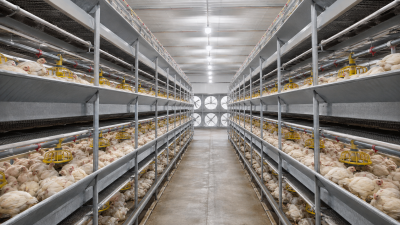
A complete H-type system involves more than cage frames.
For a 15,000-bird project, the following systems must work together.
| Equipment | Main Purchasing Concern |
|---|---|
| H-type cages and floor panels | Structural quality, bird support and cleaning |
| Automatic feeding | Consistent feed delivery across tiers |
| Nipple drinking lines | Reliable flow and drinking access |
| Feed silo and conveyors | Continuous feed supply |
| Manure belts and discharge system | Belt tracking and waste handling |
| Ventilation and cooling | Suitable airflow at every level |
| Heating and environmental controls | Stable growing conditions |
| Bird unloading equipment | Labor and handling requirements |
| Backup power and alarms | Protection during power failures |
Cage Structure: More Tiers Are Not Always Better
Additional tiers can improve space utilization, but they also make ventilation and equipment access more demanding.
Before choosing a configuration, check whether workers can reach drinking lines, feeding equipment and manure-belt drives safely.
A cage layout that looks efficient on paper may become expensive to maintain if inspections and repairs require excessive labor.
Manure Removal: Pay Attention to the Discharge End
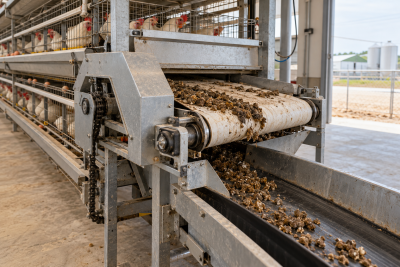
Automatic manure belts reduce manual waste handling beneath cage tiers. However, their usefulness depends on proper installation and maintenance.
Poor belt tracking can damage equipment or interrupt manure removal. If manure remains beneath the cages too long, accumulated moisture may contribute to higher ammonia levels.
We would check belt tensioning, motor access and the discharge arrangement before ordering.
The farm also needs a suitable destination for the collected manure. A well-designed cage house should connect manure removal with storage or treatment arrangements rather than leave that problem until construction is complete.
Feeding and Drinking: Reliability Matters More Than Features
Automatic feeding should deliver feed consistently across all cage rows and tiers.
Uneven distribution or repeated interruptions can affect feed access and increase daily management work.
Drinking systems need appropriate pressure regulation and accessible maintenance points.
Before comparing prices, ask how staff will inspect, adjust and repair these systems while birds are in the house.
3. What Does a 15,000-Bird H-Type Cage Farm Really Cost?
One of the most common purchasing mistakes is treating a basic cage quotation as the total construction budget.
A supplier’s published example breaks down equipment costs for 15,000 broilers as follows:
| Equipment Component | Reference Price |
|---|---|
| Broiler cages | $22,500 |
| Feeding equipment | $2,400 |
| Drinking equipment | $1,200 |
| Basic equipment total | $26,100 |
That works out to approximately $1.74 per bird position for the listed components.
These are third-party published estimates, not Guangxing quotations. The figures do not establish the cost of a complete Guangxing 9CLXR system.
Another supplier publishes a US$28,500 equipment budget for a 15,000-bird operation. Its scope is different, so the figures should not be treated as directly comparable quotations.
What Is Missing from a Basic Cage Quotation?
A complete project budget should separate the following costs.
| Budget Category | Items to Confirm |
|---|---|
| Cage equipment | Frames, floor panels, feeding and drinking |
| Manure removal | Belts, motors and discharge conveyors |
| Environmental control | Fans, cooling, heating and controllers |
| Building construction | Steel structure, roofing, insulation and foundations |
| Electrical and safety | Wiring, alarms and backup power |
| Project expenses | Freight, installation, commissioning and spare parts |
The amount spent on each category depends on the project design, destination and local construction costs.
We would request equipment-only, delivered-equipment and installed-project quotations wherever these services are available.
Keep a separate contingency allowance for unexpected foundation work, electrical changes or site adjustments. The amount should reflect local conditions and the completeness of the drawings, rather than a fixed percentage applied to every project.
Our advice: compare the total project scope, not the advertised cage price.
A supplier offering a higher but clearly specified quotation may be a better choice than one whose price excludes essential equipment.
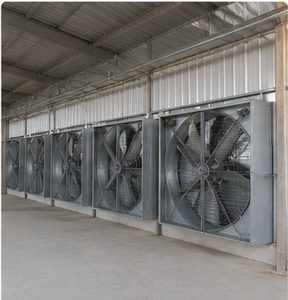
4. Why Is Ventilation a Bigger Challenge in Multi-Tier Housing?
In a floor-rearing house, birds occupy one main growing level. H-type cages place birds at different heights, making airflow distribution more complicated.
Air entering the house does not guarantee that every cage tier receives suitable ventilation.
Depending on the arrangement, temperature, airflow and moisture conditions may differ between upper and lower levels.
That is why we would review the cage layout and ventilation design together rather than purchase fans separately.
Some low-cost cage quotations cover only the cages and basic feeding equipment, leaving the buyer to arrange ventilation independently.
If the ventilation design does not match the cage layout, uneven airflow may affect bird performance and increase operating risks. The building and cage arrangement must therefore be considered together.
In hot climates, poor ventilation can affect bird comfort and feed intake. An enclosed cage house also depends heavily on electricity.
If the main ventilation fans stop during hot weather, the flock may quickly face dangerous conditions.
For this reason, backup generation, emergency alarms and critical electrical loads should be included in the initial budget.
Aviagen’s broiler management guidance emphasizes appropriate backup systems and regular testing.
Generator capacity must be calculated from the actual essential equipment loads, not bird numbers alone.
We would prioritize reliable ventilation and backup power before spending on optional remote-monitoring upgrades.
5. Can Automation Reduce Long-Term Operating Costs?
Automation can reduce repetitive work, but it does not eliminate operating expenses.
Manure conveyors need inspection, motors require maintenance and drinking equipment needs adjustment. The financial benefit depends on local labor costs, equipment reliability and spare-part availability.
Feed conversion ratio, or FCR, is another important consideration.
Suppose a farm places 15,000 chicks and sells 14,400 birds at 2.2 kg each. That gives 31,680 kg of live weight sold.
| Factor | Illustrative Assumption |
|---|---|
| Birds sold | 14,400 |
| Market weight | 2.2 kg |
| Total live weight sold | 31,680 kg |
| Assumed feed price | $0.35/kg |
| Illustrative FCR increase | 0.10 |
| Additional feed-equivalent cost | $1,108.80 |
The simplified calculation is:
31,680 kg × 0.10 × $0.35 = $1,108.80
This illustrates the cost of an additional 0.10 kg of feed per kilogram of live weight sold.
It is not a complete flock feed-cost calculation. Actual results also depend on mortality, culled birds, starting weights and feed inventory.
Nor does this example suggest that H-type cages automatically improve FCR.
The practical lesson is that feeding reliability, drinking performance and house climate can influence operating costs across repeated production cycles.
A lower equipment price is not necessarily a saving if the system creates avoidable maintenance work or recurring production problems.
6. Where Should You Buy H-Type Broiler Cage Equipment?
Local agricultural suppliers are convenient for routine materials and replacement parts. Specialist equipment distributors may provide installation and nearby technical support.
For a complete cage-house project, direct manufacturer sourcing is also worth comparing.
A manufacturer may be able to coordinate cage dimensions, feeding, drinking, manure removal and environmental-control requirements within one proposal.
However, importing does not automatically reduce the total investment.
Freight, import duties, installation, electrical compatibility and after-sales service all affect the final cost.
Before placing an order, request technical drawings, a detailed equipment list, warranty terms and spare-parts information.
When Should You Consider Guangxing?
Guangzhou Guangxing Poultry Equipment Group is a Chinese poultry equipment manufacturer established in 1988.
Its automatic multi-tier broiler cage system is designed for commercial H-type broiler housing.
The published Guangxing 9CLXR system combines multi-tier cages, automatic feeding, nipple drinking, manure removal and bird unloading equipment, with environmental-control integration.
For a 15,000-bird project, the first step should be confirming cage capacity, tier arrangement, building dimensions and ventilation requirements.
Guangxing can then review the relevant equipment configuration and clarify the proposed supply scope.
A detailed layout and bill of materials are more useful than a broad promise of a low-cost turnkey project.
7. H-Type Cages or Deep-Litter Floor Rearing?
These two systems suit different investment conditions.
| Decision Factor | H-Type Cages | Deep-Litter Floor Rearing |
|---|---|---|
| Vertical space utilization | Higher | No multi-tier arrangement |
| Initial equipment cost | Generally higher | Generally lower |
| Manure handling | Automated belts possible | Litter management required |
| Maintenance | More mechanical equipment | Fewer cage-related components |
| Welfare considerations | Cage-specific restrictions and concerns | Different welfare and litter-management requirements |
H-type cages may be worth considering where land is limited and the project can support the additional equipment investment.
Floor rearing may be more practical for farms with sufficient space and a lower initial equipment budget.
Neither system guarantees higher profits.
For comparison, read our 10,000-bird deep-litter poultry farm cost guide and broiler cage vs floor farming guide.
8. How Much Revenue Can 15,000 Broilers Generate?
Consider the same hypothetical assumptions used in our 10,000-bird article.
| Item | Example |
|---|---|
| Chicks placed | 15,000 |
| Mortality | 4% |
| Birds sold | 14,400 |
| Average market weight | 2.2 kg |
| Total live weight sold | 31,680 kg |
| Assumed selling price | $1.80/kg |
| Gross revenue per cycle | $57,024 |
14,400 × 2.2 kg × $1.80 = $57,024
This represents gross sales revenue, not profit.
Feed, chicks, electricity, heating, labor, maintenance, veterinary expenses and financing costs must still be deducted.
At this sales volume, a $0.10/kg change in selling price changes gross revenue by $3,168.
These assumptions are illustrative, not actual market prices or Guangxing customer results. Production costs, bird weights, mortality and selling prices vary by location and farm management.
Investors should compare cage and floor-rearing systems using realistic local costs, expected production performance and total capital investment.
Is an H-Type Broiler Cage System Worth the Investment?
An H-type cage system is worth considering when land is limited, local regulations and buyer standards permit cage production, and the farm has sufficient capital for reliable ventilation, automatic manure removal and ongoing maintenance.
We would be more cautious where land is inexpensive, the initial budget is tight, electricity is unreliable or the target market requires cage-free production.
The deciding factor is not how many birds can fit into the building. It is whether the additional investment can be recovered through realistic savings in land, labor and daily operations.
Before choosing H-type cages, compare the total installed cost and operating expenses with a floor-rearing alternative under the same local conditions.
Frequently Asked Questions
How much does an H-type broiler cage system for 15000 birds cost?
One supplier publishes a US$26,100 reference for cages, feeding and drinking equipment. This is not the cost of a complete automatic H-type cage farm. Manure removal, ventilation, building work and installation require separate quotations.
How much building space is needed for 15,000 broilers?
The final building dimensions depend on cage specifications, tier count, legally permitted stocking density and service access. The manufacturer should confirm the layout before construction.
Can a 15,000-bird cage farm operate automatically?
Yes. Feeding, drinking, manure removal, environmental control and some bird-unloading operations can be automated. The actual configuration depends on the selected system.
Are broiler cages permitted in every market?
No. Regulations and buyer welfare standards vary. EFSA recommends alternatives to cages for broilers, while EU welfare legislation is under review. Always verify applicable requirements before investing.
Plan Your 15,000-Bird H-Type Broiler Farm with Guangxing
A reliable cage-house project starts with the right equipment layout, not just a price per bird.
Guangxing can review the requirements for a 15,000-bird H-type broiler cage system and discuss suitable equipment configurations.
Send us your country, proposed building dimensions, target market weight and preferred automation level.
We can review cage arrangements, feeding, drinking, manure removal and environmental-control requirements before preparing a project-specific equipment quotation.
Request a 15,000-Bird H-Type Broiler Cage Equipment Plan