


The poultry farm shed cost for 10000 birds can vary considerably, even when two farms have the same flock capacity.
For a 1,200 m² deep-litter broiler house, one steel-structure supplier’s published estimates suggest US$144,000–312,000 for an open-sided house and US$312,000–600,000 for a fully enclosed, environmentally controlled house.
These figures are preliminary construction and equipment references, not Guangxing quotations or verified international market averages. Actual costs depend on the building specification, local climate, equipment package and installation location.
The important question is not which house is cheaper to build. It is whether the money saved during construction will lead to higher operating costs later.
A farmer who chooses an inexpensive building but struggles with heat stress, wet litter or poor ventilation may spend much of that saving during production.
Here is how we would approach the investment.
1. How Much Space Do 10,000 Broilers Need?
For a farm planning to sell broilers at approximately 2.2 kg, a 100 m × 12 m house provides a useful starting point.
| Planning Item | Proposed Specification |
|---|---|
| Farm capacity | 10,000 broilers per cycle |
| Housing method | Deep-litter floor rearing |
| House dimensions | 100 m × 12 m |
| Gross floor area | 1,200 m² |
| Target market weight | 2.2 kg |
| Planned live weight | 22,000 kg |
| Density based on gross area | 18.3 kg/m² |
This represents approximately 8.3 birds per square meter of gross floor area.
It is only an initial calculation. Final capacity must account for usable growing space, ventilation performance and local welfare rules.
For comparison, EU Directive 2007/43/EC generally establishes a maximum stocking density of 33 kg/m², with higher limits permitted only under specified conditions.
We would not recommend building the house before reviewing the equipment layout.
Feeding lines, drinking lines, fans, doors and service access all influence construction drawings. A small adjustment before construction may prevent expensive modifications afterward.
The site also needs space for feed deliveries, drainage, water storage, vehicle access and litter handling.
2. Open-Sided or Enclosed: Which House Is Worth the Investment?
This decision deserves more attention than choosing optional automation features.
An open-sided house can be suitable where the climate allows sufficient natural or assisted airflow. Construction is usually simpler, and electricity requirements may be lower.
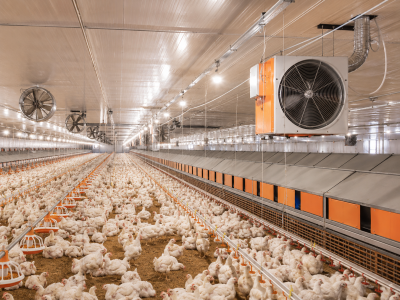
A fully enclosed house provides more active control over temperature, humidity and ventilation, but requires a larger initial investment.
| Comparison | Open-Sided House | Fully Enclosed House |
|---|---|---|
| Published cost reference | $144,000–312,000 | $312,000–600,000 |
| Insulation | Basic or site-specific | Higher specification |
| Ventilation | Natural or assisted | Mechanically controlled |
| Temperature control | More weather-dependent | Greater control potential |
| Electricity dependence | Generally lower | Higher |
| Maintenance complexity | Usually simpler | More equipment to maintain |
In hot and humid regions, the initial construction price deserves less attention than the house’s ability to maintain suitable conditions throughout the growing cycle.
An open-sided house may save money upfront. However, repeated heat stress, wet litter and inconsistent airflow can increase operating costs and affect flock performance.
Before choosing the cheaper option, compare local climate records, energy costs and realistic production results.
That does not mean an enclosed house is always better.
Its biggest operational weakness is dependence on electricity.
If the ventilation fans stop during hot weather, birds can quickly face dangerous conditions.
Aviagen’s broiler management guidance recommends backup power and alarm arrangements for mechanically ventilated houses.
For this reason, we would prioritize generator capacity, critical alarms and emergency ventilation planning before paying for advanced remote-monitoring features.
A sophisticated controller cannot protect the flock if essential equipment has no power.
3. Where Does the Construction Budget Go?
One of the most common purchasing mistakes is comparing quotations with different scopes.
A steel-frame quotation is not the same as the price of a working poultry house.
A published 2026 supplier guide provides the following reference figures:
| Cost Component | Open-Sided | Enclosed |
|---|---|---|
| Steel frame, FOB China | $32–55/m² | $40–70/m² |
| Roof and wall materials | +$18–30/m² | +$40–70/m² |
| Environmental and production equipment | +$10–25/m² | +$45–110/m² |
| Fully built reference, including foundations and erection | $120–260/m² | $260–500/m² |
These figures come from a steel-building supplier’s published estimates, not Guangxing quotations. The final row represents a separate overall estimate and must not be added to the component rows.
The cost difference is not simply about the steel structure.
An enclosed house may require insulated panels, larger ventilation systems, cooling equipment, heating, environmental controllers and more electrical work.
Before comparing quotations, ask suppliers to separate the building structure, production equipment, climate-control equipment and installation expenses.
Also check what is excluded. Land, chicks, initial feed, working capital, import duties and unexpected site work can add substantially to the investment.
Our advice: a lower quotation is only meaningful when both suppliers offer the same scope.
Otherwise, the buyer may discover additional expenses after construction begins.
4. Which Equipment Should a 10,000-Bird Farm Prioritize?
We would spend the initial equipment budget on reliable feeding, drinking, ventilation and brooding before considering sophisticated automation.
| Equipment | Initial Planning Allowance | Purchasing Priority |
|---|---|---|
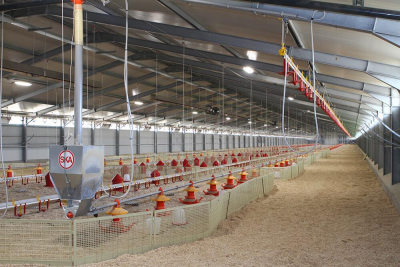
| Automatic pan feeders | 170–200 pans | Consistent feed access |
| Feed silo and conveyor | Based on consumption | Reliable feed delivery |
| Nipple drinkers | 1,000–1,200 nipples | Water access and leakage control |
| Fans and air inlets | Engineering calculation required | Heat and air-quality management |
| Brooding heaters | Climate-dependent | Chick temperature |
| Water filtration and regulation | Complete drinking system | Stable water supply |
| Lighting and controls | House-specific | Daily management |
| Backup power and alarms | Critical loads | Emergency protection |
These quantities are preliminary. The final arrangement depends on equipment specifications, bird weight and house design.
Feeding Equipment: Small Losses Add Up
The Cobb Broiler Management Guide gives approximately 45–65 birds per standard 33 cm feeding pan, depending on growing conditions.
For 10,000 broilers, 170–200 pans provide a reasonable starting allowance.
However, we would pay as much attention to feeder adjustment and distribution as to pan numbers.
Poor feeder height or unreliable delivery can create unnecessary feed spillage. Across several production cycles, repeated waste becomes a real operating expense.
Drinking Lines: Leakage Is Not a Minor Problem
An initial allowance of 1,000–1,200 nipples gives around 8–10 birds per nipple.
The final quantity must follow the selected product’s specifications and drinking requirements.
Poor pressure regulation or leaking nipples can leave the litter wet, increasing ammonia and footpad problems. The farm may then face additional bedding and labor costs.
Saving a small amount on low-quality drinking components is rarely worthwhile if it creates continuous maintenance problems.
Ventilation Should Be Engineered, Not Copied
Two poultry houses with the same capacity may need different fan arrangements because of climate, building geometry and expected bird weight.
Ask suppliers to explain minimum ventilation during brooding and maximum ventilation near market weight.
Do not approve the fan quantity simply because another 10,000-bird farm uses the same number.
5. How Much Can FCR Affect Operating Costs?
Construction cost is only one part of the investment.
Feed often represents the largest operating expense in broiler production. This means feed conversion ratio (FCR) deserves attention when evaluating equipment and housing conditions.
Consider a hypothetical production cycle:
| Item | Assumption |
|---|---|
| Birds sold | 9,600 |
| Average market weight | 2.2 kg |
| Total live weight sold | 21,120 kg |
| Assumed feed price | $0.35/kg |
| Illustrative FCR deterioration | 0.10 |
| Additional feed-equivalent cost | $739.20 |
The simplified calculation is:
21,120 kg × 0.10 × $0.35 = $739.20
This estimates the cost associated with an additional 0.10 kg of feed per kilogram of live weight sold.
It is not a complete flock feed-cost calculation. Actual feed accounting must also consider mortality, culled birds, starting weights and inventory differences.
The example does not suggest that automation guarantees better FCR.
Instead, it shows why farmers should assess the effects of feeding consistency, drinking-line problems and heat stress before selecting equipment solely by purchase price.
A cheap system that repeatedly wastes feed may cost more over its working life than a better-designed alternative.
6. Where Should You Buy Poultry Equipment?
Not every item needs to be imported.
Local agricultural shops are often the practical choice for bedding, routine supplies and urgent replacement parts. Specialist distributors may offer installation and nearby service support.
For a new commercial house requiring several coordinated systems, direct manufacturer sourcing is also worth considering.
A Chinese manufacturer may be able to review feeding, drinking and environmental-control requirements together.
However, factory price alone does not determine value.
Freight, duties, installation, electrical compatibility and replacement-parts availability all affect the total cost of ownership.
When Should You Consider Guangxing?
Guangzhou Guangxing Poultry Equipment Group is a Chinese poultry equipment manufacturer established in 1988.
Its product portfolio includes automated poultry equipment and poultry house environmental control systems.
One important distinction needs to be made.
Guangxing’s published automatic feeding system uses trolley feeding for cage houses. It is not the same as the pan-feeding equipment specified for this deep-litter project.
Buyers should therefore confirm actual product availability and compatibility rather than assume every feeding system fits every housing method.
For a complete equipment inquiry, request drawings, technical specifications, delivery scope, spare-parts information and installation responsibilities.
A manufacturer is most useful when it helps identify design and compatibility problems before equipment is ordered.
7. What Revenue Could 10,000 Broilers Generate?
Consider a simplified production scenario.
| Item | Assumption |
|---|---|
| Chicks placed | 10,000 |
| Mortality | 4% |
| Birds sold | 9,600 |
| Market weight | 2.2 kg |
| Selling price | $1.80/kg |
| Gross revenue per cycle | $38,016 |
9,600 × 2.2 kg × $1.80 = $38,016
This is gross revenue, not profit.
The farmer must still deduct chicks, feed, electricity, heating, bedding, labor, veterinary expenses and other operating costs.
At this sales volume, a $0.10/kg change in live-bird selling price changes revenue by $2,112.
Both the selling price and feed price are hypothetical. Actual figures should come from local suppliers and buyers.
For an investor, the useful question is whether the selected building and equipment can support consistent production at an acceptable cost—not merely how much revenue one cycle might generate.
8. Is Deep-Litter Floor Rearing the Right Choice?
For a 10,000-bird project, deep-litter floor rearing may offer a lower equipment entry cost than multi-tier cage systems.
However, it needs adequate floor area and consistent litter management.
Cage systems can use vertical space and integrate additional automation, but they also involve higher equipment investment, maintenance requirements and welfare considerations.
Neither method automatically delivers better returns.
For a closer comparison, read our broiler cage vs floor farming guide.
The right choice depends on the available land, climate, labor, electricity supply and customer requirements.
Frequently Asked Questions
How much does a poultry farm shed cost for 10000 birds?
For a proposed 1,200 m² house, one supplier’s published estimates suggest US$144,000–312,000 for an open-sided project and US$312,000–600,000 for a fully enclosed project. Actual quotations depend on the project scope and location.
Is a 100 m × 12 m house enough for 10,000 broilers?
It provides 1,200 m² of gross floor area, equivalent to approximately 18.3 kg/m² at 2.2 kg per bird. Actual capacity must consider usable space, climate and local welfare requirements.
Which equipment should I buy first?
Prioritize feeding, drinking, ventilation, brooding and essential safety equipment. Advanced monitoring can be considered after the core systems are properly specified.
Is a fully enclosed house always more profitable?
No. It offers greater environmental control but requires more investment, electricity and maintenance. Profitability depends on local operating conditions.
Should I import poultry equipment from China?
Importing can be suitable for coordinated equipment packages. Compare the delivered and installed cost, technical compatibility, warranty and spare-parts support against local alternatives.
Plan Your 10,000-Bird Broiler House with Guangxing
Before purchasing equipment, confirm the building dimensions, local climate, production capacity and preferred housing method.
Guangxing can discuss relevant poultry equipment and review the requirements of your proposed project.
Send us your country, available land dimensions, target market weight and preferred house type.
We can clarify the applicable equipment configuration, confirm the supply scope and prepare a quotation based on your project requirements.
Request a 10,000-Bird Broiler Farm Equipment Plan


One thought on “Poultry Farm Shed Cost for 10000 Birds: What Should You Really Budget?”