


A pig farmer may spend money on a manure separator and still end up with a wastewater problem.
We’ve seen why this can happen when reviewing treatment designs: the solid manure is only part of the job. Urine, washing water, and slurry still have to go somewhere. Add heavy rainfall, and the storage system may struggle long before the treatment equipment reaches its advertised capacity.
For pig farms in the Philippines, Indonesia, and Malaysia, this deserves attention early in the project.
The best pig manure treatment solution isn’t necessarily the one with the most equipment. It is the one that handles the farm’s actual waste volume, fits the available land, and remains manageable after installation.
Before recommending equipment, we would first want to understand how the farm collects manure and what it plans to do with the treated material.
How Much Pig Manure and Wastewater Does Your Farm Produce?
Start with the daily quantity. Pig numbers alone won’t give you the full picture.
Take two farms with 500 pigs. One removes most manure by dry scraping. The other uses water to flush manure from the buildings. Their wastewater volumes, storage requirements, and operating costs can be quite different.
The University of Missouri Extension’s EQ304 publication, citing ASABE reference data, gives an estimated manure production of approximately 1.25 US gallons (4.73 litres) per day for a grow-finish pig averaging 70 kg.
For a farm with 500 pigs of that average weight:
500 × 1.25 gallons = 625 US gallons, or approximately 2.37 m³ per day.
This is an estimated manure quantity, not the total wastewater flow. It excludes additional washdown water, leaking drinkers, and rainwater entering the collection system.
Fresh poultry manure is commonly calculated by weight, while pig slurry and wastewater are often measured by volume. This is mainly because of the way the material is collected. Dry-collected pig manure can also be weighed.
For an actual project, we recommend measuring both solid manure and liquid waste over representative operating days. Those figures are far more useful than choosing a separator or tank directly from a catalogue.
Small Pig Farms: Keep the Treatment System Manageable
For farms with up to around 100 pigs, a straightforward system may be the most economical.
If manure is collected by dry scraping, it can be moved to a covered composting area. Suitable bedding or carbon-rich materials may be added to improve the mixture before aerobic composting.
A roof, impermeable floor, and proper drainage are still necessary. An inexpensive composting area can become a costly cleanup problem if rainwater passes through the manure and carries contaminated runoff outside the farm.
Urine and washing water need their own storage and treatment arrangements.
Where the farm has sufficient agricultural land, compliant nutrient recycling may be an option. Otherwise, the liquid may need further treatment or collection by an appropriate service provider.
Would we automatically recommend a mechanical solid-liquid separator for a farm this size? No.
If the farmer already collects most manure as a relatively dry solid, adding another machine may create maintenance costs without solving a significant problem.
A small biogas digester is possible in some situations, but gas safety, daily maintenance, and digestate handling must be considered before investing.
Medium Pig Farms: When Solid-Liquid Separation Makes Sense
For farms with approximately 100–1,000 pigs, the collection method becomes especially important.
Suppose manure is flushed into a common pit. The farmer is now dealing with slurry containing water, suspended solids, and dissolved pollutants.
A screw-press separator or screening system may help divide this material into two streams.
The separated solids can be mixed with suitable bulking materials and sent for composting or aerobic fermentation.
The liquid fraction requires a different solution. Depending on its composition and the farm’s disposal requirements, that may involve storage, anaerobic treatment, ponds, or further biological treatment.
Here is something worth checking in a supplier’s quotation: What happens to the liquid after separation?
A separator removes part of the solids. It does not automatically remove dissolved nitrogen, organic pollutants, or all other contaminants.
For pig farms in high-rainfall regions, the liquid storage design also needs sufficient capacity for periods when agricultural application is not possible.
A lagoon, for example, needs appropriate lining, freeboard, drainage management, and maintenance. It isn’t simply an open pond behind the animal houses.
When comparing equipment, look beyond the purchase price. Consider electricity, cleaning frequency, screen wear, sludge handling, and the labor needed to operate the whole system.
Large Pig Farms: Design the Whole Waste Treatment Route
Once a farm grows beyond roughly 1,000 pigs, separate treatment machines need to work as one coordinated system.
The exact arrangement depends on whether the farm houses finishing pigs, breeding sows, or a mixture of production stages.
A typical project may have two main treatment routes:
Solid waste route
- Collect manure and separate solids where necessary.
- Adjust the solid material for composting or aerobic fermentation.
- Allow the treated material to mature and arrange suitable agricultural use.
Liquid waste route
- Collect slurry, urine, and washdown water.
- Apply suitable anaerobic or other wastewater treatment processes.
- Store, further treat, reuse, or discharge the resulting liquid according to local requirements.
These routes may interact, but solid manure and wastewater should not be assumed to pass through the same treatment machines.
Anaerobic digestion can recover biogas from suitable organic waste. For larger farms with consistent waste production and a reliable energy demand, this may deserve an economic assessment.
Still, a biogas system is not a complete answer.
The remaining digestate contains nutrients and may need additional storage, nutrient management, or wastewater treatment.
We would also ask a practical question during layout planning: Where will incoming waste go if a separator, pump, or treatment unit is temporarily out of service?
Allowing for maintenance and temporary storage is often cheaper than dealing with a breakdown during the rainy season.
Comparing Pig Manure Treatment Solutions by Farm Size
| Farm size | Treatment options to consider | Main planning concerns |
|---|---|---|
| Up to 100 pigs | Dry collection, covered composting, separate liquid management | Labor, drainage, storage |
| 100–1,000 pigs | Slurry separation where suitable, solid composting, liquid treatment | Separator performance, wastewater volume, operating cost |
| Over 1,000 pigs | Integrated solid manure treatment and wastewater management | Capacity, automation, maintenance, nutrient utilization |
These size ranges are used for preliminary comparison, not official farm classifications or fixed equipment thresholds.
A 1,000-head finishing farm and a 1,000-sow breeding operation cannot be treated as equivalent projects.
Pig Farm Wastewater Treatment: Don’t Ignore the Liquid
Solid manure is relatively easy to see and measure. Wastewater problems can be less obvious until storage reaches its limit.
Pig farm wastewater may contain organic matter, nitrogen, phosphorus, suspended solids, and microorganisms.
Before deciding whether to use anaerobic digestion, lagoons, or more advanced treatment, the farm should establish its daily flow and relevant water quality parameters, including COD and nutrients.
The EPA AgSTAR guide to livestock manure management practices discusses anaerobic digestion, composting, and solid separation while emphasizing operating requirements and costs.
For farms with limited land, nutrient disposal can become a major constraint even when the treatment machinery is working properly.
A system should be designed around its final reuse or discharge requirements, not just its ability to reduce the visible waste.
Where Does Guangxing’s Fermentation Equipment Fit?
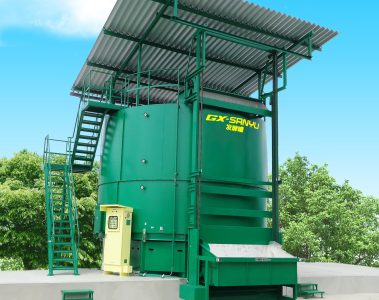
Guangxing’s 11FFG-100 vertical aerobic manure composting system is designed for livestock manure and other organic waste, including pig manure.
The enclosed system incorporates mechanical mixing, aeration, temperature control, and exhaust management.
For a pig farm, its potential role is in the prepared solid organic waste treatment stage.
That distinction matters. Highly diluted pig slurry may need dewatering or mixing with suitable materials before aerobic fermentation.
A 100 m³ effective tank volume also doesn’t mean the machine can process 100 m³ of slurry every day.
We would need the actual solid manure quantity, moisture content, material characteristics, and operating requirements before discussing the appropriate fermentation configuration.
Solid-liquid separators, biogas digesters, and wastewater treatment facilities should be assessed as separate parts of the wider project, with their supply scope confirmed.
What Information Helps Us Recommend the Right Solution?
You don’t need to prepare a complete engineering design before approaching a supplier.
A few measurements and site details are enough to begin a useful discussion:
- Pig numbers and production stages: growers, finishers, sows, or mixed groups
- Daily wastewater volume: including flushing and cleaning water
- Solid manure quantity: preferably with moisture information
- Available installation space: site dimensions and access
- Treatment goal: compost, biogas, agricultural reuse, or compliant wastewater discharge
With these details, Guangxing can help review the initial treatment approach, assess whether aerobic fermentation is suitable, and identify the equipment requirements that need further calculation.
If you also manage poultry houses, our guide on how to treat chicken manure and chicken manure treatment solutions by farm size cover those applications separately.
A reliable manure management system starts with knowing what needs to be treated. The equipment decision comes next.
Planning a Pig Manure Treatment Project?
Contact Guangxing for capacity calculation, site layout design and quotation.