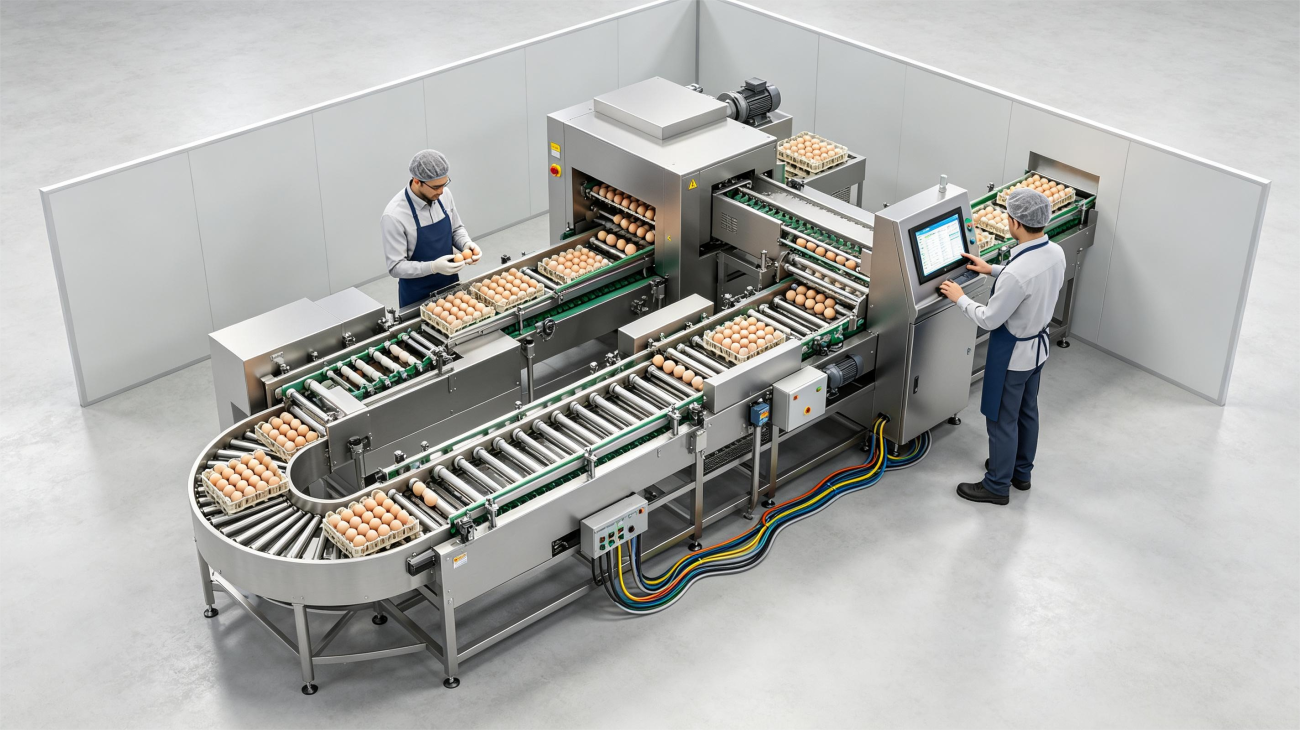
How Much Does It Cost to Build a 10,000-Layer Chicken Farm in the Philippines? Investment, Equipment, Profit and Payback Guide
Updated: July 2026
Building a commercial farm for 10,000 laying hens in the Philippines involves much more than purchasing chickens and constructing a poultry house. Investors must also consider the cost of layer cages, feeding and drinking systems, ventilation and cooling, electricity, labor, feed, biosecurity, egg collection and working capital.
Based on preliminary project planning, a newly established 10,000-layer farm may require an investment of approximately PHP 6.5 million to PHP 20 million.
The final investment depends on whether the project will use an existing poultry house, build a new open-sided house or install a fully automatic environmentally controlled layer farming system.
This figure is intended only as a preliminary planning reference and should not be treated as a fixed quotation. Land acquisition, loan interest, local taxes, international shipping and the cost of a full year of feed are normally calculated separately.

Quick Cost Estimate for a 10,000-Layer Farm
| Farm configuration | Preliminary investment range | Suitable for |
|---|---|---|
| Existing poultry house with basic A-frame layer cages | PHP 6.5–9.5 million | Farms with limited budgets and sufficient local labor |
| New open-sided poultry house with partial automation | PHP 9–13 million | Medium-sized commercial layer farms |
| New H-type fully automatic layer farming system | PHP 13–20 million | Investors focused on automation and future expansion |
The above estimates may include:
- Poultry house construction or renovation
- Layer cage system
- Feeding and drinking equipment
- Manure removal system
- Ventilation and electrical equipment
- Day-old chicks or ready-to-lay pullets
- Basic biosecurity facilities
- Initial working capital
The actual investment may be higher or lower depending on the province, poultry house dimensions, bird age, cage configuration, automation level and local construction material prices.
Why Is There No Fixed Cost for a 10,000-Layer Farm?
Even when two farms both raise 10,000 laying hens, their investment requirements can differ significantly.
Some investors already own land and an open-sided poultry house. They may only need to install A-frame layer cages, collect eggs manually and take advantage of relatively affordable local labor.
Other investors may need to construct a new steel-structure poultry house and install multi-tier H-type layer cages, automatic feeding, automatic egg collection, automatic manure removal and an intelligent environmental control system.
The final investment is mainly affected by:
- Whether the investor already owns land and a poultry house
- Whether the farm purchases day-old chicks or ready-to-lay pullets
- Whether A-frame or H-type layer cages are selected
- The automation level of the feeding, manure removal and egg collection systems
- Poultry house ventilation and cooling requirements
- Local construction, labor and electricity costs
- Shipping, installation and import expenses
- The amount of working capital reserved for feed
A reliable layer farm investment budget should therefore calculate the following costs separately:
- Fixed-asset investment
- Chick or pullet procurement
- Pre-laying rearing expenses
- Daily operating costs

1. Poultry House Construction and Site Development Costs
A poultry house does more than protect the flock. It must also provide a stable installation and operating environment for ventilation, feeding, drinking, egg collection and manure management systems.
A 10,000-layer project may require investment in:
- Site leveling and drainage
- Concrete foundations
- Steel structures or locally constructed buildings
- Roofing and wall materials
- Feed storage areas
- Egg collection and packing rooms
- Water storage and filtration facilities
- Electrical distribution systems
- Generator installation areas
- Manure storage or treatment areas
- Farm fencing and disinfection entrances
For an open-sided poultry house, natural ventilation can reduce part of the equipment investment. However, the house still requires proper orientation, roof insulation, rainwater drainage and protection against heavy rainfall.
A closed or environmentally controlled poultry house requires additional investment in:
- Exhaust fans
- Evaporative cooling pads
- Air inlets
- Temperature and humidity sensors
- Environmental controllers
- Backup power systems
Land acquisition should be calculated separately because land prices vary considerably between different provinces and cities in the Philippines.

2. Layer Cage and Poultry Farming Equipment Costs
The layer cage system is one of the most important fixed assets in a commercial egg farm.
Investors can generally choose from the following three configurations.
Option 1: Basic A-Frame Layer Cage System
A basic configuration normally includes:
- Hot-dip galvanized A-frame layer cages
- Feed troughs
- Nipple drinking lines
- Water tanks and pressure regulators
- Manual feeding or feeding trolleys
- Manual egg collection
- Manure scrapers or basic manure removal methods
This solution has a relatively low initial investment and is suitable for projects where labor is readily available and the investor prefers to begin with a simpler system.
However, manual feeding, egg collection and manure removal will increase daily labor requirements and management costs.
Option 2: A-Frame Layer Cages with Partial Automation
A partially automated layer farm may include:
- Feed silos
- Automatic feed conveying systems
- Feeding trolleys
- Automatic or mechanical manure removal equipment
- Enhanced ventilation systems
- Central control cabinets
- Optional automatic egg collection conveyors
This configuration provides a practical balance between initial investment and labor efficiency. It is suitable for a 10,000-layer farm that plans to expand and upgrade gradually.
Option 3: H-Type Fully Automatic Layer Cage System
A fully automatic layer farming system normally includes:
- Multi-tier H-type layer cages
- Automatic feed conveying systems
- Automatic feeding systems
- Nipple drinking systems
- Manure belt removal systems
- Automatic egg collection systems
- Central egg conveyors
- Ventilation fans and cooling pads
- Environmental control systems
- Lighting control systems
- Temperature and humidity sensors
- Alarm and emergency ventilation systems
H-type automatic layer cage system
H-type layer cages make more efficient use of the vertical space inside the poultry house, reducing the building area required for each bird.
This system is more suitable for commercial layer farms that want standardized management, lower labor dependence and future production expansion.
Guangxing can provide A-frame layer cages, multi-tier H-type automatic layer systems, automatic egg collection, automatic feeding, environmental control and prefabricated steel-structure poultry house solutions.

3. Should You Buy Day-Old Chicks or Ready-to-Lay Pullets?
The type and age of birds purchased will significantly affect the project investment and cash flow.
Buying Day-Old Chicks
Day-old chicks have a lower purchase price, but the investor must also cover approximately 17 to 18 weeks of brooding and rearing costs, including:
- Brooding equipment
- Heating equipment
- Chick starter and grower feed
- Vaccines
- Labor
- Electricity
- Mortality losses
- Brooding or pullet-rearing cages
During the rearing stage, the farm will generate little or no egg income.
According to the Hy-Line Brown performance standards, cumulative feed consumption before 17 weeks of age is approximately 5.8 to 6.2 kilograms per bird.
For 10,000 pullets, this means that approximately 58 to 62 metric tons of rearing feed may be required before the flock officially enters the laying period.
Buying Ready-to-Lay Pullets
Ready-to-lay pullets have a higher purchase price per bird, but they can begin producing eggs and generating income much sooner.
Choosing ready-to-lay pullets can reduce:
- Brooding management risks
- Heating costs
- Early vaccination work
- Rearing-stage management difficulties
- The waiting period before the first egg income
Before purchasing pullets, farmers should carefully verify:
- Flock age
- Vaccination records
- Body-weight uniformity
- Health condition
- Expected laying date
The lowest-priced pullets are not always the most economical choice. Birds with poor health or uneven body weight may have lower laying rates and poorer feed efficiency throughout the production cycle.
4. How Much Feed Do 10,000 Laying Hens Consume?
Feed is normally the largest recurring operating expense on a commercial layer farm.
According to the Hy-Line Brown performance standards published in December 2025, feed consumption during much of the laying period is approximately 110 to 118 grams per bird per day.
Actual feed consumption is affected by:
- Bird age
- Breed
- Feed energy level
- Body weight
- Laying rate
- Environmental temperature
Based on this feed intake range, 10,000 laying hens may require:
| Period | Estimated feed requirement |
|---|---|
| Per day | 1.10–1.18 metric tons |
| Per 30 days | 33–35.4 metric tons |
| Per year | 401.5–430.7 metric tons |
Feed Cost Calculation Formula
Annual feed cost = Number of laying hens × Daily feed intake per bird × 365 days × Feed price per kilogram
The following table provides an annual feed budget based on different feed-price assumptions:
| Assumed feed price | Estimated annual feed cost |
|---|---|
| PHP 30/kg | PHP 12.05–12.92 million |
| PHP 32/kg | PHP 12.85–13.78 million |
| PHP 35/kg | PHP 14.05–15.07 million |
These figures are planning examples and should not be treated as real-time quotations from Philippine feed suppliers.
Farmers should obtain updated prices from local feed mills and include the following items in their budgets:
- Feed transportation
- Storage losses
- Feed-price increases
- Price differences between different feeding stages
When a project starts with day-old chicks, the farm must also calculate the cost of brooding and rearing feed before the laying period begins.
5. How Many Eggs Can 10,000 Laying Hens Produce Per Day?
Egg production is mainly affected by:
- Breed and genetic performance
- Flock age
- Pullet quality
- Feed nutrition
- Lighting program
- Environmental temperature
- Disease control
- Water quality
- Flock mortality
- Daily management
Commercial layers may achieve laying rates above 90% during peak production. However, peak laying performance should not be used directly as the average production rate for an entire year.
For more reliable financial planning, investors can use conservative, base-case and high-performance scenarios.
| Operating scenario | Average laying rate | Total egg production per day |
|---|---|---|
| Conservative | 82% | 8,200 eggs |
| Base case | 88% | 8,800 eggs |
| High performance | 92% | 9,200 eggs |
Not every egg can be sold at the normal market price. Farms should deduct:
- Cracked eggs
- Dirty eggs
- Small eggs
- Misshapen eggs
- Downgraded eggs
Assuming that 97.5% of production is saleable:
| Operating scenario | Saleable eggs per 30 days |
|---|---|
| Conservative | 239,850 eggs |
| Base case | 257,400 eggs |
| High performance | 269,100 eggs |
6. Egg Prices and Monthly Sales Revenue in the Philippines
According to the Philippine Statistics Authority, the national average farmgate price of chicken eggs was approximately PHP 6.89 per egg during the first quarter of 2026.
The previous average prices were:
- Fourth quarter of 2025: PHP 6.97 per egg
- Third quarter of 2025: PHP 7.27 per egg
These figures demonstrate why profitability should not be calculated using only one fixed egg price.
The actual farm selling price is affected by:
- Province
- Egg size and grade
- Seasonal changes
- Market supply
- Packaging method
- Sales contracts
- Farmgate collection or delivered sales
- Wholesale or direct retail channels
The following table estimates revenue using different production levels and selling prices.
| Operating scenario | Saleable eggs per month | Assumed egg price | Monthly egg revenue |
|---|---|---|---|
| Conservative | 239,850 eggs | PHP 6.00/egg | PHP 1,439,100 |
| Base case | 257,400 eggs | PHP 6.89/egg | PHP 1,773,486 |
| High performance | 269,100 eggs | PHP 7.50/egg | PHP 2,018,250 |
These figures represent egg sales revenue only. They do not deduct:
- Feed
- Labor
- Electricity
- Water
- Egg packaging
- Transportation
- Vaccines and veterinary products
- Equipment maintenance
- Loan repayments
- Fixed-asset depreciation

7. Monthly Egg Revenue Compared with Feed Costs
The following table compares egg sales revenue with feed expenses only.
| Operating scenario | Egg revenue | Assumed feed cost | Revenue after feed cost |
|---|---|---|---|
| Conservative | PHP 1,439,100 | PHP 1,207,500 | PHP 231,600 |
| Base case | PHP 1,773,486 | PHP 1,075,200 | PHP 698,286 |
| High performance | PHP 2,018,250 | PHP 990,000 | PHP 1,028,250 |
The calculations use the following assumptions.
Conservative Scenario
- Average laying rate: 82%
- Egg price: PHP 6.00 per egg
- Daily feed consumption: 115 grams per bird
- Feed price: PHP 35 per kilogram
Base-Case Scenario
- Average laying rate: 88%
- Egg price: PHP 6.89 per egg
- Daily feed consumption: 112 grams per bird
- Feed price: PHP 32 per kilogram
High-Performance Scenario
- Average laying rate: 92%
- Egg price: PHP 7.50 per egg
- Daily feed consumption: 110 grams per bird
- Feed price: PHP 30 per kilogram
All three scenarios assume a saleable egg rate of 97.5%.
It is important to understand that “revenue after feed cost” is not the same as net profit. The farm must still deduct all other operating and financing expenses.
This comparison also shows why egg prices and feed prices must be analyzed together. A small decline in egg prices combined with an increase in feed costs can significantly reduce the farm’s cash margin.
8. Other Monthly Operating Costs
In addition to feed, a 10,000-layer farm should budget for:
- Salaries for farm workers and managers
- Electricity
- Water
- Generator fuel
- Vaccines and veterinary services
- Disinfectants and biosecurity supplies
- Egg trays and cartons
- Egg grading and packing
- Transportation
- Equipment maintenance
- Wearing parts and spare parts
- Insurance
- Manure management
- Mortality and culling losses
- Administrative expenses
- Loan interest
- Poultry house and equipment depreciation
Automatic feeding, automatic manure removal and automatic egg collection can reduce dependence on manual labor. However, automated farms require a reliable electricity supply, trained operators and regular preventive maintenance.
Investors should not spend their entire budget on poultry house construction and equipment. Several months of operating capital should also be reserved.
9. How to Calculate the Net Profit of a Layer Farm
A practical operating profit formula is:
Operating net profit = Egg income + Manure income + Spent-hen income − Feed − Labor − Water and electricity − Vaccines and veterinary costs − Packaging − Transportation − Repairs − Mortality losses − Administrative expenses
A complete investment analysis should also deduct:
- Equipment depreciation
- Poultry house depreciation
- Loan interest
- Taxes
- Insurance
- Major equipment replacement costs
It is not responsible to promise a fixed annual profit without first understanding local feed prices, egg selling prices, financing arrangements and flock performance.
10. How to Calculate the Break-Even Egg Price
The break-even egg price is the minimum average selling price required to cover all monthly operating expenses.
The formula is:
Break-even egg price = Total monthly operating cost ÷ Number of saleable eggs per month
For example:
- Total monthly operating cost: PHP 1,500,000
- Saleable eggs per month: 257,400
The estimated break-even price would be:
PHP 1,500,000 ÷ 257,400 = approximately PHP 5.83 per egg
The farm may generate an operating profit only when its actual average selling price remains above the break-even level.
If the project also needs to repay loans, pay taxes or replace major equipment, the actual break-even price will be higher.
11. Poultry House Design for Philippine Climate Conditions
Layer farms in the Philippines must pay particular attention to:
- High temperatures
- High humidity
- Heavy rainfall
- Typhoons
- Power interruptions
High temperatures can reduce feed intake, lower egg production and negatively affect eggshell quality.
The Hy-Line layer management guide also indicates that hot climatic conditions can reduce feed consumption. This makes feed nutrition and poultry house environmental management particularly important.
A commercial layer house may require:
- Sufficient airflow
- Exhaust fans
- Evaporative cooling pads
- Roof insulation
- Wide roof overhangs
- Temperature and humidity sensors
- Emergency ventilation systems
- Alarm systems
- Backup generators
- Water storage systems
- Drainage around the poultry house
- Corrosion-resistant farming equipment
- Reliable manure removal systems
Open-sided poultry houses may operate effectively in some regions. However, mechanical ventilation or a fully environmentally controlled poultry house may provide more stable conditions for high-density farms or locations with severe summer heat.
The final ventilation system should not be selected only according to the number of fans. It should be designed based on:
- Poultry house length
- Poultry house width
- Poultry house height
- Bird capacity
- Local temperature and humidity
- Cage row arrangement
12. Manure Management and Biosecurity
A farm with 10,000 laying hens produces a large amount of manure every day.
Poor manure management may lead to:
- Increased ammonia levels
- Fly infestations
- Unpleasant odors
- Higher poultry house humidity
- Increased disease risks
- Complaints from nearby communities
Possible manure management solutions include:
- Manure belt systems
- Manure scrapers
- Covered manure storage areas
- Composting
- Controlled drying
- Scheduled manure removal
- Separation of clean and contaminated traffic routes
The farm should also establish the following biosecurity measures:
- Controlled farm access
- Personnel and vehicle disinfection
- Visitor restrictions
- Rodent and wild-bird control
- A clean and stable drinking water supply
- Complete vaccination records
- Safe disposal of dead birds
- All-in, all-out management where practical
- Biosecurity training for employees
Biosecurity facilities should be included during the poultry house planning stage instead of being added after the farm has already been built.
13. Layer Farm Permits and Regulatory Requirements in the Philippines
The exact approval process varies according to the project location and production scale.
A commercial layer farm may need to consult:
- Barangay authorities
- Municipal or city governments
- Local planning and building departments
- Local veterinary offices
- The Philippine Bureau of Animal Industry
- The Environmental Management Bureau of the Department of Environment and Natural Resources
- Local electricity and water suppliers
The Philippine Bureau of Animal Industry has an application process for a License to Operate as an Animal Facility. Its Citizen’s Charter specifically covers poultry facilities, including:
- Broiler farms
- Layer farms
- Breeder farms
- Hatcheries
- Duck farms
- Quail farms
Depending on the project scale, location and environmental impact, investors may also need to apply for or verify the following documentation with the Environmental Management Bureau:
- Environmental Compliance Certificate
- Certificate of Non-Coverage
- Project description documents
- Environmental management information
- Site location maps
- Local land-use compatibility documents
Investors should confirm the latest requirements with the responsible local authorities before purchasing land or beginning construction.
BFAR should not be listed as the main authority for a commercial layer farm because its primary responsibilities relate to fisheries and aquatic resources rather than commercial poultry production.

14. How to Choose Between A-Frame and H-Type Layer Cages
No single layer cage system is suitable for every project.
| Comparison factor | A-frame layer cages | H-type layer cages |
|---|---|---|
| Initial investment | Lower | Higher |
| Poultry house footprint | Larger | More compact |
| Automation level | Manual or partially automatic | Usually highly automatic |
| Labor requirement | Higher | Lower |
| Egg collection | Manual or optional automatic collection | Normally automatic |
| Manure removal | Scrapers or manual cleaning | Manure belts |
| Expansion potential | Suitable for phased expansion | Suitable for large-scale expansion |
| Dependence on electricity | Lower | Higher |
| Management complexity | Relatively simple | Requires professional operation and maintenance |
Choose A-Frame Layer Cages When:
- The initial budget is limited
- Local labor is readily available
- The poultry house uses natural ventilation
- The farm plans to add automation gradually
- Sufficient land and poultry house width are available
Choose H-Type Layer Cages When:
- Better land utilization is required
- Local labor costs are increasing
- Standardized automatic management is needed
- Egg collection and manure removal need to be centralized
- The local electricity supply is reliable
- Stable technical support is available
- Future production expansion is planned
15. Common Layer Farm Budgeting Mistakes
Mistake 1: Calculating Equipment Costs but Ignoring Working Capital
Some farms complete their poultry houses and equipment installation but cannot operate normally because they do not have enough money to purchase feed.
Mistake 2: Treating Peak Laying Rate as the Annual Average
The peak laying rate will not remain unchanged throughout the entire production cycle.
Mistake 3: Ignoring Cracked and Downgraded Eggs
The financial model should deduct eggs that cannot be sold normally or can only be sold at a lower price.
Mistake 4: Using Retail Egg Prices to Calculate Farm Income
Retail egg prices normally include profit margins for transporters, wholesalers and retailers.
Mistake 5: Purchasing Only the Cheapest Layer Cages
Poor-quality cage wire, thin galvanizing, an unsuitable egg-rolling slope or leaking drinking equipment can increase corrosion, egg breakage and maintenance expenses.
Mistake 6: Ignoring Backup Power
Power failures may interrupt ventilation, drinking, feeding and automatic egg collection systems.
Mistake 7: Designing the Equipment Layout After the Poultry House Is Built
Before construction begins, the poultry house dimensions should be coordinated with:
- Number of cage rows
- Operating aisles
- Manure discharge outlets
- Ventilation systems
- Central egg collection systems
Frequently Asked Questions
How Much Feed Do 10,000 Laying Hens Need Per Day?
At a daily feed intake of approximately 110 to 118 grams per bird, 10,000 laying hens may consume around 1.10 to 1.18 metric tons of feed per day.
Actual feed consumption depends on the breed, age, feed formulation, temperature and laying performance.
How Many Eggs Can 10,000 Laying Hens Produce Per Day?
At a laying rate of 82% to 92%, the flock may produce approximately 8,200 to 9,200 eggs per day.
Cracked, dirty and downgraded eggs must still be deducted from this figure.
How Many Workers Are Needed for a 10,000-Layer Farm?
The number of workers depends on the level of automation.
A basic manual system requires more workers for feeding, egg collection and manure removal. A fully automatic system can reduce routine labor, but it requires trained operators and maintenance personnel.
Is It Better to Buy Day-Old Chicks or Ready-to-Lay Pullets?
Day-old chicks have a lower purchase price but require brooding equipment, rearing feed and several months of production without egg income.
Ready-to-lay pullets cost more but can shorten the time before the project begins generating revenue.
How Long Does It Take to Recover the Investment?
The payback period depends on:
- Egg prices
- Feed prices
- Flock performance
- Initial project investment
- Loan and financing costs
Investors should prepare conservative, base-case and optimistic financial models instead of relying on a guaranteed payback period.

Conclusion
Building a 10,000-layer farm in the Philippines has the potential to become a stable commercial egg production project.
However, profitability does not depend only on the number of laying hens. It also depends on cost control, flock performance and reliable sales channels.
Before investing, farmers should:
- Calculate fixed investment and operating expenses separately
- Obtain updated feed, pullet and egg prices
- Select a suitable cage system and automation level
- Reserve sufficient operating capital
- Plan ventilation and backup power
- Confirm local permits and approval requirements
- Calculate the break-even egg price
- Prepare conservative, base-case and optimistic operating scenarios
Guangxing provides customized A-frame and H-type layer cages, automatic feeding, automatic drinking, automatic manure removal, automatic egg collection, environmental control and poultry house planning solutions.
To receive a solution better suited to your project, please provide:
- Farm location
- Planned bird capacity
- Poultry house dimensions
- Preferred automation level
Get a Customized Layout and Equipment Quotation for a 10,000-Layer Farm