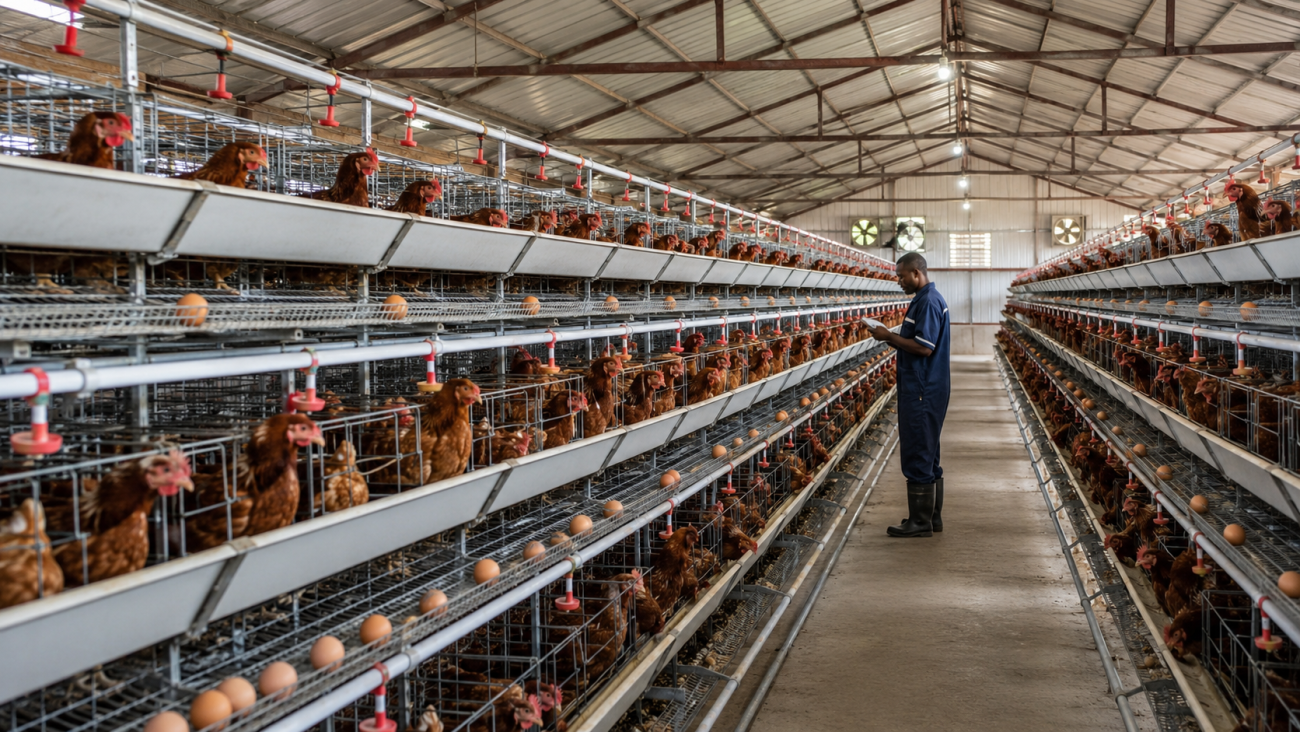
If you are planning a poultry farm in Papua New Guinea, choosing equipment should not begin with a catalogue or a standard price list.
It should begin with the farm itself.
A poultry project near Lae can face very different temperature, humidity and transport conditions from a farm in the Highlands. Likewise, a 3,000-layer starter farm does not need the same feeding, ventilation or automation system as a 50,000-bird commercial operation.
Therefore, before comparing poultry farm equipment in Papua New Guinea, start with four questions:
Are you raising layers or broilers?
How many birds are you planning for?
Where is the farm located?
How much automation does the project actually need?
Once these basic conditions are clear, it becomes much easier to decide what equipment should be purchased locally, what may be worth importing and how the poultry house should be designed.

Why Equipment Selection Is Different in Papua New Guinea
Papua New Guinea has both smallholder poultry production and larger commercial farming operations. However, local operating conditions can make equipment selection more complicated than simply choosing a cage or feeding system.
Three issues deserve particular attention.
Heat and Humidity
Many lowland and coastal areas of PNG experience warm, humid conditions.
Research conducted at the National Agricultural Research Institute livestock station near Lae recorded warm and wet conditions, including average temperatures around 32°C and relative humidity of 88–90% during the study period.
For poultry farms, this matters because high temperature and humidity affect:
- bird heat stress
- water consumption
- litter condition
- ventilation demand
- cooling efficiency
Therefore, a commercial poultry house in a hot area should not be designed around bird capacity alone.
Ventilation, house dimensions and stocking density need to be considered together.
Farm owners who want more background on poultry production research in PNG can also review the work of the Australian Centre for International Agricultural Research (ACIAR).
Power Reliability
Modern poultry equipment increasingly depends on electricity.
Automatic feeding, ventilation fans, cooling systems, manure removal, egg collection and environmental controllers may all stop during a power failure.
Therefore, the more automated the farm becomes, the more important backup power becomes.
A large mechanically ventilated poultry house should normally consider:
generator capacity + automatic transfer + alarm system + emergency ventilation
during the planning stage.
Transport and Spare Parts
Imported equipment normally arrives by container before continuing to the final farm location.
This can become an important cost factor, especially when the farm is far from the main ports.
PNG Ports operates a network that includes major gateways such as Lae and Motukea in Port Moresby, along with ports including Madang, Rabaul, Kimbe and others.
Before placing an overseas equipment order, buyers should therefore consider both sea freight and inland transport.
For official port information, project owners can check PNG Ports Corporation.
What Equipment Does a PNG Poultry Farm Actually Need?
There is no standard equipment package that works for every farm.
The first important distinction is between layer production and broiler production.
Equipment for a Layer Farm
A commercial layer farm may require:
- layer housing system
- feed storage
- feeding equipment
- nipple drinking
- manure removal
- egg collection
- ventilation
- cooling where required
- lighting
- environmental control
- electrical control
- backup power
For smaller and medium-sized layer projects, A-type systems can offer a relatively practical starting point.
They are simpler than highly automated multi-tier systems and can be suitable when the project needs to balance initial investment and labour.
For example, Guangxing’s A-frame layer cage system is designed for commercial layer farms and can be combined with feeding, drinking and other automated equipment as the project develops.
For larger commercial projects, buyers may consider H-type systems with greater automation.

However, the decision should not simply be:
“A-type or H-type?”
Instead, compare:
investment + labour + house dimensions + automation + future expansion
before selecting the final system.
Equipment for a Broiler Farm
Broiler projects require a different approach.
In floor-raised commercial broiler houses, equipment may include:
- bulk feed silos
- automatic pan feeding
- nipple drinking lines
- brooding equipment
- heating
- minimum ventilation
- tunnel ventilation
- cooling pads
- environmental controllers
- lighting
- alarms
- backup generators
For broiler farms, ventilation can be just as important as feeding and drinking.
Even good feeders and drinkers cannot compensate for poor airflow in a hot, humid poultry house.
Choosing Equipment by Farm Size
Farm capacity is one of the easiest ways to decide how much automation is reasonable.
| Farm Capacity | Practical Equipment Approach |
|---|---|
| 1,000–5,000 birds | Manual or semi-automatic equipment, nipple drinking and basic ventilation |
| 5,000–20,000 birds | Automatic feeding, nipple drinking and improved ventilation |
| 20,000–50,000 birds | Commercial automation, centralized feeding and environmental control |
| 50,000+ birds | Integrated poultry-house design and higher automation |
These numbers are only a planning reference.
Labour cost, electricity, available capital and expansion plans may change the final decision.
1,000–5,000 Birds: Keep It Practical
For a small starter farm, full automation may add unnecessary investment.
A layer project may begin with a practical housing system, nipple drinking and simpler feeding equipment.
A broiler farm may use floor rearing with appropriate feeders, drinkers and basic ventilation.
However, reducing automation does not mean choosing poor-quality equipment.
Cheap drinkers that leak or feeders that waste feed may create operating costs every day.
5,000–20,000 Birds: Reduce Repetitive Labour
At this scale, daily manual feeding becomes more demanding.
Therefore, automatic feeding and nipple drinking begin to provide greater value.
Layer farms may also introduce manure handling systems, while broiler farms may need stronger mechanical ventilation.
This is also the stage when future expansion should be discussed.
If the first phase contains 10,000 birds but the long-term target is 30,000 or 50,000, some water, feed and electrical infrastructure can be designed with additional capacity from the beginning.
20,000–50,000 Birds: Think in Complete Systems
Once a project reaches commercial scale, buying individual machines without considering system compatibility becomes risky.
For example:
Feed silo → feed conveyor → house feeding system
should work as one system.
Likewise:
Water source → filtration → pressure regulation → nipple drinking lines
should be designed together.
Ventilation should follow the same principle.
Instead of asking:
“How many fans do I need?”
the better question is:
“How much airflow does this poultry house require?”
House length, width, height, bird capacity and local climate all affect that answer.

What Can Be Purchased Locally in PNG?
Not every item needs to be shipped from an overseas poultry equipment factory.
When suitable products are available locally, some general-purpose components may be easier to source inside PNG.
These can include:
- water tanks
- concrete and building materials
- general electrical materials
- generators
- basic plumbing materials
- tools
- PPE
- some farm hardware
- feed
Local purchasing offers two clear advantages.
First, freight costs may be lower.
Second, replacement parts can often be obtained faster.
However, local components should still match the technical requirements of the imported poultry system.
For example, a locally sourced water pump must provide the pressure and flow required by the drinking system.
Likewise, a generator must be sized for the equipment that must continue operating during a power failure.
Which Poultry Equipment Is Worth Importing?
Specialized equipment is different from ordinary farm hardware.
For larger commercial projects, purchasing compatible poultry systems from one manufacturer can reduce installation and operating problems.
Equipment that may be worth importing includes:
Layer Housing Systems
Commercial A-type or H-type systems should be selected according to bird capacity and poultry-house dimensions.
The manufacturer should provide an equipment layout before production begins.
Automatic Feeding Systems
A complete feeding system may include:
feed silo + feed conveyor + distribution system + feeding equipment
The capacity should match both the number of birds and the length of the poultry house.
Nipple Drinking Systems
A good drinking system includes more than nipples.
It should also consider:
- filtration
- pressure regulation
- water measurement
- flushing
- line height
- water quality
Ventilation and Cooling
For larger poultry houses, fans, air inlets, cooling pads and environmental controls need to operate as one system.
Buying fans without calculating the airflow requirement can lead to poor results.
Egg Collection and Manure Removal
For commercial layer farms, automated egg collection and manure removal can significantly reduce routine labour.
They become increasingly useful as farm capacity grows.
Ventilation Should Match the Farm Location
PNG’s climate varies considerably.
A poultry house near the coast may require a different ventilation strategy from a farm in a cooler highland area.
Therefore, before recommending ventilation equipment, the supplier should ask for at least:
Farm location
House length
House width
House height
Bird capacity
With this information, engineers can estimate:
- airflow demand
- fan capacity
- number of fans
- inlet area
- cooling-pad requirements
This is much more reliable than simply copying equipment quantities from another project.
Do Not Increase Automation Without Planning Backup Power
Automation reduces labour, but it also increases dependence on electricity.
This becomes especially important in closed poultry houses.
During a power failure, the farm may lose:
- ventilation
- cooling
- automatic feeding
- environmental control
- egg collection
- manure removal
For broilers in hot weather, loss of ventilation can become especially serious.
Therefore, generator requirements should be discussed together with the poultry equipment.
The calculation should consider not only normal operating power but also motor start-up loads and which systems must continue operating during an emergency.
Shipping Poultry Equipment to Papua New Guinea
A low factory price does not necessarily mean a low final project cost.
Before confirming an order, ask the supplier to clearly define:
- FOB or CIF terms
- destination port
- estimated container quantity
- packing method
- inland transport responsibility
- unloading requirements
- installation requirements
- spare parts
- technical documents
Container planning is particularly important for large poultry projects.
Cages, fans, feeding equipment and steel structures can occupy significant volume.
Therefore, good loading planning can reduce freight cost and make unloading easier.
For projects requiring several containers, packing equipment according to the installation sequence can also improve site efficiency.

How to Compare Poultry Equipment Suppliers
Do not compare suppliers only by their final quotation.
A lower quotation may simply include less equipment.
Instead, compare the details.
Equipment Specifications
Check:
- material
- dimensions
- motor specifications
- production capacity
- corrosion protection
- equipment quantities
Project Design
Ask whether the supplier designs according to your actual farm.
A serious supplier should request house dimensions and bird capacity before giving a final configuration.
System Compatibility
Feeding, drinking, ventilation, environmental control and electrical equipment should work together.
This becomes more important as farm size increases.
Installation Support
Before ordering, confirm what happens after the containers arrive.
Ask whether the supplier can provide:
- installation drawings
- manuals
- remote guidance
- commissioning assistance
- on-site engineering support where required
- operator training
Spare Parts
Do not wait until equipment fails to discuss spare parts.
Prepare a basic spare-parts package before shipment.
For a PNG project, this may save weeks of waiting for a small component to arrive internationally.
Expansion
Finally, tell the supplier about long-term plans.
A farm may start with 10,000 birds today but increase to 50,000 later.
When this is known early, feed storage, water supply, electrical systems and controls can sometimes be designed for future growth.
When Does a Turnkey Poultry Farm Solution Make Sense?
For smaller farms, buying several simple systems separately may be manageable.
However, larger projects require more coordination.
The poultry house, cage or floor layout, feeding system, drinking system, ventilation, electrical control and waste management all affect each other.
Therefore, larger new farms may benefit from working with one supplier that can coordinate the project from layout design through equipment installation.
Guangxing’s turnkey poultry farm project solution combines poultry-house planning with feeding, drinking, ventilation, environmental control and related farm systems.
This approach is especially useful when the owner is developing a new farm rather than simply replacing one existing machine.
What Information Should You Send for a Poultry Equipment Quotation?
A useful quotation needs useful project information.
Instead of asking only:
“What is your price for poultry equipment?”
prepare the following information:
| Information | Example |
|---|---|
| Poultry type | Layer or broiler |
| Farm location | Lae, Port Moresby, Highlands, etc. |
| Target capacity | 5,000 / 20,000 / 50,000 birds |
| House dimensions | Length × width × height |
| Number of houses | 1, 2, 4 or more |
| Project status | New farm or existing house |
| Automation level | Manual / semi-automatic / automatic |
| Water source | Bore, tank or other |
| Power supply | Grid + generator |
| Expansion plan | Current and future capacity |
A farm drawing is even better.
With these details, an equipment manufacturer can calculate a much more practical system.
Planning a Poultry Farm in Papua New Guinea?
The right poultry equipment is not necessarily the most automated or the cheapest.
It is the equipment that matches:
your bird capacity + farm location + poultry house + labour + power supply + future plans.
A 3,000-bird starter farm should remain practical and easy to maintain.
A 20,000-bird project should begin reducing repetitive labour.
A 50,000-bird or larger farm should be treated as an integrated commercial production system.
If you are planning a new layer or broiler farm in Papua New Guinea, start by sending these four details:
1. Layer or broiler
2. Farm location in PNG
3. Target bird capacity
4. Poultry-house dimensions
If you already have a farm layout or house drawing, include it as well.
Send Guangxing your project information to receive an initial poultry equipment configuration based on your actual farm conditions rather than a generic equipment list.