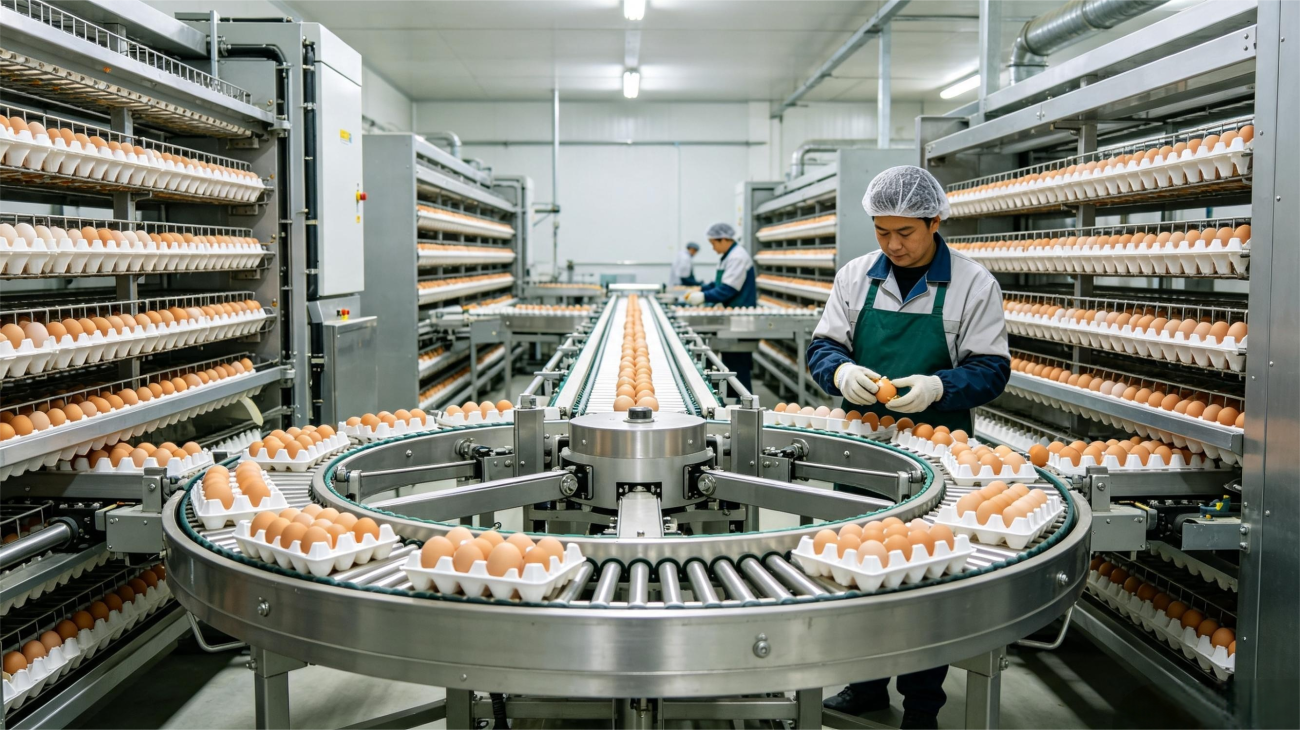
Starting a poultry farm in Africa sounds simple until you start working out the details.
If you are keeping a few hundred chickens, you can usually start with a basic house, feeders, drinkers and some manual work.
But if the plan is 10,000, 20,000 or 100,000 birds, the situation changes quickly. You have to think about the poultry house, feeding, drinking, ventilation, manure, electricity and labor before the first birds arrive.
This is also where we see some projects run into trouble. A customer may have already built the poultry house and then ask which cage system can fit inside it. Sometimes the house can be adjusted. Sometimes it is too late without adding construction costs.
If you are still at the planning stage, it is much easier to design the house and equipment together.
First Decide What Kind of Farm You Are Building
Before asking a supplier for a cage price, I would start with three basic questions:
- Are you raising layers or broilers?
- How many birds do you want to keep?
- Is there a plan to expand later?
These sound like simple questions, but they determine much of the equipment configuration.
| Farm Capacity | What Usually Becomes More Important |
|---|---|
| 5,000 birds | Keep the investment manageable and make daily feeding and drinking reliable |
| 10,000–20,000 birds | Reduce unnecessary manual work |
| 30,000–50,000 birds | Improve automation and make daily operation easier |
| 50,000–100,000 birds | Coordinate feeding, drinking, manure and egg collection |
| 100,000+ birds | Plan several houses and the supporting systems together |
There is no rule saying that a bigger farm is always better. A farm has to match the owner’s land, labor, electricity, water supply and management ability.
Layer and Broiler Farms Are Different
A layer farm and a broiler farm may share some equipment, but the way the houses operate is different.
For layers, cage arrangement, feeding, drinking, manure removal and egg collection are major parts of the design.
For broilers, the decision may be between floor raising and a multi-tier automated system. The right choice depends on the production model, house design, available labor and investment plan.
If you have already bought the land but have not started construction, this is a good time to talk to an equipment supplier.
At this stage, it is still possible to adjust the house width, length, passages, feed routes, manure outlets and ventilation positions.
Once the concrete and steel structure are finished, changing them is a different story.
A-Type or H-Type Layer Cage?
This is one of the questions we receive quite often from layer farm investors.
An A-frame layer cage has a relatively straightforward layout and can be a practical option for projects that want to keep the initial investment under control.
An H-Type automatic layer cage system uses the height of the poultry house more efficiently and can work well for intensive farms that want a higher level of automation.
But I would not choose between them just by looking at the number of birds per square meter.
Look at the whole farm.
How much labor is available? How reliable is the electricity? How many birds will be housed in each building? How will manure be removed? How much space is available? Do you expect to add more houses later?
For some projects, an A-type system is a sensible way to start.
For a more intensive project where saving floor space and reducing manual work are important, an H-type system may be more suitable.
The cage should fit the farm, rather than the farm being forced to fit a cage quotation.
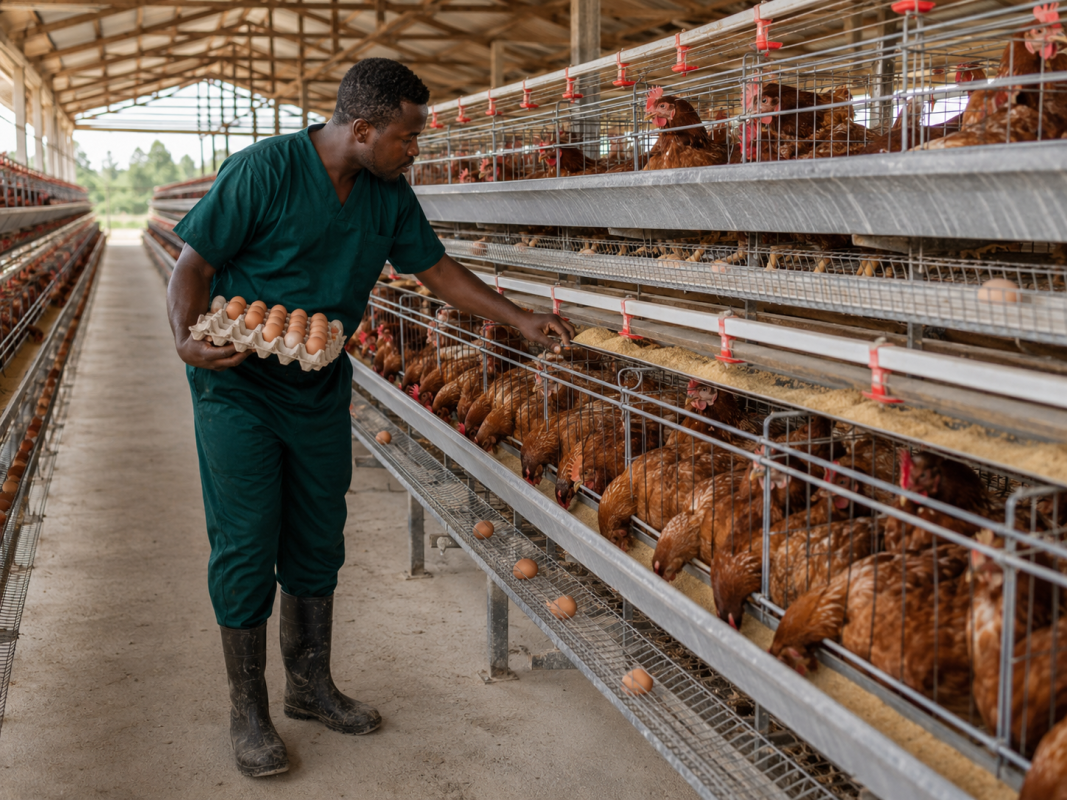
Do Not Finish the Poultry House Before Checking the Equipment Layout
This is worth emphasizing because changing a building later is expensive.
Before construction, the equipment supplier should have enough information to check things such as:
- house length and width;
- cage rows and working passages;
- feed delivery route;
- manure discharge area;
- egg collection route;
- electrical cabinet position;
- fan and cooling-pad positions.
For example, a structural column in the wrong place can interfere with equipment installation. A manure outlet that is too small can also create unnecessary work later.
These are not major problems on a drawing. They become major problems when the equipment arrives at the farm.
Ventilation Depends on Where the Farm Is
There is no single ventilation design for the whole of Africa.
A poultry farm in a hot and humid coastal area has different requirements from one in a drier or higher-altitude location.
The house itself also matters.
Some farms use open-sided houses with natural airflow and mechanical fans. Others need a more controlled environment with mechanical ventilation, cooling pads and automatic control.
A poultry house environmental control system can help manage these systems, but the controller cannot fix a badly designed house.
The same applies to water.
Before stocking birds, make sure there is enough water, storage capacity, pumping capacity, filtration and stable pressure for the drinking lines.
And do not forget electricity.
If your farm depends on automatic feeding, manure belts, egg conveyors, cooling pumps and ventilation fans, a power interruption is not just an inconvenience. It can affect the whole operation.
If the local grid is unstable, backup power should be part of the original plan.

When Does Automatic Feeding Make Sense?
On a small farm, carrying feed manually may not be a big issue.
With several houses and tens of thousands of birds, it becomes a daily labor problem.
An automatic poultry feeding system can move feed from storage to the feeding lines and reduce this manual work.
But automation should be introduced for a reason.
There is no need to install every possible automatic system on a small farm simply because it is available. At the same time, trying to manage a large commercial farm with too much manual work can create its own problems.
The right setup depends on the number of birds, house layout, labor situation and the way the farm will actually be operated.
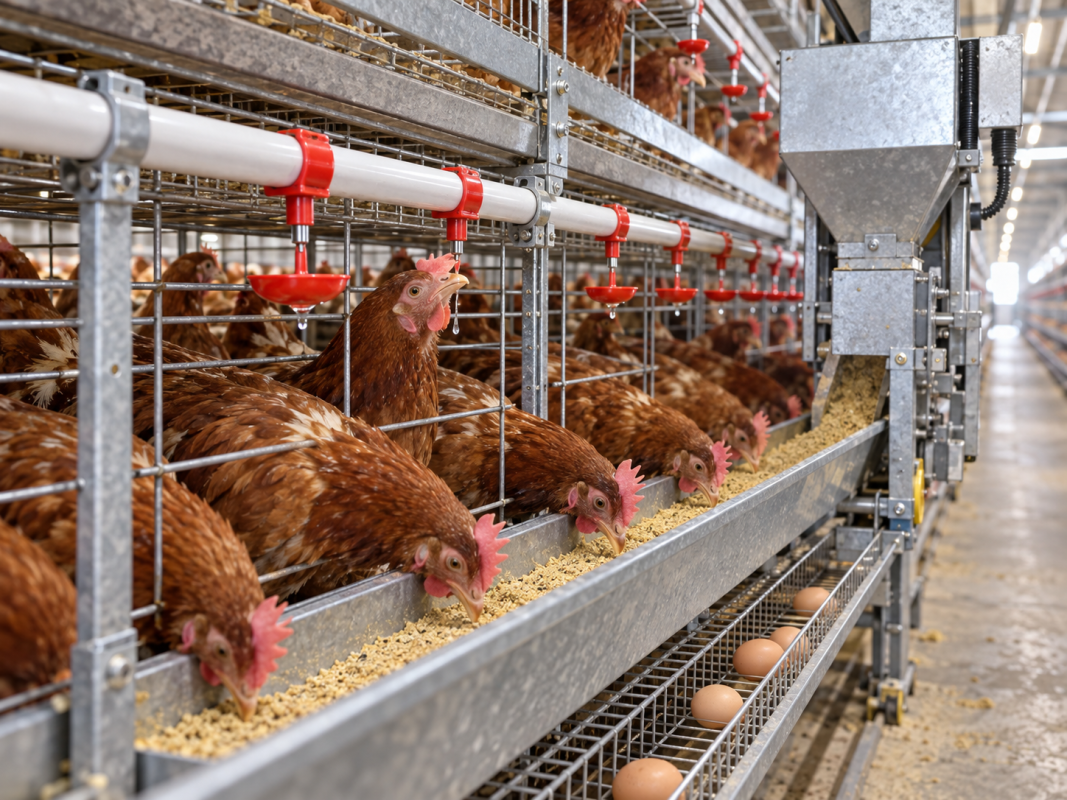
Egg Collection Becomes a Labor Issue as the Flock Grows
The same thing happens with eggs.
Collecting eggs manually may be perfectly workable when the flock is small. With a much larger layer farm, workers have to collect eggs repeatedly, move them out of the houses and handle them carefully to avoid unnecessary breakage.
An automatic egg collection system can move eggs from the cage rows to a collection point.
For larger projects, egg collection can also be planned across several houses.
The point is not to make the farm as automated as possible. It is to identify where manual work is becoming a real bottleneck and deal with it.
Manure Is Another Part of the Layout
Manure is often discussed too late.
Once the farm is operating, it affects labor, ammonia, flies, odor and general cleanliness. More importantly, someone has to move it somewhere.
A-type systems may use mechanical scraping, while multi-tier H-type systems commonly use manure belts.
Before construction, think about where manure will leave the house and where it will go afterward.
Will it be stored? Sold? Composted? Used for fertilizer?
If you are planning to expand the farm, leave enough room for manure handling and transport from the beginning.
Should You Buy Everything From One Supplier?
Not necessarily.
In many projects, farmers can source concrete, basic construction materials and some plumbing or electrical materials locally.
Specialized poultry equipment is different.
If you buy cages, feeding, drinking, manure removal, egg collection and environmental controls from different suppliers, make sure the systems can actually work together.
For this reason, when comparing quotations, check the details instead of looking only at the final number.
Does the quotation include the motors? What about the control cabinet, conveyors, brackets, accessories and spare parts? Does the supplier provide installation drawings?
Sometimes two quotations look very different simply because the equipment scope is different.
What Would I Look at on a 20,000-Layer Project?
Suppose you are planning a 20,000-layer farm.
I would not start the discussion with:
“What is the price of the cages?”
I would first want to know:
- How much land is available?
- What size is the poultry house?
- How many houses are planned?
- What is the local labor situation?
- Is water reliable?
- Is electricity reliable?
- How will manure be handled?
- Will the farm be expanded later?
After that, the cage type and automation level become much easier to decide.
This is also the basic approach shown in our 20,000 Layer Chicken Farm Equipment Solution in Nigeria.
The equipment quotation should be prepared after the farm plan is clear, not used as a substitute for the farm plan.

What About Broiler Farms?
The same thinking applies to broilers, although the equipment is different.
A 5,000-bird farm may be relatively simple to manage.
At 20,000 birds, feeding, drinking and ventilation require more attention. At 80,000 or 200,000 birds, the project becomes a much larger operation involving several houses, feed storage, water supply, ventilation, cooling, electricity and maintenance.
Our Nigeria Broiler Farm Solutions for 5,000–200,000 Birds gives an example of how equipment requirements change as farm capacity increases.
The exact solution should still be adjusted to the local farm conditions.
How Much Does It Cost to Start a Commercial Poultry Farm in Africa?
This is probably one of the first questions any investor will ask.
The problem is that there is no useful single price for a commercial poultry farm.
Two farms with the same number of birds can have very different costs because their houses, equipment and infrastructure are different.
The main factors include:
- farm capacity;
- layer or broiler production;
- poultry house construction;
- cage or raising system;
- automation level;
- ventilation and cooling;
- water and power infrastructure;
- transport and installation;
- manure handling;
- egg handling for layer farms.
For this reason, rather than asking only for a price per bird, it is better to define the project first.
A supplier should quote according to the actual bird capacity, house dimensions and equipment scope.
This makes it much easier to compare different suppliers on the same basis.
What Information Should You Send a Supplier?
You do not need a complete engineering drawing to make the first inquiry.
Start with:
Country + Layer/Broiler + Bird Capacity + Poultry House Size
If the house has not been built, send the available land dimensions.
Photos, sketches or a simple house drawing are also useful.
With this information, a supplier can usually understand the basic project and tell you what additional details are needed for a proper equipment proposal.
Plan the Farm Before You Buy the Machines
A commercial poultry farm works as a connected system.
The poultry house affects ventilation, while flock size determines manure volume and feed storage needs. As the level of automation increases, electricity demand also rises. For layer farms, the egg collection route can even influence the final house layout. Future expansion should also be considered before the first poultry house is built.
These things are connected, and it is much easier to solve them on paper than after construction has started.
Guangzhou Guangxing Poultry Equipment Group has more than 30 years of experience in poultry equipment manufacturing and commercial poultry farm projects. We provide layer and broiler cage systems, feeding, drinking, manure removal, egg collection and environmental control equipment for overseas poultry projects.
Planning a Commercial Poultry Farm in Africa?
Send us:
Country + Layer/Broiler + Bird Capacity + Poultry House Size
If your poultry house has not been built yet, you can send the available land dimensions instead.
Our team can review the basic project information and recommend a suitable poultry house layout and equipment configuration.
Guangzhou Guangxing Poultry Equipment Group Co., Ltd.
WhatsApp:+852 4609 0144
电话/微信:+86 178 7666 8787
网站:https://guangxiniot.com/