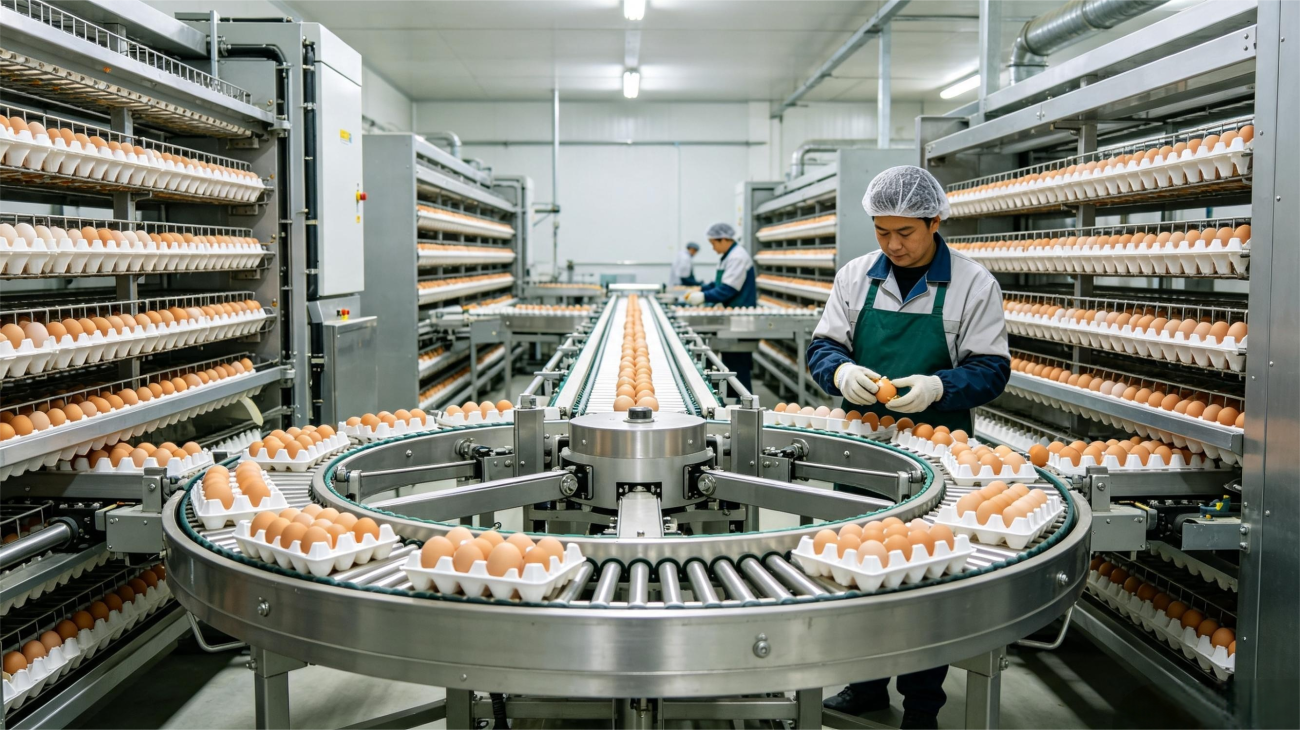
In today’s poultry industry, layer farms are facing increasing pressure from rising labor costs, stricter food safety standards, and intensifying market competition. Traditional manual egg sorting methods can no longer meet the demands of commercial egg production. Manual grading is slow, inconsistent, labor-intensive, and often results in higher egg breakage rates.
As supermarkets, food distributors, and export markets demand cleaner, safer, and more standardized eggs, modern poultry farms are rapidly upgrading to automated egg processing systems.
One of the most important upgrades is the automatic egg grading machine.
Modern egg grading systems not only classify eggs by weight and quality, but also improve production efficiency, reduce labor costs, minimize product damage, and help farms meet higher hygiene and traceability standards.
Whether for small, medium, or large commercial poultry farms, investing in the right egg grading equipment has become a key step toward modernization and long-term profitability.

Challenges of Manual Egg Sorting in Poultry Farms
Many poultry farms still rely on manual labor to inspect, sort, and pack eggs. While this may work for very small-scale operations, it creates serious operational challenges as production increases.
Common challenges include:
High labor costs
Slow processing speed
Inconsistent egg grading
Increased egg breakage
Difficulty meeting supermarket standards
Weak hygiene control
Limited traceability
Manual sorting also leads to inconsistent quality. Eggs of different sizes are often mixed together in packaging, which affects product appearance and customer satisfaction.
In addition, frequent human handling significantly increases the risk of contamination and shell damage.
As the global poultry industry continues moving toward automation and industrialization, manual processing is becoming less competitive.
What Is an Automatic Egg Grading Machine?
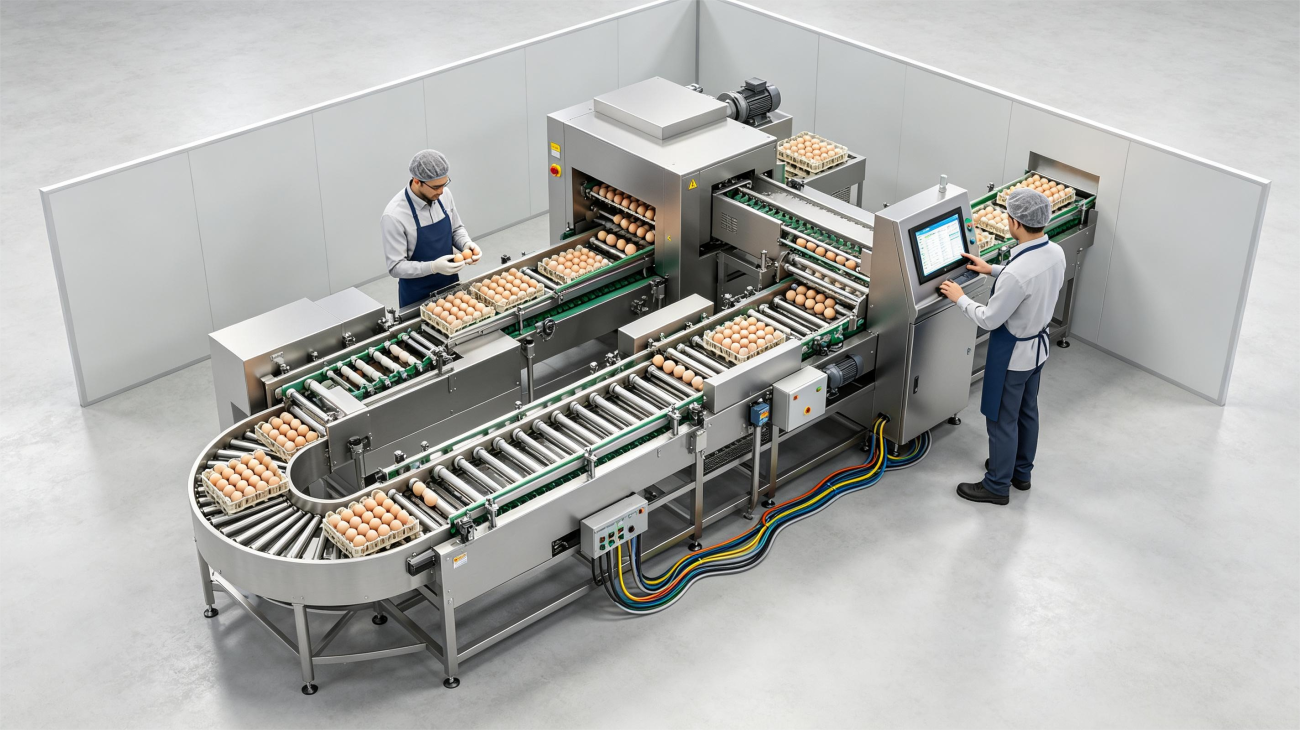
An automatic egg grading machine is a specialized poultry processing system designed to classify eggs according to weight, size, and quality.
Modern systems can automatically complete multiple processing steps, including:
Egg conveying
Cleaning
Drying
UV sterilization
Crack detection
Weight grading
Coding and labeling
Automatic packing
The system uses intelligent sensors and electronic weighing technology to ensure accurate grading while minimizing human contact.
Depending on farm scale, egg grading machines can process from 2,000 eggs per hour to over 200,000 eggs per hour.
For modern commercial farms, automated grading systems have become a core component of the egg processing line.
Why Modern Poultry Farms Need Egg Grading Machines
1. Reduce Labor Costs
Labor costs are rising in almost every country.
Many poultry farms struggle to hire enough workers for repetitive sorting and packaging tasks. Manual operations also require continuous supervision and training.
An automatic egg grading machine significantly reduces labor dependency.
In many commercial farms, automation can reduce labor costs by more than 50%.
Instead of large sorting teams, farms can operate with fewer workers while improving consistency and efficiency.
This is especially important for large-scale layer farms producing tens of thousands of eggs daily.
2. Improve Grading Accuracy
Consumers and supermarkets expect standardized egg sizes.
Manual sorting often leads to inconsistent grading because workers cannot maintain accurate judgment over long working hours.
Modern electronic egg grading machines use high-precision sensors to classify eggs with high accuracy.
Typical grading categories include:
Small eggs
Medium eggs
Large eggs
Extra-large eggs
Accurate grading helps farms:
Improve product consistency
Increase market value
Meet retail packaging standards
Enhance customer trust
Uniform packaging also strengthens the brand image of commercial egg producers.
3. Reduce Egg Breakage
Egg breakage is one of the hidden costs in egg production.
Improper handling during transportation and sorting can cause cracks, reducing product quality and increasing losses.
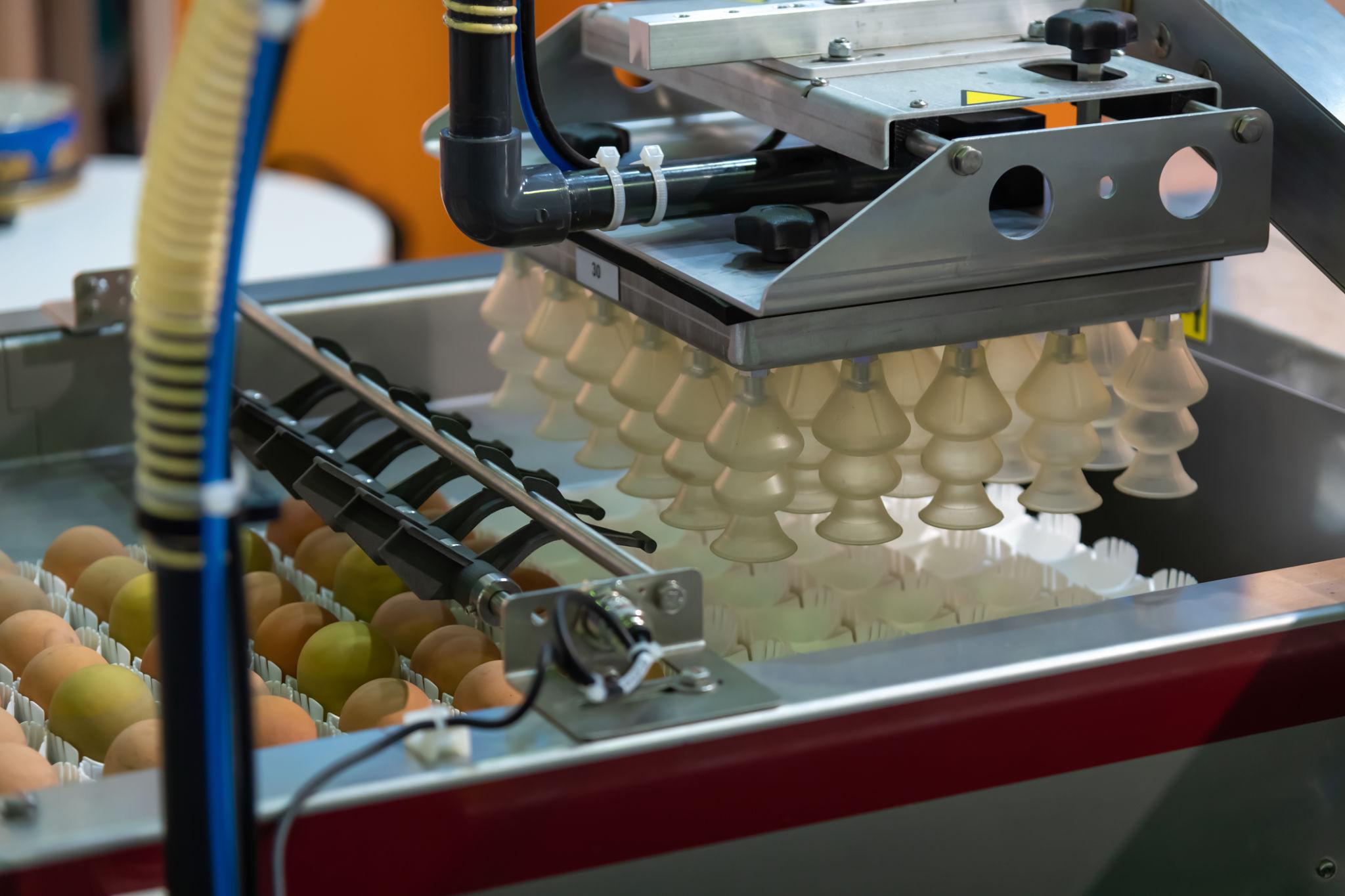
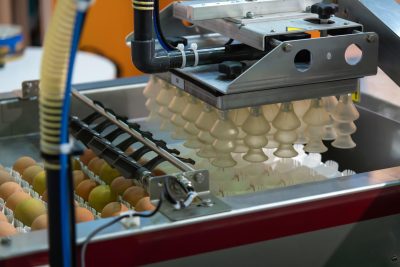
Modern egg grading systems use synchronized conveyor systems and gentle handling technology to protect eggs during processing.
Features such as soft transfer systems, automatic alignment, and controlled movement help reduce shell damage.
Advanced systems can also automatically detect cracked eggs before packaging, preventing defective products from entering the market.
Reducing breakage directly improves farm profitability.

4. Improve Food Safety and Hygiene
Global food safety standards are becoming increasingly strict.
Supermarkets, distributors, hotels, and export buyers now require hygienic egg processing systems.
Modern egg grading lines may include:
Automatic washing systems
UV sterilization
Disinfection functions
Stainless steel construction
Hygienic conveyor design
These systems help reduce contamination risks while improving product cleanliness.
High hygiene standards are especially important for farms supplying:
Supermarkets
Food processing plants
Export markets
Restaurants
Institutional buyers
Modern grading lines help poultry farms meet international food safety requirements more easily.
5. Support Traceability and Brand Development
Today’s consumers demand safer and more transparent food products.
Large egg producers are increasingly adopting traceability systems that allow eggs to be tracked throughout the grading and packing process.
Advanced egg grading systems can integrate:
Egg coding
Batch management
Production date printing
Farm identification
Data recording systems
This improves quality control and supports brand development.
Traceability is especially important for premium egg markets and export-oriented farms.
Key Functions of a Modern Egg Grading Machine
Automatic Egg Washing
The washing system removes dirt and surface contamination before grading.
Clean eggs improve appearance and help meet retail hygiene standards.
Drying System
After washing, eggs pass through drying units to remove moisture before further processing.
Proper drying helps prevent bacterial growth and protects packaging quality.
Crack Detection System
Modern crack detection technology automatically identifies damaged eggs.
This prevents defective eggs from entering the market and reduces customer complaints.
Some advanced systems now use AI-based vision inspection for higher accuracy.
Intelligent Weight Grading
Electronic weighing systems classify eggs into precise weight categories.
This ensures consistency and improves packaging efficiency.
UV Sterilization
UV sterilization systems help reduce bacteria on the egg surface.
This is especially useful for commercial egg processing plants focused on food safety.
Automatic Packing
Automatic packing systems reduce labor requirements and increase production speed.
Integrated systems can place eggs directly into trays or retail packaging.
Egg Grading Machine Capacity Guide
Different farms require different production capacities.
Small Poultry Farms
Suitable for:
Family farms
Small-scale poultry operations
Capacity:
2,000–5,000 eggs/hour
Usually semi-automatic systems with lower investment cost.

Medium Commercial Farms
Suitable for:
Growing egg businesses
Regional suppliers
Capacity:
10,000–30,000 eggs/hour
These farms typically require automatic grading and packing systems.
Large Industrial Egg Processing Plants
Suitable for:
Large commercial layer farms
Food processing companies
Export-oriented businesses
Capacity:
50,000–200,000+ eggs/hour
These systems usually include full automation, intelligent control, and integrated traceability functions.
How Much Does an Egg Grading Machine Cost?
The price of an egg grading machine varies depending on:
Capacity
Automation level
Detection functions
Material quality
Brand
Customization requirements
General price ranges:
| Machine Type | Capacity | Estimated Price |
| Semi-automatic grader | 2,000–5,000 eggs/hour | $1,000–5,000 |
| Automatic grading machine | 10,000–30,000 eggs/hour | $10,000–30,000 |
| Complete egg processing line | 50,000+ eggs/hour | Customized |
Although automated systems require higher initial investment, they often deliver strong long-term ROI through:
Labor savings
Reduced egg breakage
Higher efficiency
Improved product quality
Stronger market competitiveness
How to Choose the Right Egg Grading Machine
Choosing the right equipment depends on current farm needs and future expansion plans.
Key factors include:
Production Capacity
Select a system that matches both current output and future growth.
Automation Level
Some farms only need grading functions, while others require a full processing line.
Food Safety Standards
Choose hygienic designs that meet modern food safety requirements.
Technical Support
Reliable suppliers should provide:
Installation guidance
Operator training
Spare parts support
After-sales service
Supplier Experience
Experienced poultry equipment manufacturers understand real farm challenges and can provide customized solutions.
Global project experience is especially valuable for international buyers.
The Future of Egg Processing Automation
The poultry industry is rapidly moving toward smart farming and full automation.
Future egg grading systems are expected to include:
AI-based crack detection
Smart monitoring systems
Data analytics platforms
Remote equipment management
Robotic packing systems
Automation is no longer only about reducing labor.
It is now a key strategy for improving efficiency, food safety, sustainability, and long-term competitiveness.
Farms that invest in modern egg processing technology today will be better prepared for future market demands.
Why More Global Farms Choose Chinese Poultry Equipment Manufacturers
China has become one of the world’s leading suppliers of poultry automation equipment.
Many international farms choose Chinese manufacturers because of:
Competitive pricing
Strong manufacturing capacity
Fast production cycles
Flexible customization
Increasing global project experience
Leading Chinese suppliers now offer complete turnkey poultry solutions, including:
Poultry house design
Cage systems
Automatic feeding systems
Egg collection systems
Egg grading and packing lines
Environmental control systems
For growing poultry businesses, working with an experienced supplier can significantly improve project success rates.


| Model | SKY-600G | SKY-660G | SKY-760G |
|---|---|---|---|
| Processing Capacity | 60,000 eggs/hour | 66,000 eggs/hour | 76,000 eggs/hour |
| Voltage | Three-phase 380V 48kW / Single-phase 220V 6.2kW / Single-phase 220V 2.0kW | Three-phase 380V 48kW / Single-phase 220V 6.2kW / Single-phase 220V 2.0kW | Three-phase 380V 56kW / Single-phase 220V 6.2kW / Single-phase 220V 2.0kW |
| Hot Water Consumption | 20 L/min (55°C) | 20 L/min (55°C) | 24 L/min (55°C) |
| Water Consumption | 20 L/min (for automatic cleaning) | 36 L/min (for automatic cleaning) | 36 L/min (for automatic cleaning) |
| High-Pressure Air Consumption | 70 NL/min (0.5 MPa) | 70 NL/min (0.5 MPa) | 90 NL/min (0.5 MPa) |
Conclusion
Automatic egg grading machines are transforming the modern poultry industry.
From reducing labor costs to improving food safety and product consistency, automated grading systems help poultry farms operate more efficiently and competitively.
As egg production becomes increasingly industrialized, modern processing equipment is no longer optional for commercial farms—it is essential.
Whether you operate a small farm or a large industrial egg processing plant, choosing the right egg grading solution can improve productivity, reduce losses, and support long-term business growth.
For farms planning future expansion, investing in a reliable and scalable egg grading system is one of the most strategicdecisions for sustainable success in today’s competitive market.