


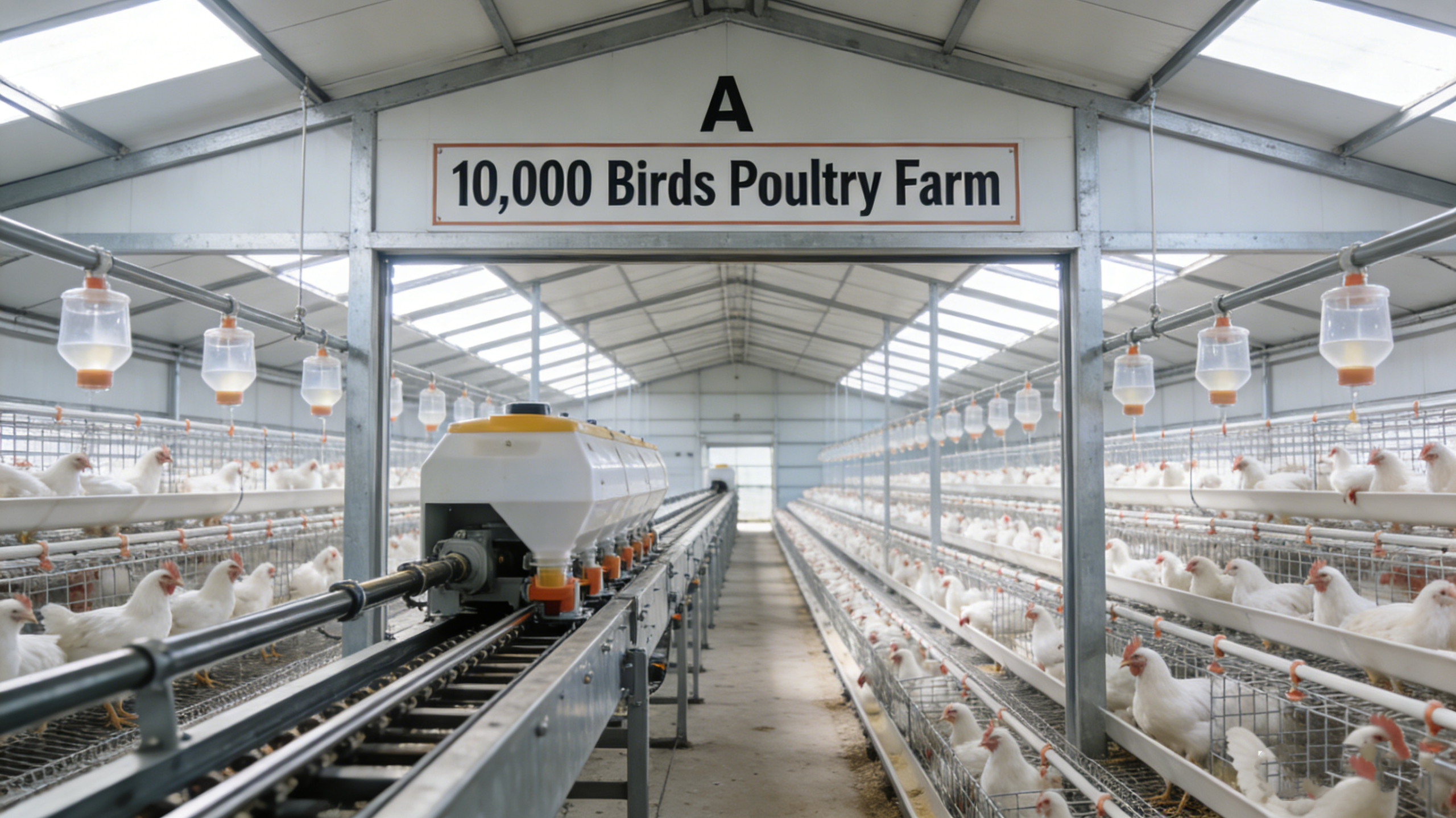
As a rapidly developing agricultural market in Southeast Asia, the Philippines sees steady growth in egg and white meat consumption, making poultry farming a highly attractive sector for investors. Whether you are planning a startup layer farm of 10,000 birds or a fully automated facility for 200,000 birds, accurate cost estimation is the core of your project feasibility analysis.
This guide provides a comprehensive breakdown of cost components, scale variations, local Philippine factors, automation levels, and ROI projections to help you scientifically plan your investment budget.
I. Core Factors Influencing Construction Costs
Before budgeting, identify the key variables that drive expenses:
| Key Factor | Impact Level |
| Farm Scale (Capacity) | High |
| Type of Farming (Layer vs. Broiler) | High |
| Automation Level | Medium – High |
| Site Location | Medium |
| Local Labor & Material Costs | High |
| Climate & Ventilation Design | Medium |
| Logistics & Transportation | Medium |
Note: The Philippines is subject to high tropical temperatures and monsoon seasons; therefore, design and equipment selection must be adapted to local climatic conditions.

II. Breakdown of Total Construction Costs
Total investment is generally divided into the following categories:
Land Acquisition (Varies by region)
Civil Works & Structural Engineering (Poultry houses)
Equipment Procurement (The core investment)
Utilities (Power, water systems, and environmental facilities)
Logistics & Installation
Initial Operating Capital (Working capital)
III. Detailed Cost Analysis
1. Land Acquisition
Prices fluctuate significantly based on proximity to urban centers and infrastructure:
| Area Type | Estimated Price (USD per Hectare) |
| Remote/Agricultural Areas | $5,000 – $15,000 |
| Near Urban Areas/Developed Infrastructure | $15,000 – $60,000 |
Example: A 100,000-layer farm typically requires 2–3 hectares.
2. Civil Works & Housing Construction
Due to the heat and humidity, ventilation design is critical. Structures typically include steel frames, insulated sandwich roof panels, moisture-proof walls, and concrete flooring with drainage.
Civil Cost Estimate: $90 – $160 per sqm
Example (100,000 birds): Total area ≈ 8,000 sqm (approx. 4 houses of 2,000 sqm each).
Total Civil Cost: $720,000 – $1,280,000
3. Equipment Costs (The Core Investment)
Costs vary by the level of automation:
| Automation Level | Cost per Bird (USD) | Recommended Scale |
| Semi-Automated (Basic feeding/watering) | $6 – $10 | 10k – 30k birds |
| Medium Automation | $10 – $15 | 30k – 80k birds |
| Fully Automated Systems | $15 – $22 | 80k – 200k+ birds |
Includes: Caging/flooring, automated feeding, drinking, manure removal, egg collection (for layers), and climate control (fans/cooling pads).

4. Utilities (Power & Water)
Must include backup systems due to local grid reliability:
Main power & backup generators, transformers, water towers, and treatment facilities.
Budget Reference: $60,000 – $140,000
5. Logistics & Installation
Covers shipping, customs duties, inland transport, and technical labor.
Estimated Cost: 8% – 15% of equipment value.
6. Operating Reserve
Covers Day-Old Chicks (DOC), initial feed stocks, labor, and emergency funds.
Budget Reference: $50,000 – $150,000
IV. Investment Estimates by Project Scale
| Project Scale | Civil Works | Equipment | Utilities | Logistics/Install | Start-up Capital | Total Estimate |
| 10k Birds | $80k–$120k | $60k–$100k | $20k–$35k | $10k–$25k | $15k–$30k | $185k–$310k |
| 50k Birds | $360k–$640k | $500k–$750k | $70k–$110k | $80k–$130k | $50k–$80k | $1.06M–$1.71M |
| 100k Birds | $720k–$1.28M | $1.7M–$2.0M | $120k–$160k | $200k–$350k | $80k–$120k | $2.82M–$3.91M |
| 200k Birds | $1.44M–$2.56M | $3.0M–$4.4M | $200k–$300k | $400k–$700k | $100k–$150k | $5.14M–$8.11M |

V. Specific Market Factors in the Philippines
Tropical Climate: High-power ventilation and cooling pads are non-negotiable, increasing initial costs compared to temperate regions.
Archipelago Logistics: Multi-modal transport (sea and land) and port handling fees can increase shipping budgets.
Labor Advantage: Local labor is relatively affordable, making daily maintenance and installation training more cost-effective.
VI. ROI Example (100,000 Fully Automated Layer Farm)
Annual Egg Production: Approx. 28 million eggs.
Estimated Net Profit: $0.03 – $0.05 per egg.
Annual Revenue: $840,000 – $1,400,000.
Payback Period: 2.5 – 4 years.
VII. Strategies to Mitigate Cost Risks
Right-size Automation: Match technology to your scale to avoid over-investment.
Experienced Suppliers: Partner with vendors who have a track record in the Philippines.
Climate-Centric Design: Prioritize ventilation to ensure low mortality rates in heat.
Contact Us
For precise quotation modeling, optimized construction plans, or full EPC (Engineering, Procurement, and Construction) solutions:
Email: [email protected]
Website: www.guangxiniot.com
Would you like me to help you draft a specific Break-Even Analysis for a certain number of birds, or perhaps a Request for Proposal (RFP) template to send to equipment suppliers?


