The poultry farm cost for 20000 layers depends on the building, cage arrangement and automation package. One Chinese supplier publicly lists US$50,000–80,000 EXW for a 20,000-hen H-type equipment package. That is a reference for equipment procurement, not the cost of constructing and operating a complete egg farm.
Building work, ventilation, installation, shipping and working capital require separate allowances. The figure is also not a Guangxing quotation.
For buyers planning a 20,000-layer farm, we recommend starting with two equipment options: an A-type arrangement for a more controlled initial investment, or an H-type system where space utilization and coordinated automation are priorities.
Guangxing manufactures both systems. The right choice depends on available house dimensions, egg-handling requirements, local labor costs and the intended market.
1. How Would Guangxing Configure a 20,000-Layer Farm?
A useful supplier proposal should show how feeding, drinking, egg collection and manure removal work together inside the building.
For a 20,000-hen project, the following provides a starting point for discussing Guangxing equipment. It is a configuration framework based on the company’s published products, not a finalized project design.
| System | Option A: A-Type | Option B: H-Type |
|---|---|---|
| Cage arrangement | Stepped A-frame cages | Vertically stacked H-type cages |
| Feeding | Manual or automatic, as specified | Integrated automatic feeding |
| Drinking | Nipple drinking lines | Multi-tier nipple drinking |
| Egg collection | Manual or automatic collection | Row-level or central automatic collection |
| Manure handling | Scraper or other compatible arrangement | Automatic manure belts and discharge |
| House type | Open, semi-closed or controlled, subject to design | Usually planned with coordinated ventilation |
| Main consideration | Initial equipment budget | Automation and building-space efficiency |
Guangxing’s A-frame layer cage is offered in three- and four-tier configurations, with options for automatic feeding, egg collection and manure handling.
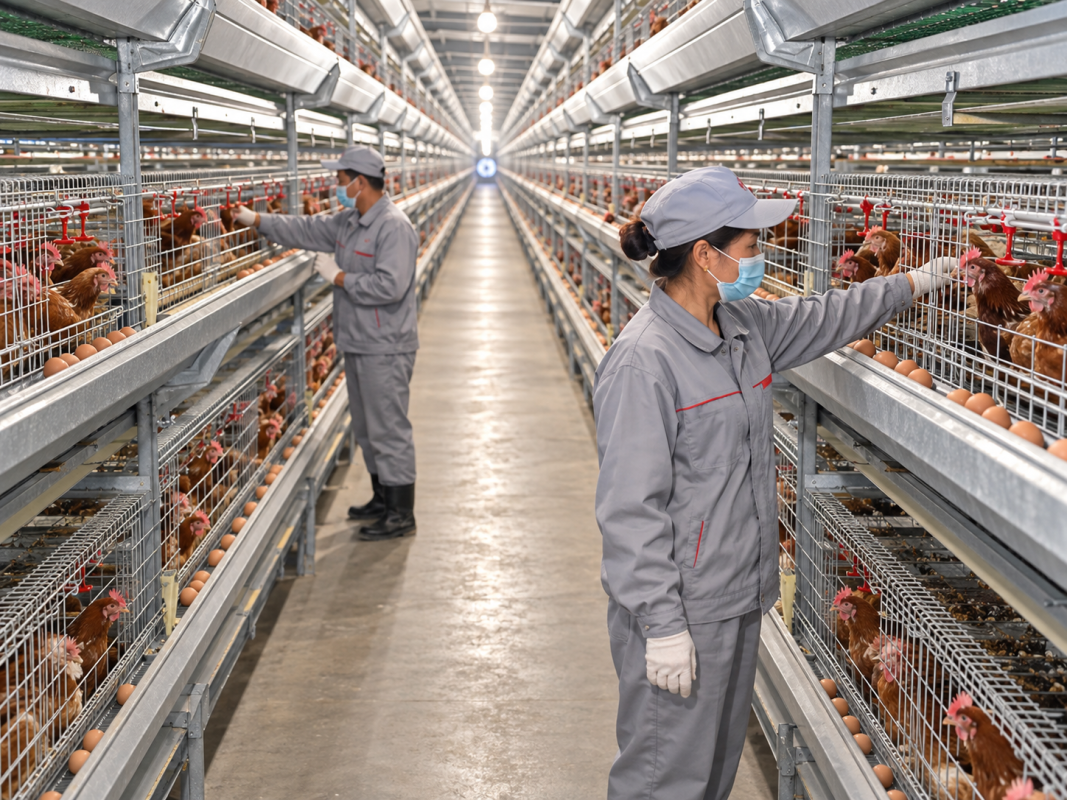
Its H-Type Automatic Layer Cage System integrates feeding, nipple drinking, egg collection and manure removal into a multi-tier arrangement.
For either option, the engineering team must confirm cage capacity, row count, tier count, usable floor area, service aisles and equipment exits.
We would not promise a fixed building size from the number of hens alone.
The first deliverable should be a preliminary cage-house layout, followed by a detailed equipment list and quotation.
That approach helps avoid ordering equipment that cannot fit the proposed house or connect properly to the egg-packing and manure-handling areas.
2. What Can Buyers Learn from a Guangxing Layer Project?
Guangxing’s published Shanxi Shilou Golden Rooster Project provides an example of its H-type equipment in a commercial layer farm.
The project page documents a multi-tier layer cage system, automatic egg collection and related feeding equipment. It also describes the importance of coordinating equipment layout and daily farm management.
The project is not presented here as a 20,000-hen installation; its publicly available description does not establish that capacity.
What matters for a buyer is the equipment arrangement.
Egg collection must connect the cage rows with a practical receiving area. Feeding equipment needs suitable access and distribution routes. Meanwhile, manure removal must lead to an appropriate discharge location.
These connections should appear on the drawings before construction begins.
A supplier’s ability to coordinate those systems is more useful than a quotation that lists individual machines without showing how they fit together.
3. A-Type or H-Type: Where Is the Extra Money Better Spent?
H-type cages use building height more intensively, but that does not make them the best choice for every 20,000-hen project.
Where land is available and the farm wants a simpler starting configuration, A-type cages may deserve priority.
Where building space is limited or manual egg handling would require substantial labor, H-type automation becomes more attractive.
Still, we would ask three questions before selecting H-type equipment.
First, will the building provide sufficient clear height and maintenance access?
Second, will the farm benefit from coordinated egg collection and manure removal?
Third, can local staff maintain the motors, belts and controls?
An H-type system that saves building space but creates difficult maintenance access may be expensive to operate.
The final comparison should use complete equipment packages, including the collection and manure systems, rather than cage prices alone.
There is also a regulatory issue. The EU prohibited conventional non-enriched layer cages in 2012. Permitted enriched cage systems must meet specific welfare requirements, while some customers require cage-free eggs.
Buyers should confirm local law and market requirements before committing to either cage design.
4. What Should the Equipment and Construction Budget Include?
The published US$50,000–80,000 EXW H-type reference covers a supplier-defined equipment package. The actual price changes with cage specifications, feeding equipment, egg collection, manure discharge and controls.
It should not be treated as a complete Guangxing farm budget.
For a useful comparison, ask suppliers to separate these costs:
| Budget Category | Items to Confirm |
|---|---|
| Cage equipment | Cage rows, tiers, flooring, frames and accessories |
| Feeding and drinking | Feed delivery, troughs, nipples and water regulation |
| Egg collection | Row belts, elevators and central conveyors |
| Manure removal | Tier belts, motors and discharge equipment |
| Environmental systems | Ventilation, cooling, lighting and controls |
| Civil and building works | Steel structure, foundations, roofing and drainage |
| Delivery and installation | Freight, import costs, electrical work and commissioning |
| Operating capital | Pullets, feed, packaging, labor and reserves |
For Guangxing, the final quotation should follow the confirmed layout and bill of materials.
We would also distinguish between equipment installed at the factory, equipment delivered to the destination and work the local contractor must complete.
This matters because a low EXW price may exclude substantial costs for transportation, foundations and electrical installation.
A contingency allowance is sensible for site adjustments, but the amount should reflect the actual construction risks rather than a standard percentage applied to every project.
5. Feed Cost: Why Five Grams per Hen Matter
Feed is a major recurring expense in commercial egg production.
The Hy-Line Brown performance standards provide breed-specific benchmarks for daily intake and laying performance.
Using 110 g per hen per day as an illustrative assumption:
20,000 × 0.110 kg = 2,200 kg of feed daily
At a hypothetical feed price of US$0.35/kg, that represents US$770 in daily feed purchases.
Now consider an additional 5 g per hen each day.
| Feed Sensitivity | Example |
|---|---|
| Additional feed per hen | 5 g/day |
| Additional feed for the flock | 100 kg/day |
| Assumed feed price | $0.35/kg |
| Additional daily expense | $35 |
| Equivalent over 365 days | $12,775 |
This calculation illustrates cost sensitivity. It does not claim that Guangxing equipment saves 5 g per hen or that lower feed consumption always means better performance.
Actual feed requirements depend on breed, age, egg mass, temperature and diet.
For this reason, we would examine feeder adjustment, trough geometry and distribution consistency when reviewing the equipment.
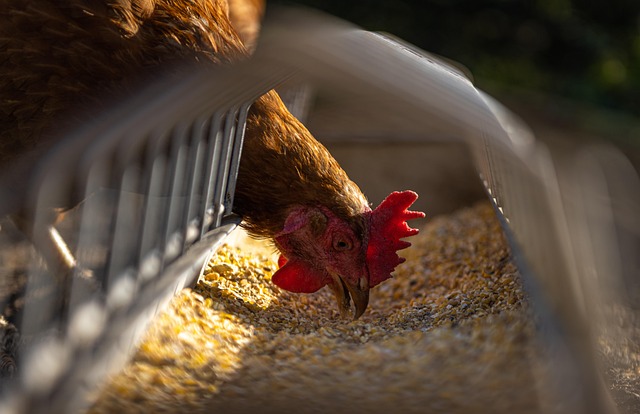
Guangxing’s H-type product description includes a V-shaped feed-trough design intended to reduce spillage. The buyer should request suitable specifications and operating evidence rather than assume feed waste can be completely eliminated.
The goal is consistent feeding with minimal avoidable loss, not simply the lowest daily feed intake.
6. Egg Collection: How Much Are Saleable Eggs Worth?
A 20,000-hen farm with a hypothetical 90% hen-day laying rate produces:
20,000 × 90% = 18,000 eggs per day
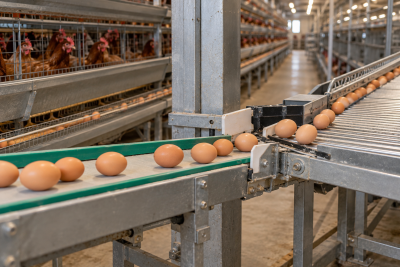
At that volume, collection equipment should protect the eggs as they move between cage belts, elevators and conveyors.
Suppose the percentage of eggs that cannot be sold increases by one percentage point.
| Egg Loss Sensitivity | Example |
|---|---|
| Daily eggs produced | 18,000 |
| Additional unsaleable share | 1 percentage point |
| Additional unsaleable eggs | 180/day |
| Assumed selling price | $0.10/egg |
| Daily revenue difference | $18 |
| Equivalent over 365 days | $6,570 |
This is an illustrative scenario, not a guaranteed saving from automatic collection. Production and market prices change throughout the year.
Nevertheless, the calculation explains why egg-transfer design deserves attention.
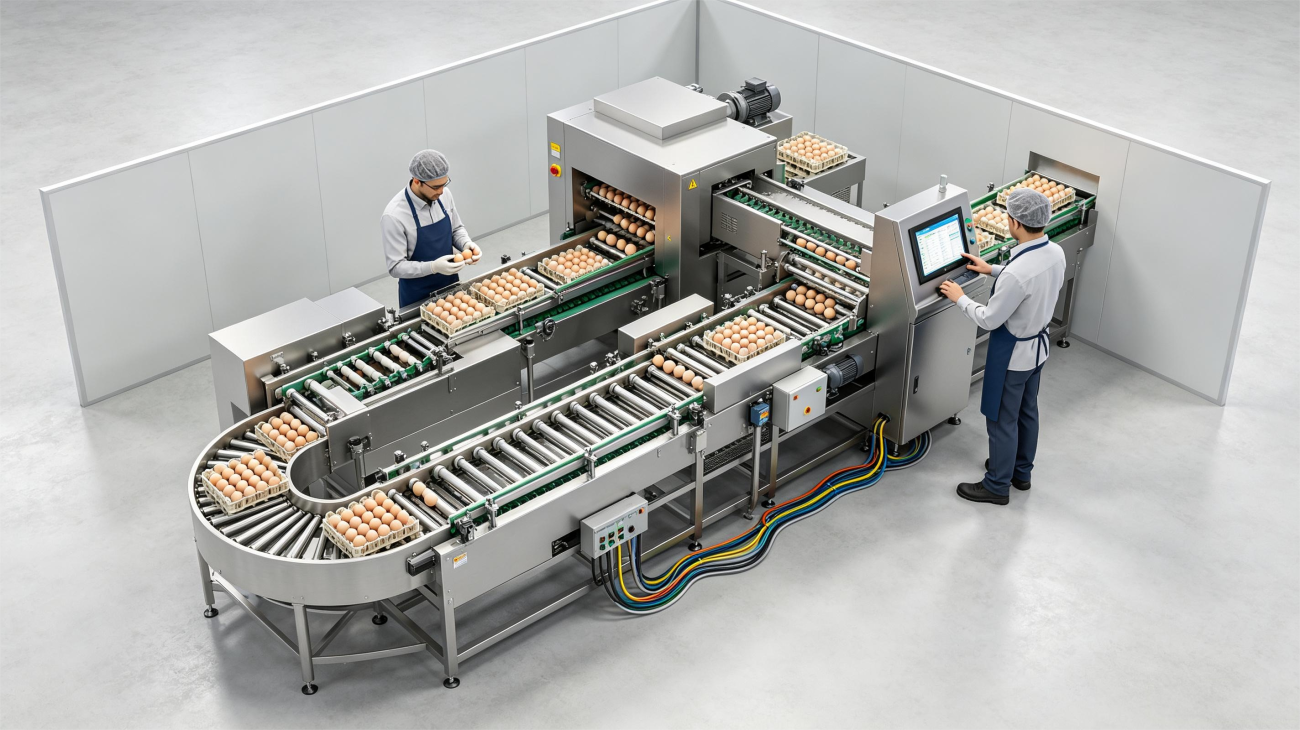
Guangxing’s automatic egg collection system offers standard collection and centralized arrangements for multi-row farms.
Its published product description includes buffered conveying and a low-breakage performance claim. Buyers should ask for the relevant test conditions before using that figure in a financial forecast.
For a 20,000-layer project, our recommendation would be to determine the collection route first.
If several cage rows must send eggs to one packing area, central collection may reduce handling work. If row-level collection already meets the farm’s needs, additional conveyors may not be worth the investment.
7. Manure Removal, Ventilation and Power: Don’t Treat Them as Extras
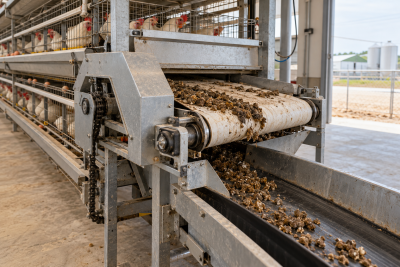
A layer house needs a practical manure-discharge arrangement, not simply belts beneath the cages.
Where manure leaves the building affects cleaning, storage, vehicle access and possible future treatment equipment.
We would confirm belt-drive access and the discharge route before approving the house layout.
Ventilation deserves the same early attention.
H-type cages place hens at different heights, so the airflow design must match the cage arrangement. A generic fan package may not distribute air appropriately throughout the house.
For a mechanically ventilated building, essential backup power and alarms should be included from the beginning.
The farm may tolerate a temporary egg-conveyor shutdown. Losing essential ventilation during extreme heat can create a much more serious problem.
These systems should be specified before spending on optional monitoring upgrades.
8. Can a 20,000-Layer Farm Generate Attractive Returns?
At a hypothetical 90% hen-day laying rate and US$0.10 per egg:
| Item | Illustrative Result |
|---|---|
| Hens in production | 20,000 |
| Daily eggs produced | 18,000 |
| Assumed egg price | $0.10 |
| Gross daily egg revenue | $1,800 |
This assumes all produced eggs are saleable at the same price. It is not net profit or a year-round production forecast.
Real returns depend on the laying curve, feed costs, pullet purchases, labor, electricity, egg grading, equipment maintenance and financing.
We would use the selected breed’s performance guide and local market prices to calculate a realistic operating budget before discussing payback.
An H-type system is worth considering when the farm can justify its higher equipment cost through space utilization, labor efficiency and reliable daily operations.
An A-type arrangement may make more sense where land is available, the budget is tighter or centralized automation offers limited additional benefit.
The best choice is the system whose total installed cost and expected operating performance fit the farm’s actual market—not the one with the most automation features.
Frequently Asked Questions
How much does a 20000-layer farm cost?
A third-party supplier lists US$50,000–80,000 EXW for an H-type equipment package. Complete construction, shipping, installation, pullets and initial operating costs are additional. Guangxing prices require a project-specific quotation.
Can Guangxing provide both A-type and H-type systems?
Yes. Guangxing publishes A-frame and H-type layer cage products, with compatible feeding, drinking, egg collection and manure-handling options. Final configurations depend on the project.
Does central egg collection always pay for itself?
No. It is worth evaluating when several cage rows feed a common packing area and the farm can reduce handling work or losses sufficiently to justify the investment.
What information is needed for a 20,000-layer quotation?
Provide the country, layer breed, planned capacity, building dimensions, preferred A/H-type system, egg-collection requirements and the level of automation needed.
Get a 20,000-Layer Equipment Plan from Guangxing
For a new project, Guangxing can review the proposed cage arrangement, feeding and drinking equipment, egg collection, manure removal and related environmental-control requirements.
Send us your country, available building dimensions, layer breed, planned capacity and preferred automation level.
We can discuss the appropriate equipment configuration, identify essential and optional systems, and prepare a project-specific layout and quotation with a defined supply scope.
Request a 20,000-Layer Farm Equipment Plan