


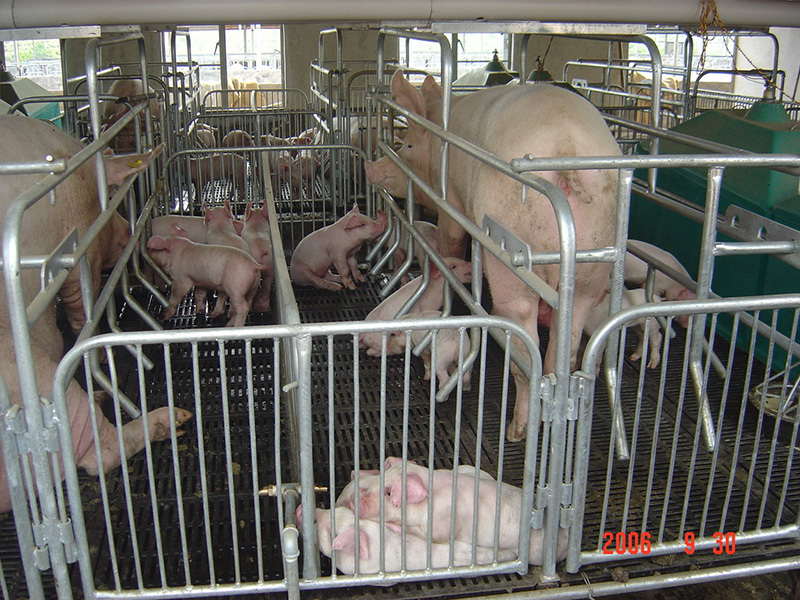
Choosing the right farrowing system is a very important decision in the construction and upgrading of modern pig farms. A farrowing pen is not only the place where sows give birth, but also directly affects piglet survival rate, sow comfort, labor efficiency, farrowing house hygiene and the long-term production benefits of the farm.
For many commercial pig farms, the most common question is:
Should a pig farm choose traditional farrowing crates or a free farrowing system?
There is no single answer to this question. Traditional farrowing crates and free farrowing pens have different design purposes. Traditional farrowing crates focus more on piglet protection and standardized management, while free farrowing systems provide sows with more activity space. EFSA’s scientific opinion on pig welfare clearly mentions that, for animal welfare reasons, farrowing pens are recommended for periparturient and lactating sows instead of traditional farrowing crates, which better reflects the trend toward improved animal welfare in pig farming.
For pig farm owners, investors and project managers, the right choice should be based on multiple factors, including piglet mortality control, sow welfare requirements, pig house area, labor management level, local regulations, project budget and future market positioning.
This article will systematically introduce the main differences between traditional farrowing crates and free farrowing systems, helping you choose a more practical sow farrowing pen solution for your pig farm.

What Is a Traditional Farrowing Crate?
A traditional farrowing crate is a farrowing system used during sow farrowing and lactation. It usually consists of a sow crate in the middle, piglet activity areas on both sides, a feeding trough, drinking system, slatted floor and piglet heating area.
The main function of a traditional farrowing crate is to limit the movement of the sow. When the sow lies down, stands up or changes position, the farrowing crate can help reduce the risk of piglets being crushed or stepped on.
For commercial pig farms, traditional farrowing crates are widely used because they make farrowing house management more standardized and efficient.
Main Functions of Traditional Farrowing Crates
A well-designed traditional farrowing crate can help pig farms improve daily management efficiency in several ways.
First, it can limit sow movement and reduce the risk of the sow suddenly lying down, turning over or crushing piglets. Newborn piglets are weak, slow-moving and very sensitive to low temperatures. In the first few days after birth, piglet crushing by the sow is one of the most common risks in the farrowing house.
Second, farrowing crates make it easier for workers to manage feeding, drinking and health observation. Workers can more conveniently check the sow’s feed intake, body condition, udder condition, farrowing progress and piglet nursing behavior.
Third, farrowing crates help improve farrowing house hygiene. When used with slatted flooring, manure can be discharged more smoothly, helping keep the farrowing area clean and dry.
Fourth, traditional farrowing crates save space and are more suitable for high-density, large-scale commercial pig farming. For farms with limited pig house space, traditional farrowing crates are easier to arrange in a standardized layout.

What Is Free Farrowing?
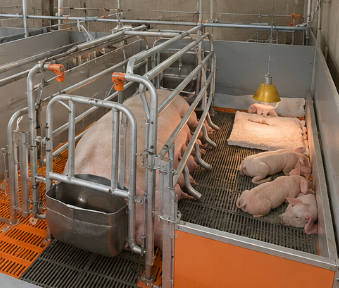
Free farrowing is a farrowing system that gives the sow more activity space before, during and after farrowing. In a free farrowing pen, the sow can usually turn around, stand, lie down and express more natural behavior.
Compared with traditional farrowing crates, free farrowing pens are usually larger and more open in structure. They can be equipped with anti-crushing bars, piglet heating areas, heating plates, guard rails and special pen layouts to protect piglets.
As animal welfare requirements continue to increase, free farrowing systems are receiving more attention in some markets. The Pig Site classifies indoor free farrowing alternatives into individual free farrowing pens, temporary confinement pens and group systems. These systems are often used in high-welfare pork production, branded pork projects, export-oriented pig farms and markets with higher animal welfare requirements.
However, free farrowing does not simply mean “letting the sow loose.” If the pen design is unreasonable or management cannot keep up, the risk of piglets being crushed may increase. Therefore, a successful free farrowing system requires scientific pen design, good staff training and more frequent inspection.
Common Types of Free Farrowing Systems
Free farrowing systems can be designed into different types according to farm needs.
Fully free farrowing pens allow sows to move freely during most of the farrowing and lactation period. This design provides better freedom of movement for the sow, but it requires a larger pen area and more complete piglet protection measures.
Temporary confinement free farrowing pens allow sows to move freely for part of the time, but during the high-risk period around farrowing, the crate can be temporarily closed to control sow movement. This design tries to achieve a balance between sow welfare and piglet safety. AHDB also provides practical guidance on free farrowing and temporary confinement systems.
Improved farrowing pens are a more realistic choice for many commercial pig farms. They are more comfortable than traditional narrow farrowing crates, while still retaining key protection functions such as anti-crushing bars, piglet heating areas and moderate sow confinement.

Traditional Farrowing Crate vs Free Farrowing: Key Differences
The biggest difference between traditional farrowing crates and free farrowing systems lies in the balance between sow freedom of movement and piglet protection.
Traditional farrowing crates restrict sow movement. This helps reduce the risk of piglets being crushed, especially for large pig farms that require stable management and standardized operation.
Free farrowing systems provide sows with more space. Sows can express more natural behavior and animal welfare is improved, but they also require larger pen areas, more scientific layouts and more refined management.
Simply put:
Traditional farrowing crates have more advantages in piglet protection and management efficiency.
Free farrowing systems have more advantages in sow welfare and future market positioning.
For commercial pig farms, the real focus of decision-making is not only animal welfare, but how to achieve a balance between protecting piglets, maintaining production efficiency and meeting market requirements.
Comparison Table: Traditional Farrowing Crate vs Free Farrowing
| Comparison Item | Traditional Farrowing Crate | Free Farrowing |
| Sow activity space | Restricted movement | Larger activity space, able to turn around |
| Piglet protection | Stronger anti-crushing protection | Depends on pen design and management level |
| Sow welfare | Lower freedom | More in line with natural behavior needs |
| Pig house space requirement | Smaller area per pen | Usually requires a larger area per pen |
| Management difficulty | Easier for standardized management | Requires higher management level and more frequent inspection |
| Investment cost | Usually more controllable | Usually higher due to space and design requirements |
| Hygiene management | Easier to clean when used with slatted flooring | Requires a more reasonable layout to stay dry and clean |
| Suitable farms | Commercial pig farms and large-scale pig farms | High-welfare farms, branded pork projects and markets with higher welfare requirements |


Advantages of Traditional Farrowing Crates
The most important advantage of traditional farrowing crates is piglet protection.
Newborn piglets are very vulnerable. They need warmth, colostrum and a safe area away from the pressure of the sow’s body. During the first few days after birth, piglets often stay close to the sow for warmth and nursing. If the sow suddenly lies down, weak piglets may not be able to escape in time and may be injured or crushed.
Traditional farrowing crates can reduce this risk by controlling the sow’s movement range and lying position. When combined with anti-crushing bars and a reasonable piglet heating area, they can provide a safer activity space for piglets.
Traditional farrowing crates can also improve labor efficiency. Workers can more easily feed sows, check piglets, assist farrowing, care for weak piglets and clean the pens.
For large commercial pig farms, standardization is very important. A unified farrowing crate layout helps improve daily operation, disease prevention and control, manure discharge and batch management efficiency.
Disadvantages of Traditional Farrowing Crates
The biggest disadvantage of traditional farrowing crates is that they restrict sow movement.
In traditional farrowing crates, sows usually cannot turn around freely. This limits natural behaviors such as nest-building, exploration and free movement. Therefore, in many markets, traditional farrowing crates are facing increasing animal welfare concerns.
Another issue is future regulatory pressure. Some countries and regions are paying more attention to animal welfare in livestock farming. For pig farms selling to high-welfare markets, it may be necessary to consider improved or alternative farrowing systems in advance.
Therefore, when choosing traditional farrowing crates, farms should not choose outdated, narrow or poorly designed products. Modern farrowing crates should have a stronger structure, safer anti-crushing design, better cleaning performance and improved comfort for both sows and piglets.
Advantages of Free Farrowing
The biggest advantage of free farrowing is improved sow welfare.
Sows can move, turn around, stand, lie down and interact with piglets more naturally. This helps reduce sow stress and makes farrowing behavior closer to the natural state.
Free farrowing is also suitable for farms that want to build a high-welfare pork brand. In some markets, consumers, retailers and food companies are paying more attention to animal welfare. Free farrowing systems can help farms improve their brand image and adapt to future market requirements.
In addition, free farrowing pens are more flexible in design. Farms can customize them according to sow size, piglet heating area, heating method, floor structure, feeding position and pig house layout.

Disadvantages of Free Farrowing
Free farrowing also has some practical challenges.
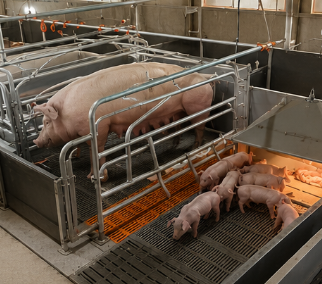
The first challenge is the risk of piglets being crushed. When sows have more freedom of movement, piglets may face a higher crushing risk if the pen does not provide enough protection. Therefore, anti-crushing bars, heating areas, safe corners and reasonable pen layouts are very important.
The second challenge is floor space. Free farrowing pens usually require a larger area per pen than traditional farrowing crates. For pig farms with limited house space, this may reduce the number of farrowing places in the same farrowing house.
The third challenge is investment cost. A larger pen area, more complex design and higher management requirements will all increase project investment.
The fourth challenge is staff training. Workers need to observe sow behavior, piglet position, heating area use, temperature changes and weak piglet conditions more carefully. If management is not in place, the welfare advantages of free farrowing may not necessarily translate into better production performance.
Which System Is More Suitable for Commercial Pig Farms?
For most commercial pig farms, the most suitable system depends on production goals.
If the farm pays more attention to stable piglet survival rate, lower management difficulty and higher space utilization, traditional farrowing crates or improved farrowing pens are usually more practical.
If the farm pays more attention to high-welfare pork production, brand premium or target markets with higher animal welfare requirements, a free farrowing system may be a better long-term choice.
If the farm wants to balance piglet safety and sow welfare, improved farrowing pens or temporary confinement free farrowing systems may be more realistic solutions.
Many pig farms do not need to upgrade directly from traditional farrowing crates to fully free farrowing systems all at once. Step-by-step renovation is often more suitable for actual operation. For example, farms can choose a wider sow area, adjustable confinement structure, better anti-crushing protection, more reasonable piglet heating areas and more comfortable flooring systems.
Guangxing Modern Sow Farrowing Pen Solutions for Pig Farms
Guangxing can provide customized farrowing pen solutions for commercial pig farms, breeding farms and modern pig house projects.
According to your pig house size, sow breed, farming scale and management model,
Guangxing farrowing pen solutions are designed to help farms improve piglet survival rate, reduce crushing risk, keep the farrowing house environment clean and make daily management easier and more efficient.
For new pig farm projects, we can provide design support from the farrowing house layout stage. For existing pig farm renovation projects, we can also provide customized equipment solutions according to the current pig house size and production needs.
Conclusion
Traditional farrowing crates and free farrowing systems both have clear advantages and disadvantages.
Traditional farrowing crates are more suitable for farms that need stable piglet protection, efficient management and higher space utilization. Free farrowing systems are more suitable for farms that focus on sow welfare, branded pork production and long-term welfare requirements.
For many commercial pig farms, the best choice is not simply choosing one of the two. Improved farrowing pens or customized farrowing systems can achieve a better balance between piglet safety, sow comfort, hygiene management and investment cost.
Before choosing a farrowing system, pig farm owners should comprehensively consider piglet mortality risk, sow welfare goals, pig house area, labor management level, local regulations, project budget and future market direction.
If you are planning a new farrowing house or preparing to upgrade an existing pig farm, Guangxing can provide customized farrowing pen solutions according to your actual production conditions.
For product and solution consultations, please contact Guangxing’s professional team for customized advice: WhatsApp: 00852-46090144 or [Phone/WeChat]: 0086-17876668787


