Why Is Large Litter Farrowing Management Becoming Increasingly Important?
When a litter contains a large number of piglets, differences in piglet body weight often become more noticeable. Some weaker piglets may be unable to secure a teat or consume enough colostrum in time. Other piglets may die because of chilling, sow crushing, insufficient milk supply, or poor hygiene conditions in the farrowing house.
Therefore, the objective of large litter management should not simply be to help sows produce more piglets. It should use suitable farrowing pen design, heating equipment, nursing management, and environmental control to help more piglets survive in good health and reach weaning successfully.

Main Challenges of Large Litter Farrowing
1. The Number of Piglets Exceeds the Number of Functional Teats
Although a sow has multiple teats, not every teat can consistently provide enough milk. When the number of live-born piglets exceeds the number of functional teats, competition among piglets becomes significantly more intense.
Larger and more active piglets usually secure the better-positioned teats more quickly, while low-birth-weight or slower piglets are more likely to be pushed away. Piglets that cannot establish access to a fixed teat for a long period may grow more slowly and face a higher risk of mortality.
2. A Higher Proportion of Low-Birth-Weight and Weak Piglets
Large litters often show greater variation in piglet body weight. Low-birth-weight piglets have fewer energy reserves, weaker temperature-regulation ability, and poorer mobility and suckling ability than normal piglets.
If the farm does not provide timely heating, assisted suckling, and special care, these weaker piglets may quickly develop chilling, low blood glucose, dehydration, and other problems during the early period after birth.
3. Insufficient Colostrum Intake
Colostrum not only provides energy for newborn piglets but also delivers essential maternal immune protection. Large litters contain more piglets, while the total amount of colostrum produced by the sow is limited. As a result, the average quantity received by each piglet may decrease.
If weak piglets cannot consume colostrum early enough, their disease resistance, growth performance, and pre-weaning survival may all be negatively affected.
4. Increased Risk of Piglets Being Crushed by the Sow
As the number of piglets increases, activity inside the farrowing pen becomes more frequent. If the pen is too small or lacks anti-crushing rails and piglet escape areas, piglets are more likely to be injured when the sow lies down, rolls over, or stands up.
The risk is particularly high during the first few days after farrowing because newborn piglets have limited mobility and are slower to react to sow movements. A properly designed pen structure is therefore necessary to reduce crushing risk.

5. Greater Difficulty in Heating and Environmental Control
Lactating sows and newborn piglets have different temperature requirements. Sows need a relatively cool environment to maintain feed intake and milk production, while newborn piglets require a warm, dry, and draught-free resting area.
If the entire farrowing house is too warm, sows may experience heat stress. If it is too cold, piglets may become chilled. Large litter farrowing houses therefore require clearer separation between warm piglet zones and cooler sow zones.
Choosing a Farrowing Pen Suitable for Large Litters
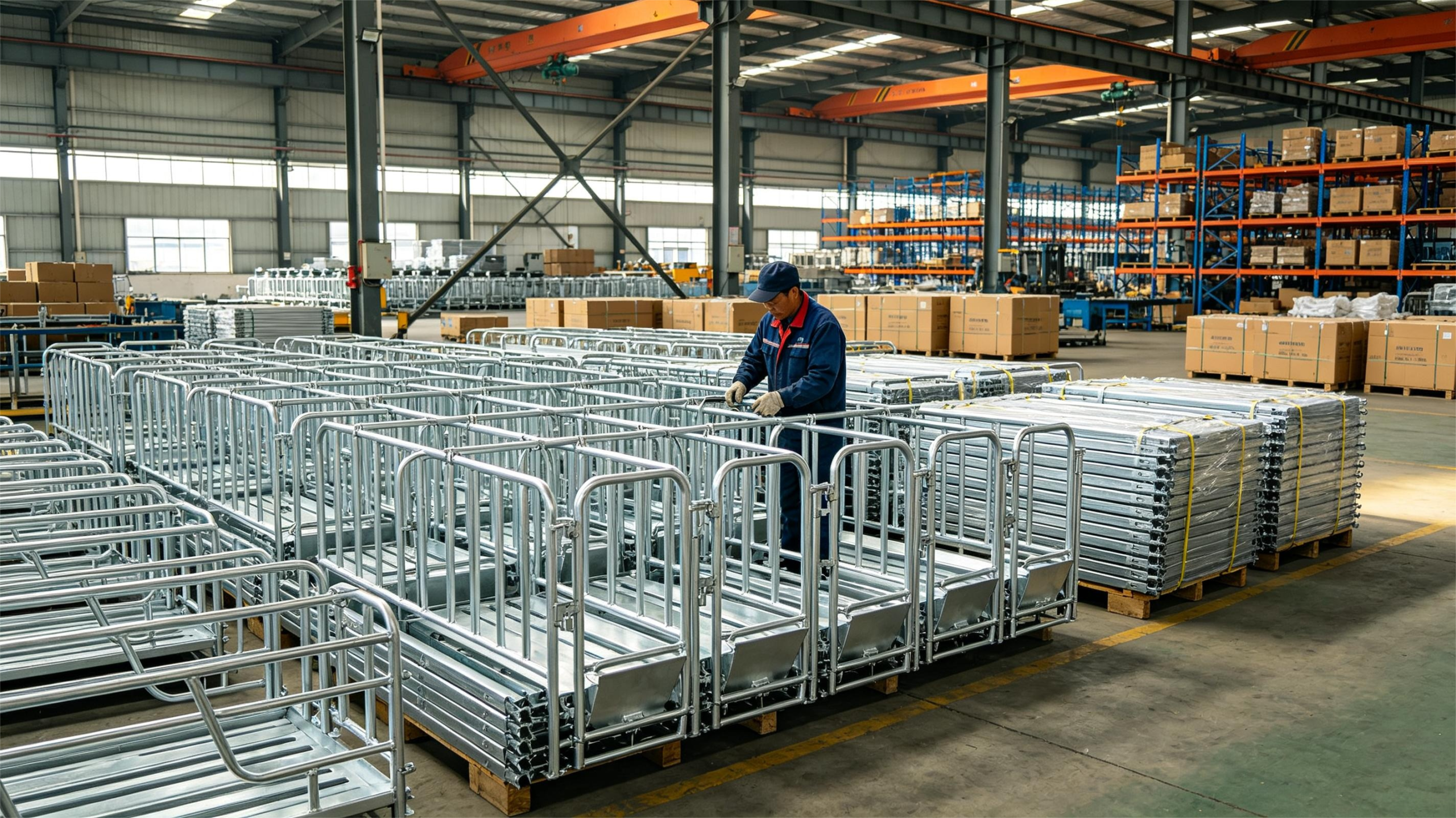
A high-quality farrowing pen is the foundation of a large litter farrowing solution. It should not only limit dangerous sow movements but also provide sufficient space for piglets to move, nurse, rest, and escape safely.
1. Adjustable Sow Restraint Structure
Sow body size varies according to breed and parity. An adjustable sow restraint structure can be adapted to the sow’s body length and width, allowing her to stand, lie down, and nurse normally while reducing the risks associated with sudden turning or rapid lying-down movements.
A restraint area that is too narrow may reduce sow comfort, while one that is too wide may fail to provide effective anti-crushing protection. Farrowing pen dimensions should therefore be designed according to the actual sow body size on the farm.
2. Complete Anti-Crushing Design
A farrowing pen suitable for large litters should include anti-crushing rails, protective side structures, and piglet escape areas. When the sow lies down, these features can slow her movement and provide temporary safe spaces for piglets.
The edges of the pen should also be free from sharp components and oversized gaps that could trap or injure piglets.
3. A Larger Piglet Activity Area
The greater the number of piglets, the more activity space they require. An undersized piglet area can cause overcrowding and increase trampling, contamination, and competition for teats.
A practical pen layout should include a separate resting area, nursing access, and sufficient movement space, allowing piglets to travel safely between the sow area and the heated creep area.
4. Convenient Access for Manual Care
Large litters require more frequent observation, weighing, assisted suckling, cross-fostering, and milk supplementation. The farrowing pen should therefore also be designed for convenient staff access.
Opening side panels, suitable aisle widths, and structures that allow easy access to piglets can improve farrowing house management efficiency and reduce safety risks for workers during routine care.
Establishing a Separate and Warm Piglet Creep Area
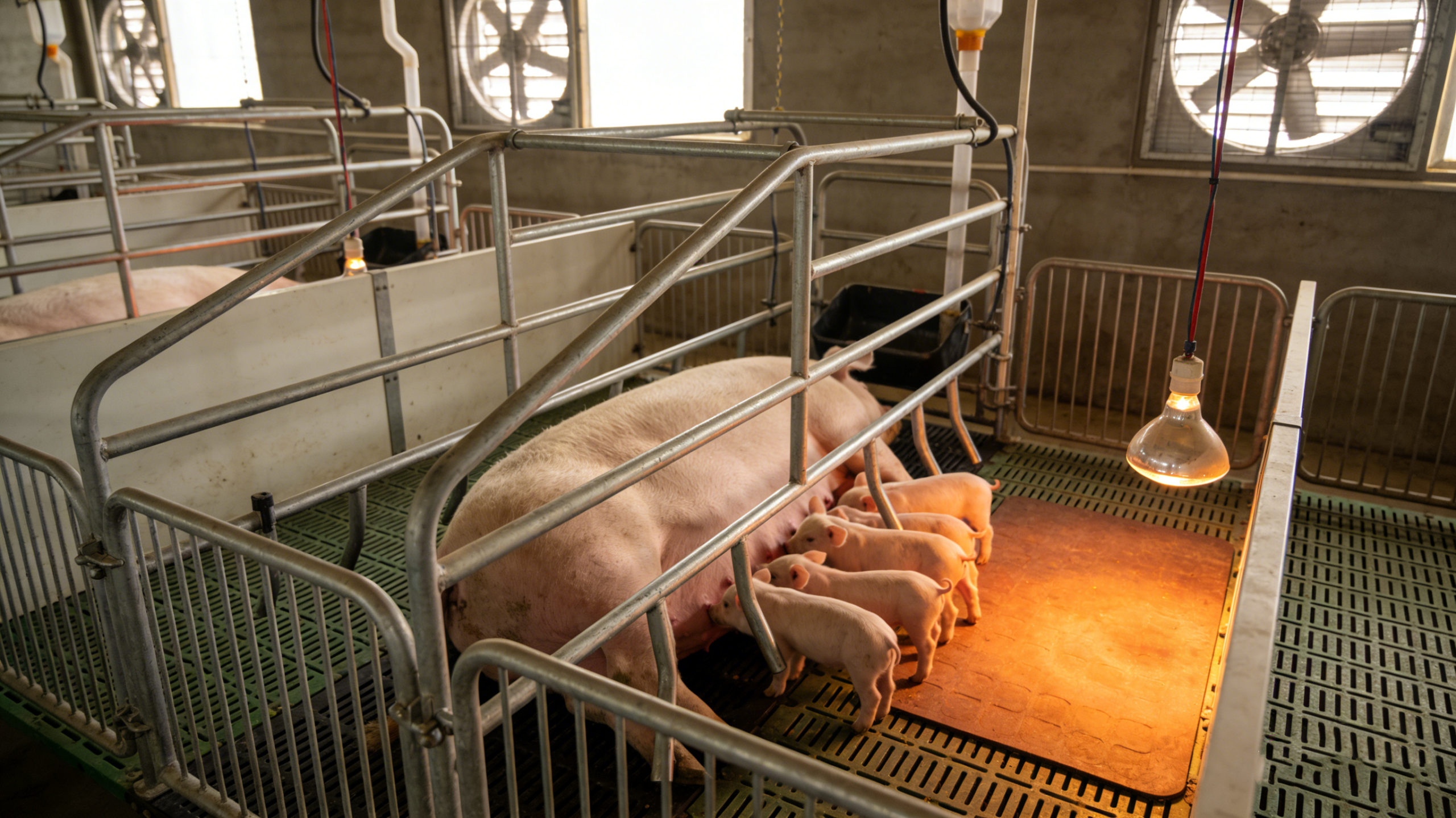
A warm, dry, and quiet creep area is extremely important for newborn piglets. A well-designed creep area not only reduces the risk of chilling but also encourages piglets to rest away from the sow’s lying area, helping to reduce crushing risk.
1. Separate the Sow and Piglet Temperature Zones
The farrowing house should not rely on heating the entire room to meet piglet needs. A more practical approach is to keep the sow area relatively cool while using localized heating to create a warm microenvironment for the piglets.
This zoning method helps the sow maintain normal feed intake while meeting the thermal requirements of newborn piglets.
2. Select Suitable Heating Equipment
Common piglet heating equipment includes:
Infrared heat lamps;
Electric heating plates;
Piglet creep boxes;
Underfloor heating systems;
Covered piglet resting areas.
Pig farms can select the most suitable configuration according to the local climate, energy conditions, pen structure, and management method.
3. Keep the Creep Area Dry and Free from Draughts
The creep area should not be located close to cold-air inlets, and it should not be contaminated by drinker leakage or manure. Even when the temperature is relatively high, wet flooring or draughts can still cause piglets to lose body heat.
Heating equipment should be easy to remove, clean, and disinfect. Heating performance and electrical safety should also be inspected regularly.
Ensuring That Every Piglet Receives Colostrum in Time
Colostrum management is one of the most important parts of large litter care. Farms should monitor the farrowing process continuously to ensure that weak piglets, late-born piglets, and slow-moving piglets can reach the teats in time.
1. Help Weak Piglets Suckle as Early as Possible
After birth, piglets should be dried quickly and placed near the sow’s teats. Piglets with a low body temperature or a weak suckling reflex can be warmed first and then assisted manually to nurse.
Farm staff should confirm that the piglet is actually drinking milk rather than simply lying beside a teat.
2. Use Split Suckling
Split suckling is commonly used in large litter management. Piglets that have already consumed colostrum and are stronger can be temporarily placed in the heated creep area, allowing weaker and later-born piglets to suckle with less competition.
This method can reduce competition between strong and weak piglets, but the separation period should not be too long, as it may affect the feeding and thermal comfort of the other piglets.
3. Maintain Farrowing Records
Recording the farrowing time, number of live-born piglets, number of stillborn piglets, number of weak piglets, and colostrum-management measures for each sow can help staff identify litters requiring special attention.
Complete records can also help the farm analyze causes of mortality and continuously improve equipment and management procedures.
Balancing Litter Size Through Cross-Fostering and Nurse Sows
When the number of piglets clearly exceeds the number of functional teats, natural nursing alone is often unable to meet the needs of every piglet. Farms can balance litter size through cross-fostering or nurse sow management.
1. Carry Out Cross-Fostering Properly
Cross-fostering should consider the number of functional teats, sow milk production, farrowing time, and piglet body weight. After adjustment, the number of piglets assigned to each sow should not significantly exceed the number of functional teats.
Piglet movement between different areas should be minimized, and identification records and hygiene management should be maintained.
2. Group Piglets According to Body Weight and Vitality
Placing piglets of similar body size in the same litter can reduce excessive competition between stronger and weaker piglets. However, piglets should not be moved frequently because repeated transfer may cause stress, disease transmission, and disruption of teat order.
3. Use Nurse Sows
For farms with high litter sizes and large farrowing batches, a nurse sow management system can be established. Healthy sows with strong milk production and stable maternal behavior can be selected to nurse surplus piglets.
Nurse sow programs require professional batch management and strict hygiene measures. Otherwise, they may increase disease transmission and make sow management more complicated.
Optimizing Farrowing House Hygiene and Environmental Control
Large litters create more manure, moisture, and pathogen pressure inside the farrowing house. A clean, dry, and stable environment is essential for reducing diarrhoea and infection risk.
1. Use Suitable Slatted Flooring
The sow area can use strong slatted flooring with good load-bearing capacity, while the piglet area should use flooring with a more comfortable surface and suitable gap size.
A practical combination of cast-iron, plastic, or composite slatted flooring can balance manure drainage efficiency, sow stability, and piglet comfort.
2. Reduce Cleaning Dead Zones
Pen joints, feeders, drinkers, and creep areas should be easy to wash and disinfect. Complicated structures and excessive dead corners can accumulate manure and increase pathogen residues.
Between batches, pens should follow appropriate cleaning, disinfection, and drying procedures before the next group of sows enters.
3. Improve Ventilation
The ventilation system should control temperature, humidity, odours, and harmful gases while avoiding direct airflow onto newborn piglets.
In cold regions, ventilation should not be shut down for long periods simply to retain heat. In hot regions, priority should be given to preventing sow heat stress and excessive humidity in the farrowing house.

How to Customize a Large Litter Farrowing Solution for a Commercial Pig Farm
A large litter farrowing solution should not focus only on an individual pen. It should be planned from the perspective of the entire farrowing house system.
Before preparing a design, the equipment supplier usually needs to understand:
The basic sow inventory of the farm, the number of sows farrowing in each batch, the average total-born and live-born piglets per sow, and the average sow body size;
The length, width, and height of the farrowing house, and the total number of farrowing pens planned;
The local extreme summer and winter temperatures;
The current piglet mortality rate and the main causes of mortality;
The existing feeding, water-supply, heating, and ventilation systems on the farm;
Whether the farm uses conventional farrowing crates, temporary crating, or loose free-farrowing systems.
Based on this information, the supplier can further design the farrowing pen dimensions, sow restraint width, piglet activity area, creep area, slatted flooring, feeding and drinking systems, ventilation and cooling systems, and manure-handling solution.
Conclusion
Large litter farrowing creates greater production potential, but it also increases the difficulty of piglet care and farrowing house management. Simply increasing litter size does not automatically increase the number of piglets weaned.
Suitable farrowing pens, anti-crushing structures, piglet creep areas, colostrum management, split suckling, cross-fostering, supplementary nutrition, and environmental control must work together as a complete management system.
For commercial pig farms, the most effective approach is to customize the farrowing solution according to sow body size, average litter size, building conditions, and management model. This can reduce piglet losses, increase the number of piglets weaned per litter, and improve overall farrowing house production efficiency.
Request a Customized Solution
Are you looking for a suitable farrowing solution for large litters or hyperprolific sows?
Please provide your sow quantity, average litter size, farrowing house dimensions, planned number of pens, and local climate conditions. Guangxing can provide customized farrowing pens, piglet creep areas, slatted flooring, feeding and drinking systems, and farrowing house environmental-control solutions according to your farm layout.
For product and solution consultations, please contact Guangxing’s professional team for customized advice: WhatsApp: 00852-46090144 or [Phone/WeChat]: 0086-17876668787