


The market competition in the global poultry breeding industry has intensified year by year. For operators of broiler and breeding chicken farms, operational pressures primarily revolve around two core challenges: enhancing egg production and hatching rates, and reducing daily operating costs. Many farmers still rely on traditional floor-based laying methods, yet this outdated approach has long failed to meet the demands of large-scale, standardized farming practices.
If you are facing these challenges in poultry farming—limited land space, rising labor costs, poor egg hygiene leading to low hatching rates, disorganized manure management, and inconsistent production performance of breeding chickens—the comprehensive automated multi-level cage-raising system for broilers can fundamentally transform the daily operations of your farm.


The conventional ground-based free-range farming model presents significant operational challenges. This method is only suitable for small-scale farmers raising a few thousand breeding chickens; once the scale expands, various complex issues arise one after another, steadily eroding the farm’s profit margins.
The land utilization rate is extremely low, and site expansion is severely limited.
All breeding space is confined to the ground level, resulting in complete waste of vertical space. To raise a larger number of breeding chickens, additional land must be acquired and new poultry houses constructed, leading to significant increases in land and infrastructure costs. In regions with tight land prices and scarce land resources, expanding breeding scale is virtually impossible.
operations are highly dependent on manual labor, with labor costs remaining persistently high.
Tasks such as feeding, water supply, egg collection, manure removal, and poultry inspection all rely entirely on workers on-site. Large-scale farms require a substantial number of permanent staff, yet labor wages continue to rise annually across regions, significantly eroding net profits due to monthly labor expenses. Moreover, operational standards lack uniformity—the timing of feedings, frequency of egg collection, and cleanliness levels depend entirely on workers’ diligence, resulting in extremely poor operational consistency.
The issue of contaminated eggs directly reduces hatching profitability.
Breeding chickens move continuously on floors mixed with bedding and feces, causing the laid eggs to land directly on polluted surfaces covered with fecal matter and feed residues. Even after cleaning, significant bacterial contamination remains on eggshells, leading to a substantial increase in embryo mortality during incubation. Contaminated eggs are also subject to grading and price reduction during sale, resulting in direct economic losses for each batch of breeding eggs.
Fecal management poses significant challenges with prominent hygiene and environmental risks.
Prolonged accumulation of feces on poultry house floors, coupled with inadequate timely removal, leads to sustained increases in ammonia and harmful gas concentrations, which irritate the respiratory tracts of breeding chickens and frequently induce respiratory and intestinal diseases. Accumulated manure facilitates the proliferation of mosquitoes, flies, and rodents, compromising the farm’s biosafety system. Additionally, many farms face environmental penalties due to non-compliant storage or disposal practices of fecal waste.
The production performance of breeding chickens is unstable, with an imbalance between input and output.
Open ground-based chicken houses struggle to maintain balanced temperature, humidity, and ventilation control; certain areas experience high temperatures and stifling conditions, while others are subjected to direct cold airflow. Breeding chickens remain under chronic stress, resulting in significant fluctuations in egg production cycles, decreased fertilization rates, and uneven body weights within the flock. Despite equal investments in feed and veterinary medication costs, expected yields cannot be achieved.
The convergence of multiple challenges has not only led to a sustained decline in the farm’s overall profitability but also made daily management increasingly chaotic and cumbersome, leaving farmers physically and mentally exhausted.

What is a complete set of multi-layer broiler and breeding chicken farming equipment?
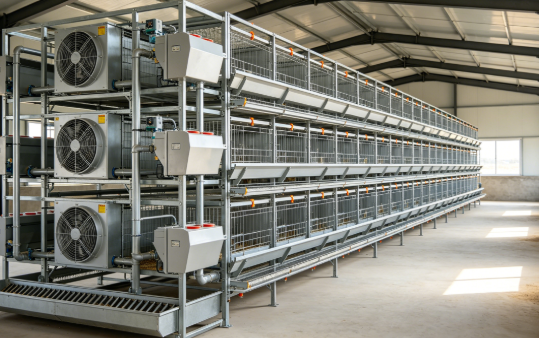
The multi-layer breeding equipment for breeding chickens is a high-density, intensive integrated farming system that stacks multiple layers of cages vertically for housing parent generations of meat breeding chickens. It incorporates five core automated modules to form a comprehensive farm support infrastructure, enabling fully mechanized and intelligent management throughout the entire process, thereby completely replacing scattered manual operations.
Automated Chain Feeding System:
Delivers feed in timed and measured quantities to each layer of chicken cages, ensuring uniform feeding for both roosters and hens with standardized nutrient intake.
Continuous Automatic Egg Collection Belt:
Directly transports laying eggs onto a dedicated conveyor belt for centralized transfer to the sorting area without manual intervention.
Real-time removes fecal waste from beneath chicken cages, eliminating overnight accumulation within the facility.
Intelligent Whole-House Environment Control System:
Interconnects fans, cooling damp curtains, heating units, and light timing devices to precisely regulate required temperature, humidity, and lighting duration for breeding stock. This comprehensive hardware system transforms the previously labor-intensive, manual farming approach into a standardized, automated model with minimal human involvement.
Global Trend in Farm Implementation: Why Breeding Flocks Worldwide Are Increasingly Adopting Multi-Level Cage Systems
Guangxing has delivered multi-level breeding equipment for poultry farming to farmers across Africa, Central Asia, South America, and Southeast Asia. The market adoption rate of this equipment continues to rise rapidly, primarily driven by local breeding demands in these regions.
In Africa: Due to local labor shortages and persistently rising worker wages, fully automated equipment has become essential; numerous medium-sized farms have abandoned conventional ground-based breeding practices to reduce long-term labor costs.
Central Asian countries such as Uzbekistan require large-scale national breeding programs to be supported by high-density, high-capacity infrastructure to ensure adequate local chick supply; multi-tiered cage systems have become standard equipment in tender specifications.
In South American markets such as Brazil, poultry farmers prioritize stable return on investment and capacity expansion. Multi-level cage systems allow increasing the total number of breeding birds without expanding poultry houses, thereby enhancing overall project profitability.
To this day, fully automated multi-layer broiler breeding equipment has become the standard configuration for newly established commercial parent-generation breeding farms worldwide.
According to data from overseas projects we have successfully implemented, standard-scale breeding farms can recoup all equipment procurement costs within just 1 to 2 breeding cycles (1–2 years). After cost recovery, the farms generate annual net revenue growth through reduced operating expenses. The equipment cages are manufactured using hot-dip galvanizing technology, offering a service life of 15 to 20 years with extremely low long-term maintenance and replacement costs.
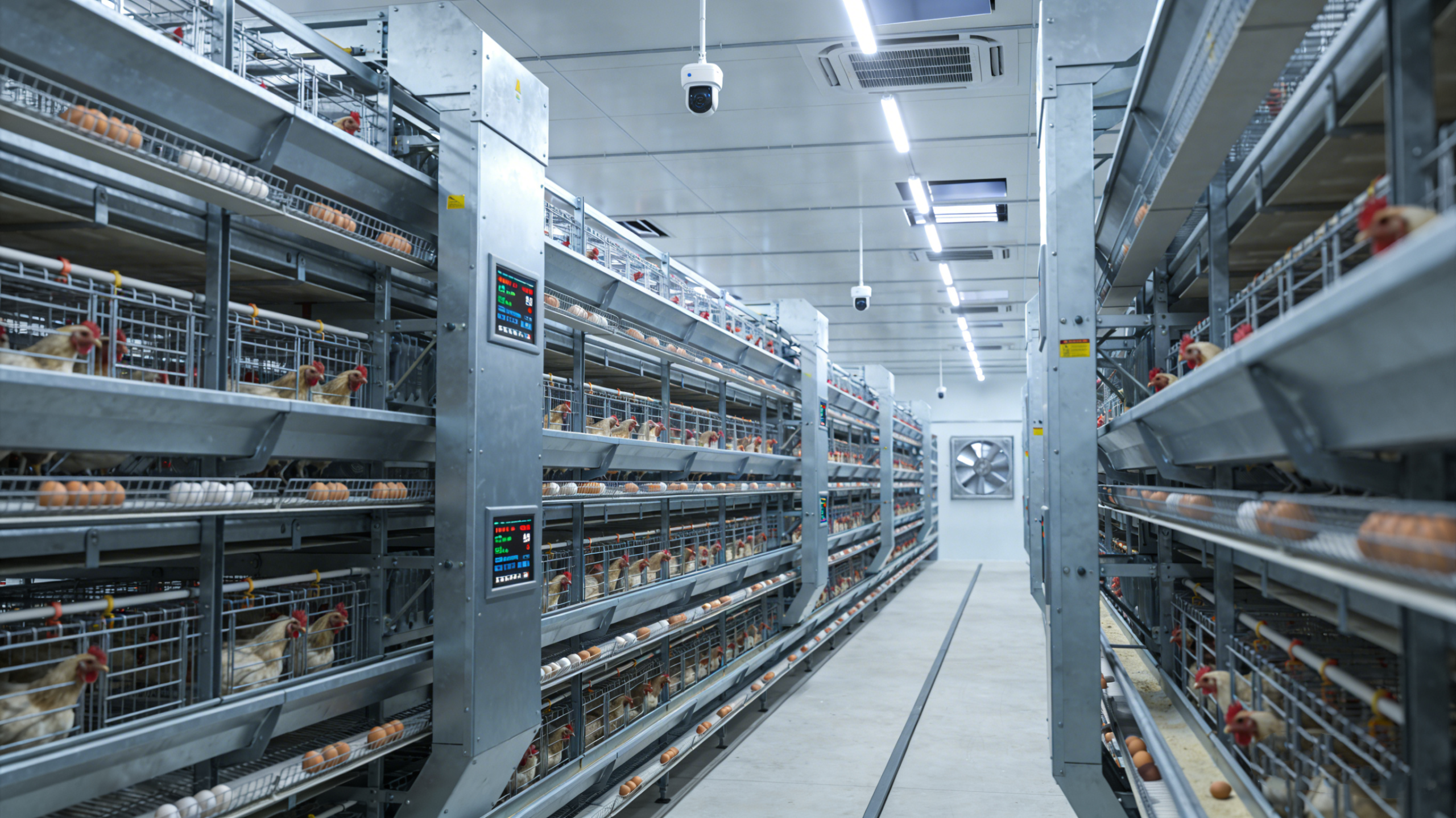
The multi-layer automated broiler and breeding chicken farming system fundamentally addresses the core challenges of traditional poultry farming through a three-dimensional cage layout, a comprehensive automation system, and intelligent environmental control.This equipment not only significantly enhances livestock density under limited land conditions and substantially reduces operational labor costs, but also stabilizes flock performance, improves egg cleanliness and hatching quality. When integrated with automated manure removal systems and intelligent monitoring solutions, it effectively optimizes poultry house environments, lowers mortality rates and disease risks, providing robust support for standardized, precision-based, and intelligent farm management.



