


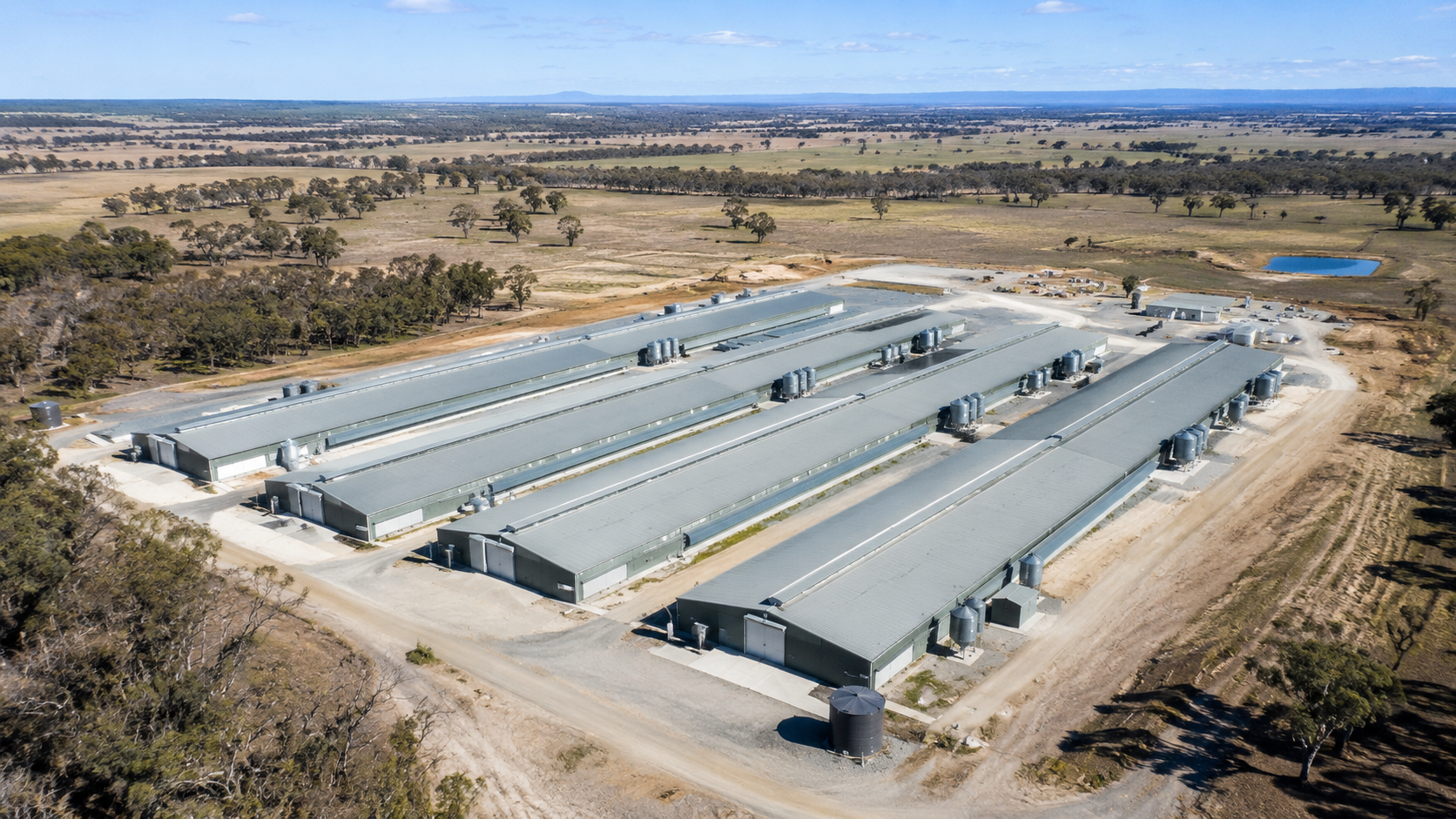
If you are planning a commercial broiler farm in Australia, equipment selection should not begin with a simple list of feeders, drinkers and fans.
Instead, it should begin with the farm itself.
Shed dimensions, bird capacity, local climate, water supply, power reliability and the required level of automation all affect the final equipment configuration. For example, two broiler houses with the same bird capacity may still need different ventilation or cooling systems if they are located in different parts of Australia.
Therefore, when buyers compare broiler farm equipment Australia suppliers, the most useful question is not:
“Who offers the lowest equipment price?”
A better question is:
“Which equipment configuration can keep feed, water, temperature and airflow stable throughout the production cycle?”
That difference matters. Individual equipment may look good on paper. However, if the feeding, drinking, ventilation and control systems do not work together, farm performance can still suffer.
How Are Commercial Broilers Raised in Australia?
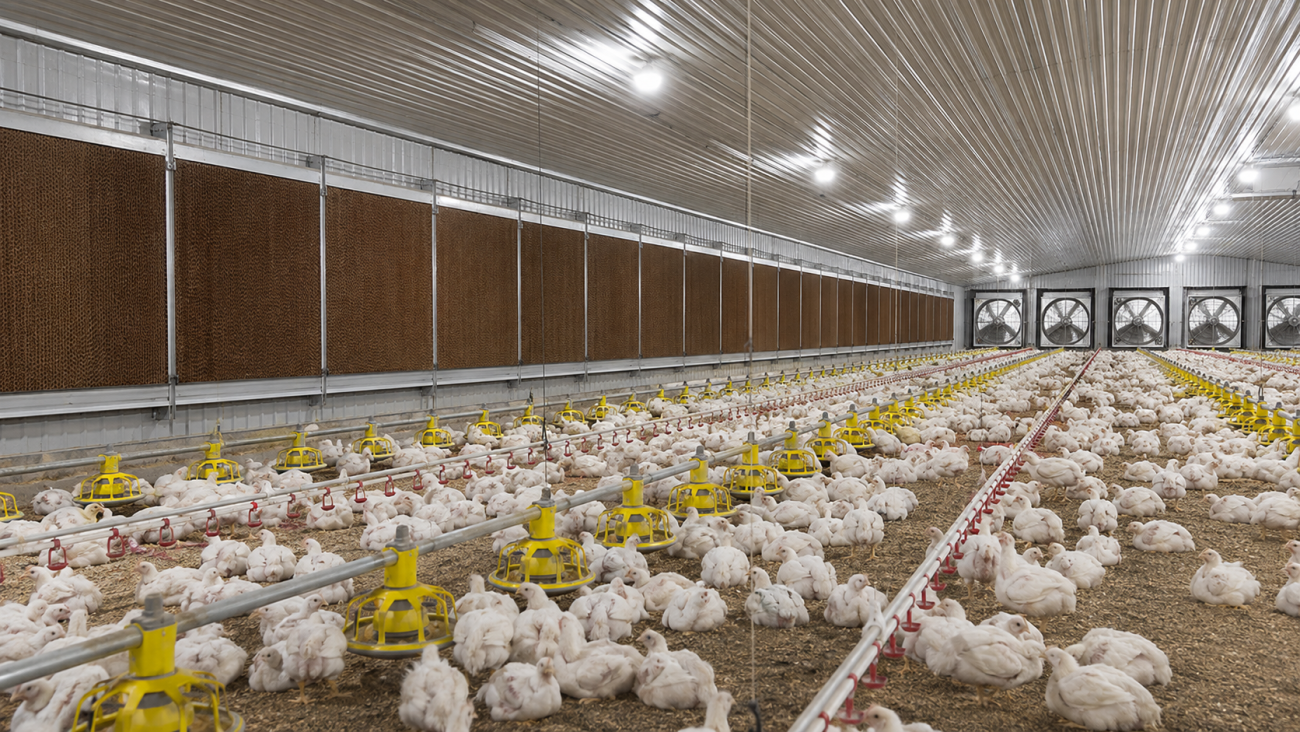
Australian meat chickens are generally raised on the floor inside large poultry sheds rather than in cages.
The floor is usually covered with litter. Meanwhile, feed is supplied through automatic pan feeding systems, while water is delivered through nipple drinking lines.
Depending on farm design and local climate, broiler sheds may use natural ventilation, mechanical ventilation, tunnel ventilation or a combination of these systems.
As a result, a typical commercial broiler project may require:
- bulk feed silos
- feed conveying equipment
- automatic pan feeding lines
- nipple drinking lines
- water filtration and pressure regulation
- heating and brooding equipment
- minimum ventilation
- tunnel ventilation
- evaporative cooling pads where suitable
- environmental controllers and sensors
- poultry house lighting
- alarm systems
- backup power
More importantly, these systems should be planned together.
For larger projects, our 50,000-bird poultry house design guide explains how house dimensions, equipment layout and environmental control can be coordinated at commercial scale.
1. Automatic Feeding System: Start with Bird Distribution
Feed is one of the biggest operating costs on a broiler farm. Therefore, the feeding system deserves more attention than simply comparing feed pan prices.
A typical broiler feeding system follows this process:
Feed silo → feed conveyor or auger → hopper → feed pipe → automatic feed pans
The goal is simple: birds throughout the house should have equal access to feed.
However, this becomes more difficult as the poultry house gets longer.
To maintain even feed distribution, the supplier needs to consider:
- feed-line length
- motor capacity
- pan spacing
- feed conveying capacity
- number of feed lines
- suspension height
For example, a feeding system designed for a short broiler house should not simply be extended to a much longer shed without checking motor and conveying capacity.
Therefore, when requesting a quotation, ask the supplier to show how many feeding lines and pans are proposed for each poultry house.
In addition, farms that want centralized feed storage can consider an automatic poultry feeding system connected to outdoor silos and feed conveying equipment.
2. Nipple Drinking System: Water Quality Affects Litter Quality
The drinking system may look simpler than the ventilation system.
However, poor water management can quickly create problems.
Too much pressure may increase leakage. As a result, litter becomes wetter. On the other hand, pressure that is too low may limit water access for birds at the end of the line.
A complete drinking system normally includes:
- main water supply
- water tank
- filtration
- medication equipment
- pressure regulator
- water meter
- drinking pipes
- nipple drinkers
- flushing devices
- lifting equipment
Water quality also needs attention.
For example, bore water may require different filtration from municipal water. Therefore, the supplier should understand the actual farm water source before finalizing the system.
Before choosing equipment, I would ask three simple questions:
How many birds are allocated per nipple?
How is water pressure controlled across the full line?
How easily can the system be flushed between flocks?
These questions are simple. Nevertheless, the answers often show whether the supplier understands commercial broiler production.
You can also review our guide to poultry nipple drinking systems when comparing different watering configurations.
3. Ventilation Is One of the Most Important Broiler House Systems
Ventilation should never be treated as a secondary accessory in a commercial broiler project.
As chickens grow, they produce more heat and moisture. At the same time, the house must remove carbon dioxide, ammonia and dust.
During brooding, the house normally starts with minimum ventilation.
At this stage, the objective is to bring in enough fresh air without losing too much heat.
Later, as the birds grow, ventilation demand increases. The system may then move from minimum ventilation to transition ventilation and finally to tunnel ventilation.
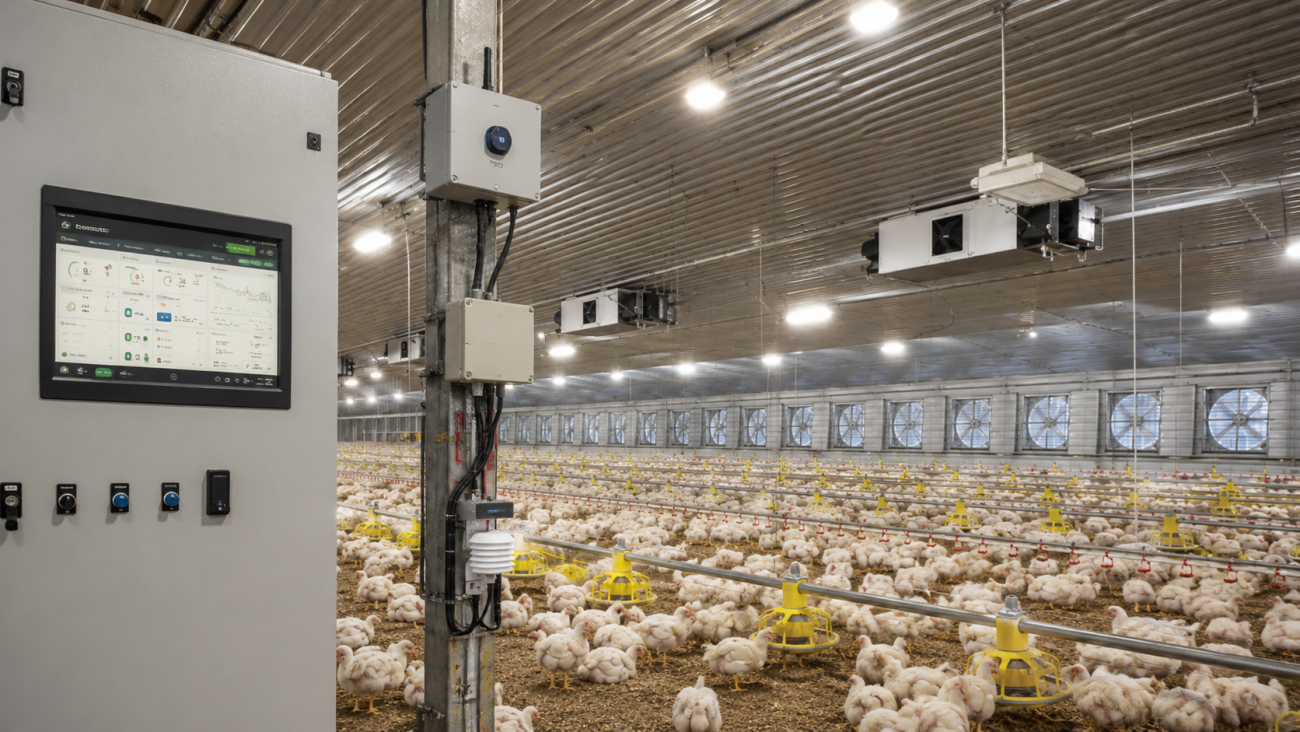
A tunnel ventilation system commonly includes:
exhaust fans + controlled air inlets + negative pressure + cooling pads + environmental controller
However, simply installing more fans does not guarantee better airflow.
The supplier should also calculate:
- total airflow requirement
- target air velocity
- fan performance under static pressure
- tunnel inlet area
- cooling-pad area
- house length
- house cross-sectional area
For this reason, ventilation design should always be based on the real shed dimensions.
For more detail, see our guide to ventilation systems for poultry houses.
4. Cooling Equipment Must Match the Local Australian Climate
Australia has very different climate conditions from one region to another.
For example, conditions in Queensland may be very different from those in Victoria, inland New South Wales or Western Australia.
Therefore, one cooling specification cannot suit every broiler farm.
In hot regions, many closed broiler houses use:
tunnel ventilation + evaporative cooling pads
The cooling pads reduce incoming air temperature through evaporation. At the same time, tunnel fans move the air through the house.
However, more fans and larger cooling pads do not always mean better cooling.
If the air inlets are badly designed, or if the poultry house has too many air leaks, airflow may not reach the birds correctly.
As a result, even expensive equipment may perform below expectations.
Therefore, before recommending fan and cooling-pad quantities, the supplier should know at least:
farm location + shed dimensions + bird capacity
This information allows the system to be sized more accurately.
In addition, our guide on reducing poultry mortality during hot seasons explains how ventilation, cooling and environmental control work together during hot weather.
5. Environmental Controllers Connect the Whole System
Once a broiler house depends on mechanical ventilation, the environmental controller becomes one of the most important parts of the system.
The controller can manage:
- temperature
- humidity
- ventilation stages
- air inlets
- negative pressure
- heating
- cooling
- lighting
- alarms
More advanced farms may also monitor water consumption, carbon dioxide and equipment status.
The purpose is not only to turn fans on and off.
Instead, a good controller helps the farm respond to changing conditions automatically.
For example, if house temperature rises, the controller can increase fan stages. If temperature continues to rise, the cooling system can then start.
In addition, abnormal water use or sensor readings can help farm staff identify problems earlier.
Therefore, environmental control should be considered part of the production system, not just an electrical accessory.
6. Heating and Brooding Still Matter in Australia
Australia is often associated with hot-weather poultry management.
However, brooding still requires careful heating.
Day-old chicks need:
- suitable air temperature
- warm floor conditions
- fresh air
- easy access to feed
- easy access to water
Depending on local fuel availability, farms may use gas brooders, space heaters or other heating systems.
However, heating should not be designed separately from ventilation.
If ventilation is too low, humidity and air quality may become a problem. On the other hand, excessive ventilation wastes heat and increases fuel use.
Therefore, the goal is to maintain a balance between fresh air and heat retention.
7. Backup Power and Alarm Systems Are Essential
Backup power should not be treated as an optional item in a mechanically ventilated broiler house.
During hot weather, ventilation can become critical very quickly if electricity fails.
Therefore, commercial farms should consider:
- backup generators
- automatic transfer switches
- high-temperature alarms
- power-failure alarms
- controller alarms
- emergency ventilation
In addition, these systems should be discussed before equipment manufacturing begins.
Otherwise, the project team may only discover during installation that the generator, alarm system or electrical interface is not included in the supplier’s scope.
As a result, project costs and installation time may increase.
8. Design the Equipment Around the Actual Shed
One common purchasing mistake is to select poultry equipment first and then try to fit it into the shed.
Instead, the shed should determine the equipment layout.
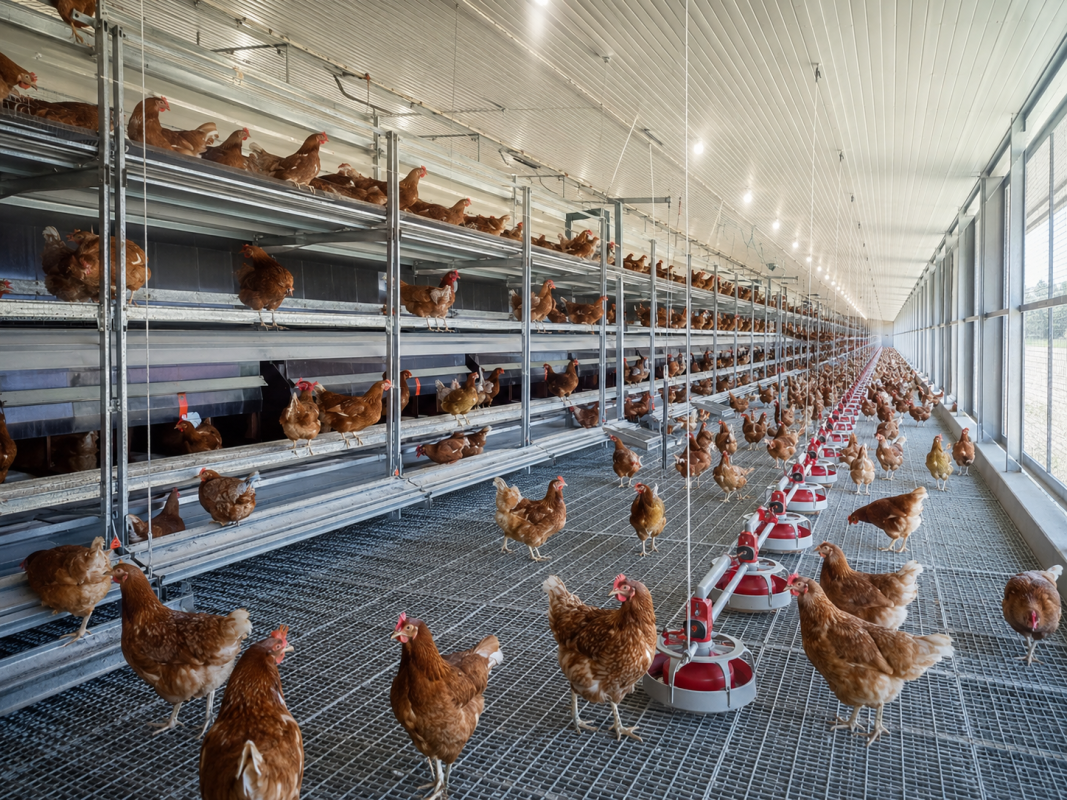
Before requesting a final broiler farm equipment Australia quotation, provide the supplier with the following information:
| Project Information | Why It Matters |
|---|---|
| Farm location | Determines climate and cooling needs |
| Number of sheds | Affects central equipment planning |
| Shed length × width × height | Determines equipment layout |
| Birds per shed | Determines system capacity |
| Production system | Affects conventional or free-range design |
| Water source | Affects filtration and drinking design |
| Electrical supply | Affects motors and controls |
| Backup power | Protects ventilation |
| Automation level | Determines equipment configuration |
| Expansion plan | Helps future system planning |
For example, a 40,000-bird house and a 60,000-bird house should not automatically use the same feed-line quantity, drinking-line layout or fan configuration.
Therefore, farm data should come before equipment selection.
For larger projects, our 50,000-bird broiler farm equipment guide provides another useful reference.
9. What Should Australian Buyers Check Before Choosing a Supplier?
Price is important.
However, the lowest total quotation does not always offer the lowest long-term cost.
Therefore, buyers should compare the details behind each system.
Feeding System
Check:
- silo capacity
- conveying capacity
- motor specifications
- number of feed lines
- number of pans
Drinking System
Check:
- nipple quantity
- water filtration
- pressure regulation
- flushing equipment
- spare nipples
Ventilation System
Check:
- fan airflow
- static-pressure performance
- fan quantity
- inlet configuration
- cooling-pad dimensions
Control System
Check:
- sensor quantity
- alarm functions
- control stages
- expansion capacity
Electrical Requirements
Before manufacturing begins, confirm voltage, frequency, motor requirements and electrical protection.
Spare Parts
In addition, identify important spare parts before shipment.
These may include:
- motors
- sensors
- controller parts
- nipple drinkers
- switches
- other wear parts
A small spare-parts package may look like an extra cost at first.
However, it can save much more money if a small component fails during production.
For buyers who want one supplier to coordinate design, equipment and installation support, a turnkey poultry farm project solution can also reduce the number of separate project interfaces.
10. Check Australian Welfare and Local Requirements
Equipment design should also consider the local rules that apply to the farm.
Australia has national poultry welfare standards. However, implementation and legal requirements are managed by individual states and territories.
Therefore, project owners should also check the rules in the specific location where the broiler farm will operate.
In addition to poultry welfare requirements, a new project may need to consider:
- planning approval
- environmental requirements
- electrical standards
- building requirements
- water management
- waste management
For this reason, the final equipment layout should not be confirmed before local project requirements are reviewed.
Does Every Broiler Farm Need Full Automation?
No.
A smaller broiler farm with reliable labour may not need the same level of automation as a large multi-shed project.
However, as farm size increases, automation becomes more valuable.
It can help maintain more consistent:
feeding + drinking + ventilation + cooling + monitoring
across several houses.
Therefore, automation should be selected according to farm scale, labour cost, management experience and future plans.
Expansion is another important point.
For example, if the farm may add another two or four sheds in the future, feed storage, water supply, electrical systems and controllers can be designed with extra capacity from the beginning.
As a result, future expansion may require fewer changes to the original system.

Planning Broiler Farm Equipment for an Australian Project
A reliable broiler farm does not depend on one expensive piece of equipment.
Instead, performance depends on how well all the systems work together.
Shed dimensions determine equipment layout.
Bird capacity determines feeding, drinking and ventilation demand.
Local climate affects ventilation and cooling design.
Water quality influences the drinking system.
Power reliability determines backup requirements.
Therefore, commercial broiler equipment should be configured around actual farm conditions rather than supplied as a standard package.
For an Australian broiler project, the equipment scope may include:
- automatic pan feeding
- feed storage and conveying
- nipple drinking
- tunnel ventilation
- cooling pads
- environmental controllers
- lighting
- electrical control
- poultry house equipment
- steel-structure poultry houses
- project layout and system planning
If you are planning a new broiler farm or upgrading an existing poultry shed in Australia, start with three basic details:
1. Farm location in Australia
2. Poultry house dimensions (L × W × H)
3. Target number of broilers per house
In addition, you can provide the number of sheds, water source, electrical supply and preferred automation level.
With this information, the feeding, drinking, ventilation and cooling systems can be discussed more accurately.
Planning a commercial broiler project in Australia? Send your shed dimensions and target capacity to Guangxing for an equipment configuration and project quotation.



