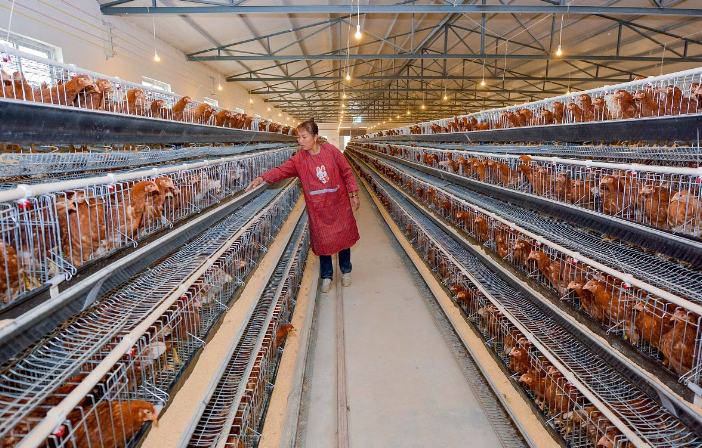
If you are planning a new commercial layer farm, the first question should not be, “How many tiers can I install?”
Start with the farm itself.
How many layers do you plan to house? How wide and high is the poultry house? How much labor do you want to reduce? How will eggs and manure leave the building? Can the ventilation system handle the planned stocking capacity?
These questions matter because an
H type layer chicken cage is not simply a taller version of a conventional cage. It is part of an integrated production system in which cages, feeding, drinking, manure removal, egg collection, ventilation and controls must work together.
For a well-designed project, the advantage of an H-type system is not just that more birds fit inside the house. The real value is the ability to manage a larger flock with a more organized and automated production process.
What Is an H-Type Layer Chicken Cage?
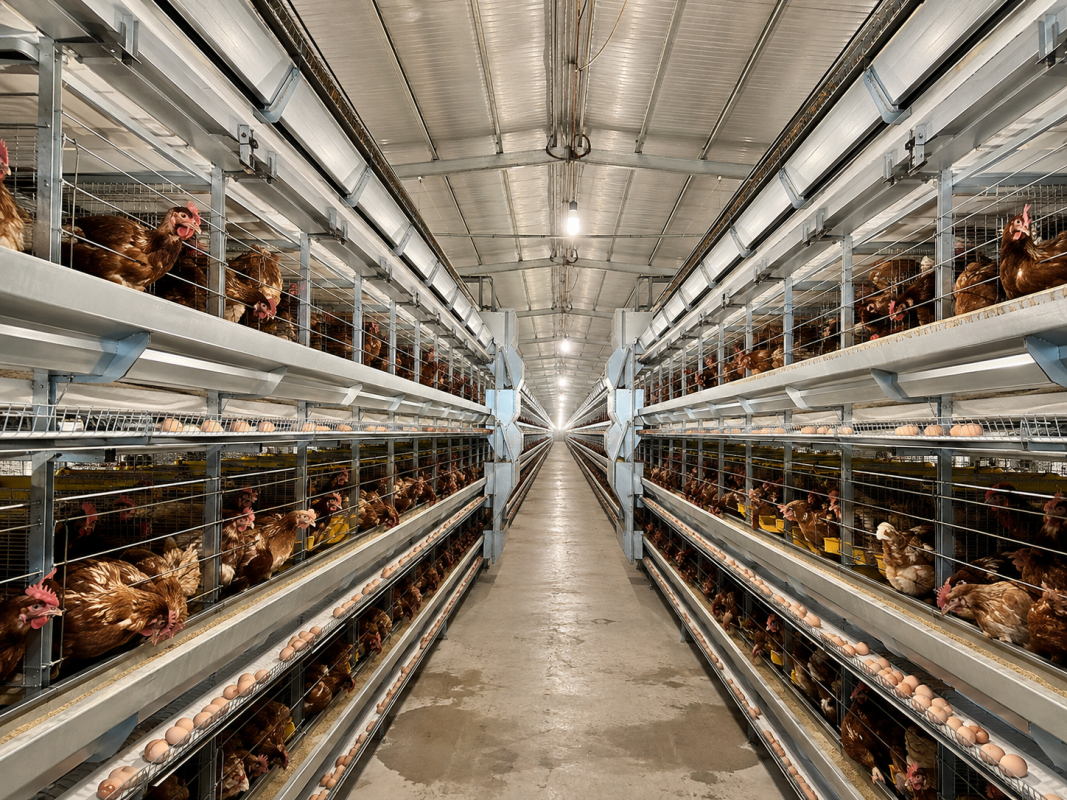
An H-type layer cage is a vertically stacked poultry housing system developed mainly for medium and large commercial egg farms.
Viewed from the end of a cage row, the supporting structure and vertically arranged cage tiers form a shape similar to the letter “H,” which gives the system its name.
Unlike traditional stepped cages, the tiers are positioned directly above one another. This allows much more of the poultry house height to be used for production.
A complete
Guangxing H-Type Automatic Layer Cage System can integrate automatic feeding, nipple drinking, manure removal and egg collection into the same cage layout.
This integration is important.
If you are operating tens of thousands of layers, manually feeding birds, collecting eggs and cleaning manure from every row quickly becomes expensive and difficult to manage consistently.
The H-type system is designed to move these repetitive jobs from manual operation toward mechanized or automatic operation.
How Does an H-Type Layer Cage System Work?
The cage itself is only the framework where the birds are housed. The real operating system is built around it.
Feed is delivered from the feed storage and conveying system to each cage row. A feeding machine distributes feed along the troughs so birds on different tiers receive feed consistently.
Nipple drinking lines run through the cage rows and provide water directly to the birds.
After a hen lays an egg, the cage floor allows the egg to roll gently toward the egg belt. The belt moves eggs toward the end of the row, where they can enter an elevator or central collection conveyor.
You can see the complete process in Guangxing’s
Automatic Egg Collection System.
Below every cage tier, a manure belt receives manure directly from the birds. Instead of allowing manure to accumulate underneath the cage for a long period, the belt periodically carries it out of the poultry house.
This type of
manure belt system becomes increasingly important as stocking density increases because manure volume also rises with farm capacity.
The result is a production flow in which feeding, drinking, egg collection and manure removal can be managed systematically rather than as separate manual jobs.

The Number of Cage Tiers Should Follow the Poultry House Design
One of the most common questions we receive is:
“Should I choose four tiers, six tiers or eight tiers?”
There is no useful answer without first looking at the poultry house.
More tiers increase bird capacity, but they also increase the demands placed on ventilation, structural support, maintenance access, manure handling and egg transportation.
For example, adding extra tiers to a house with limited internal height may leave insufficient space above the cages. This can affect airflow and make maintenance more difficult.
The same applies to house width.
A theoretical layout may allow several cage rows to fit inside the building, but if the aisles become too narrow, workers may struggle to inspect birds, repair equipment or remove components when maintenance is required.
This is why we normally confirm the
poultry house length, width, clear height and target bird capacity before finalizing the number of tiers and rows.
A cage layout should fit the building. The building should not be forced to accept the maximum possible number of cages.
When Does an H-Type Layer Cage Make Sense?
H-type systems become more attractive as farm scale and labor pressure increase.
For a relatively small layer farm, especially where labor is readily available and the initial investment budget is limited, a simpler cage system may still make more financial sense.
As the flock moves toward 30,000, 50,000 or more layers, the situation changes. Feeding every row manually becomes more difficult, egg collection requires more labor, and manure handling becomes a larger daily task.
For projects around this scale, it is useful to compare a multi-tier system with a more traditional arrangement. Our
50,000-Bird Poultry House Design Guide explains how cage systems, feeding, drinking, egg collection and manure removal need to be considered together.
For farms above 100,000 layers, especially multi-house projects, centralized automation usually becomes even more important. At that scale, the question is no longer simply how many cages you can buy. The project must consider feed delivery, central egg transport, manure discharge, environmental control, backup power and equipment maintenance across the entire site.
H-Type vs. A-Type Layer Cages
H-type cages are not automatically better for every farm.
An
A-Frame Layer Cage uses a stepped arrangement. The structure is relatively simple, ventilation between cage levels is straightforward, and it can be a practical choice for small and medium farms or existing poultry-house renovation.
The main difference is how each system uses space and automation.
| Factor |
A-Type Layer Cage |
H-Type Layer Cage |
| Structure |
Stepped |
Vertically stacked |
| Space utilization |
Moderate |
High |
| Typical project scale |
Small to medium |
Medium to large |
| Automation potential |
Manual to automatic |
Usually highly automated |
| Initial investment |
Lower |
Higher |
| Labor requirement |
Depends on configuration |
Lower with full automation |
| Manure handling |
Ground, scraper or belt options |
Belt under each tier |
| Egg collection |
Manual or automatic |
Usually automatic |
| Ventilation demand |
Relatively simple |
Requires careful engineering |
| Best use |
Budget-sensitive or existing houses |
High-capacity commercial farms |
If land is available and labor costs are low, an A-type project may still be a sensible investment.
If poultry-house space is limited and the long-term goal is higher automation with less dependence on manual labor, H-type deserves closer consideration.
The correct choice depends on operating conditions rather than which system appears more advanced.
Ventilation Is One of the Most Important Parts of an H-Type Project
This is an area buyers sometimes underestimate.
If you double the number of birds inside the same building, you also increase heat, moisture, carbon dioxide and manure output. A high-density cage layout therefore cannot be designed independently from the ventilation system.
Air must reach different rows and cage levels without creating large temperature differences inside the house.
In a closed poultry house, this may require coordinated use of exhaust fans, air inlets, minimum ventilation, tunnel ventilation, cooling equipment and environmental controllers.
The specific design depends heavily on climate.
A farm in a hot, humid region will have very different summer requirements from a farm operating through cold winters.
That is why copying the fan quantity from another project is risky. Ventilation should be calculated around the house dimensions, bird numbers, cage arrangement and local weather conditions.
If an equipment supplier sends a high-density cage layout without asking about ventilation, that is something worth questioning.
Automatic Feeding Should Be Judged by Uniformity and Maintenance
Automation is useful only when it works reliably every day.
An automatic feeding system should distribute feed consistently along long cage rows without excessive spillage or large differences between sections.
Guangxing’s H-type system is designed to integrate automatic feed distribution with the cage structure, while its broader
automatic poultry feeding guidance explains why large farms often move away from manual feeding as capacity increases.
Before approving a feeding system, we suggest asking practical questions.
How is the feeder driven? What happens if one motor stops? Can a single row be repaired without stopping the entire house? Which spare parts should remain on site? How is feed distribution adjusted?
These details rarely appear in the headline of a quotation, but they matter every day after the farm begins operating.
Egg Collection Is About More Than Saving Labor
Egg collection is another reason many large layer farms choose H-type systems.
In a multi-tier poultry house, collecting eggs manually from every level would be slow and increase handling.
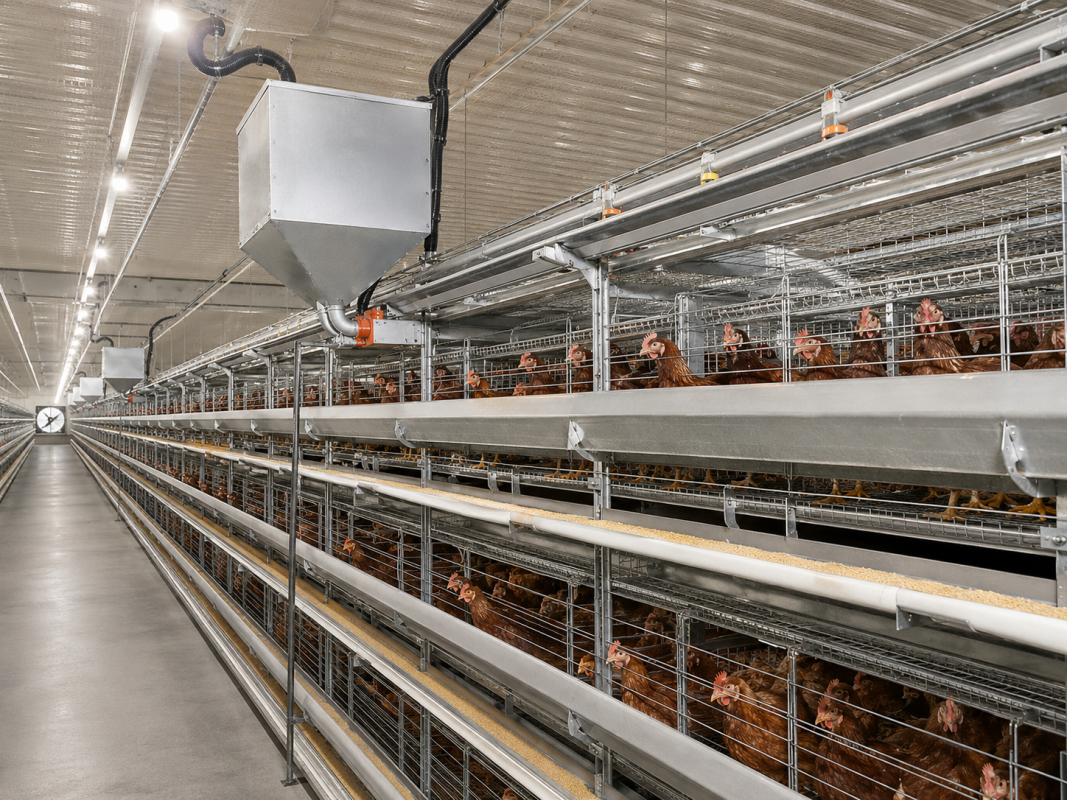
With automatic collection, eggs roll onto belts and move toward a collection point or central conveyor.
Guangxing’s egg collection equipment uses buffered conveying to reduce unnecessary collisions during transportation, and the system can be customized for multi-row and multi-tier farms.
But good egg handling depends on more than the belt itself.
Cage-floor angle, belt speed, transfer points, elevator alignment and central conveyor routing all affect the final result.
For a large project, the route from the hen to the packing room should therefore be planned before the equipment is manufactured.
Manure Removal Cannot Be Added as an Afterthought
Every additional tier produces additional manure.
In an H-type system, a manure belt below each tier allows waste to be removed regularly instead of accumulating inside the poultry house.
This helps keep the production area cleaner and makes downstream manure handling more organized.
But the design must continue beyond the cage row.
Where does the manure go after leaving the house?
Will it enter a cross conveyor, manure storage area or treatment system? Is there enough space outside the building for vehicles or further processing equipment?
These are project-layout questions, not cage questions.
If they are ignored at the beginning, manure discharge can become a bottleneck after the farm starts operating.
What Buyers Often Underestimate Before Ordering
The cage price is easy to compare. The hidden operating issues are harder.
A large H-type project should be reviewed as one system rather than several pieces of equipment.
Before placing an order, pay particular attention to
ventilation capacity, backup power, aisle space, egg-conveyor routing, manure discharge, electrical standards, spare-parts availability, installation access and future expansion.
For example, a fully automated house depends on electricity. If the farm is located in an area with unstable power, a backup generator and emergency ventilation plan are not optional details.
Likewise, if a motor or sensor fails during production, waiting several weeks for a small spare part can create more operational trouble than the original part cost would suggest.
Good project planning tries to solve these problems before the first bird enters the house.
How Much Does an H-Type Layer Cage System Cost?
There is no responsible fixed price for an H-type system without project information.
Two farms with 50,000 layers can receive very different quotations.
One may use an existing poultry house with basic automation. Another may be a new closed house requiring cages, automatic feeding, egg collection, manure removal, ventilation, environmental controls, feed silos and installation support.
The final cost therefore depends on cage configuration, tier number, house dimensions, automation level, local climate, electrical requirements, shipping terms and installation scope.
For this reason, it is more useful to compare complete configurations than cage prices alone.
A low quotation may exclude important equipment. A higher quotation may include systems that your farm does not actually need.
The goal is not to buy the cheapest cage. It is to build a system that you can operate reliably over many production cycles.
What Information Should You Send Before Requesting a Quote?
For a meaningful H-type layer cage proposal, prepare the following information before contacting the supplier:
- Project country and location
- Planned number of layers
- Poultry house length, width and clear height
- New construction or existing house
- Desired automation level
- Local climate conditions
- Available power supply and backup power
- Egg collection and packing requirements
- Manure handling plan
- Installation requirements
- Expected future expansion
With these details, an equipment manufacturer can begin working on an actual layout rather than sending a generic cage price.

Final Thoughts
An
H type layer chicken cage can be an effective solution for medium and large commercial egg farms, but its value comes from more than vertical cage stacking.
The system works best when cage layout, feeding, drinking, egg collection, manure removal and ventilation are designed as one project.
If your priority is simply the lowest initial investment, an H-type system may not always be the right answer.
If your goal is to operate a larger flock within limited poultry-house space, reduce repetitive manual work and build a more centralized production system, it is worth evaluating carefully.
Start with the farm dimensions and production target.
Then decide the equipment.
If you are planning an H-type layer project, you can send Guangxing your
bird capacity, poultry-house dimensions, project location and required automation level. The engineering team can use these details to evaluate the cage layout and supporting equipment before preparing a quotation.
For a commercial egg farm, the right layout on day one can prevent many expensive problems later.