If you are planning a commercial poultry farm, studying the world’s leading poultry markets can be more useful than simply asking which country raises the most chickens.
Production volume tells only part of the story.
For example, the United States has one of the world’s largest broiler industries. Brazil combines high chicken production with a powerful export network. China operates both large poultry-meat businesses and highly automated egg farms. Meanwhile, other markets stand out because of climate management, animal-welfare systems or rapid farm modernization.
Therefore, instead of trying to name one country as the “most developed,” it is more useful to ask:
What does each leading poultry market do well, and what can your own farm project learn from it?
According to the USDA Foreign Agricultural Service, global chicken meat production is forecast to reach approximately 110.7 million metric tons in 2026. Several major poultry-producing countries are expected to continue expanding production.
Meanwhile, the Food and Agriculture Organization of the United Nations (FAO) reports that world egg production reached about 100 million tonnes in 2024, with hen eggs accounting for around 94% of total egg production.
Together, these figures show how large and modern the global poultry industry has become.

Which Countries Produce the Most Chicken Meat?
USDA’s 2026 forecast places the United States, China and Brazil well ahead of most individual countries in chicken meat production.
| Country | 2026 Chicken Meat Production | Main Strength |
|---|---|---|
| United States | About 22.2 million MT | Large-scale broiler production |
| China | About 17.3 million MT | Large production base and automation |
| Brazil | About 15.8 million MT | Production and export efficiency |
| Russia | About 5.1 million MT | Large domestic poultry industry |
| Mexico | About 4.3 million MT | Strong domestic chicken market |
| Thailand | About 3.6 million MT | Export-oriented poultry production |
In addition, the European Union remains a major regional producer, with production of roughly 12 million metric tons.
However, production rankings alone do not tell you how to build a successful poultry farm.
For an investor or farm owner, the more useful question is how these markets manage feeding, drinking, ventilation, housing, manure and labor at large scale.
United States: Large-Scale Broiler Production
The United States is a useful reference for anyone planning a large commercial broiler farm.
Modern broiler production usually relies on connected systems rather than separate pieces of equipment.
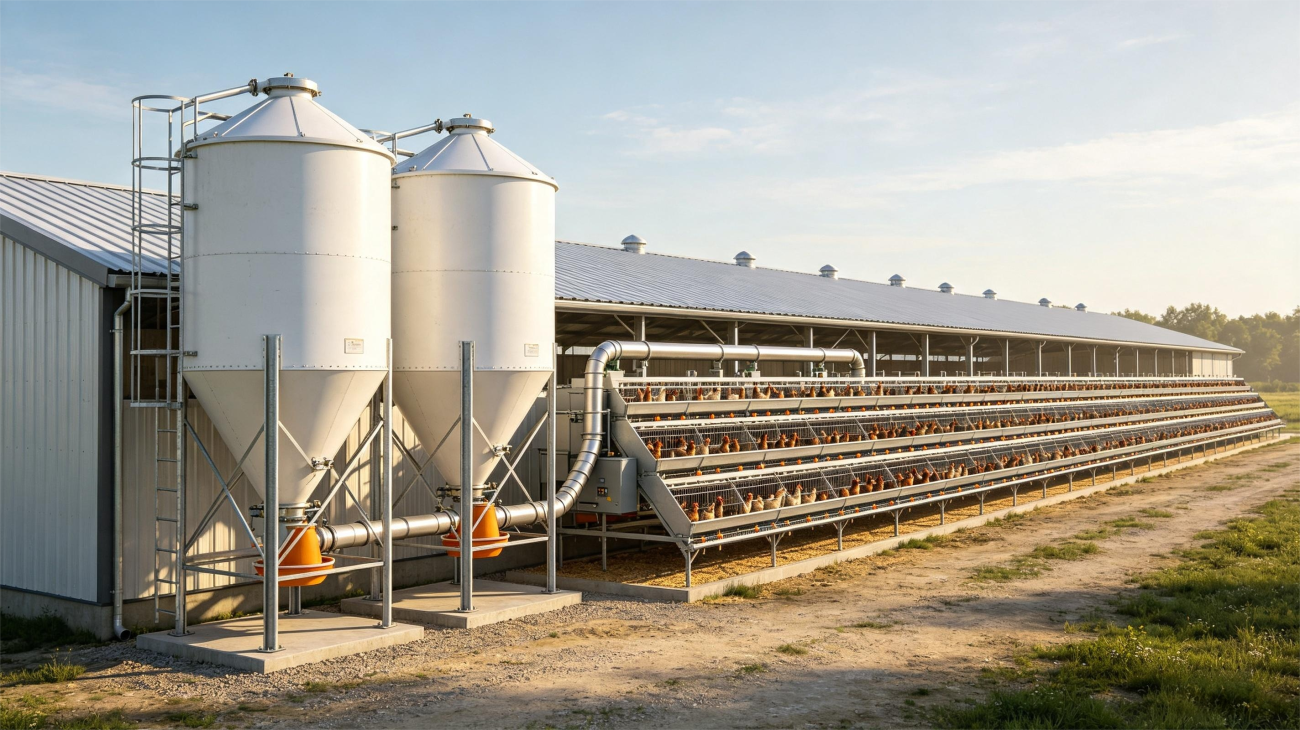
A commercial poultry house may include:
- Feed silos
- Automatic pan feeding
- Nipple drinking lines
- Brooding and heating
- Tunnel ventilation
- Cooling systems
- Environmental controllers
- Lighting
- Alarm systems
- Backup power
The main lesson is not simply that American poultry houses are large.
Instead, feeding, water supply, ventilation and environmental control are planned around the expected bird capacity.
For example, if a farm increases stocking capacity without increasing ventilation or feed-distribution capacity, daily management becomes more difficult.
Therefore, a 100,000-bird farm should not simply copy the equipment configuration of a 30,000-bird operation.
If you are planning a large broiler project, link this section to your 50,000-Broiler Farm Equipment Guide so buyers can continue into a practical equipment configuration.
Ultimately, a larger poultry house only works when the supporting systems grow with it.
China: Large Layer Farms and Poultry Automation
China is one of the world’s largest poultry markets and plays an especially important role in egg production.
FAO continues to identify China as the world’s leading egg-producing country. At the same time, USDA expects China to remain one of the largest chicken-meat producers in 2026.
For commercial layer investors, China provides a useful example of how automation can support very large flocks.
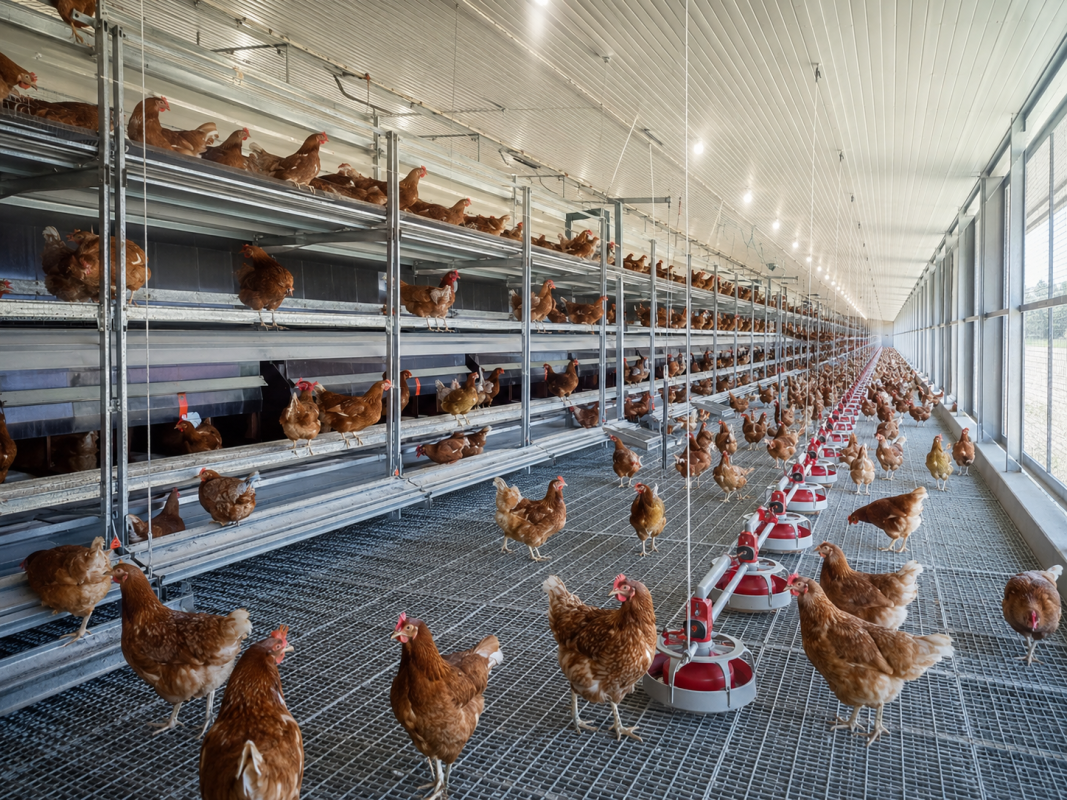
Large layer farms increasingly use:
- Multi-tier housing
- Automatic feeding
- Nipple drinking
- Manure belts
- Automatic egg collection
- Central egg conveying
- Ventilation
- Environmental control
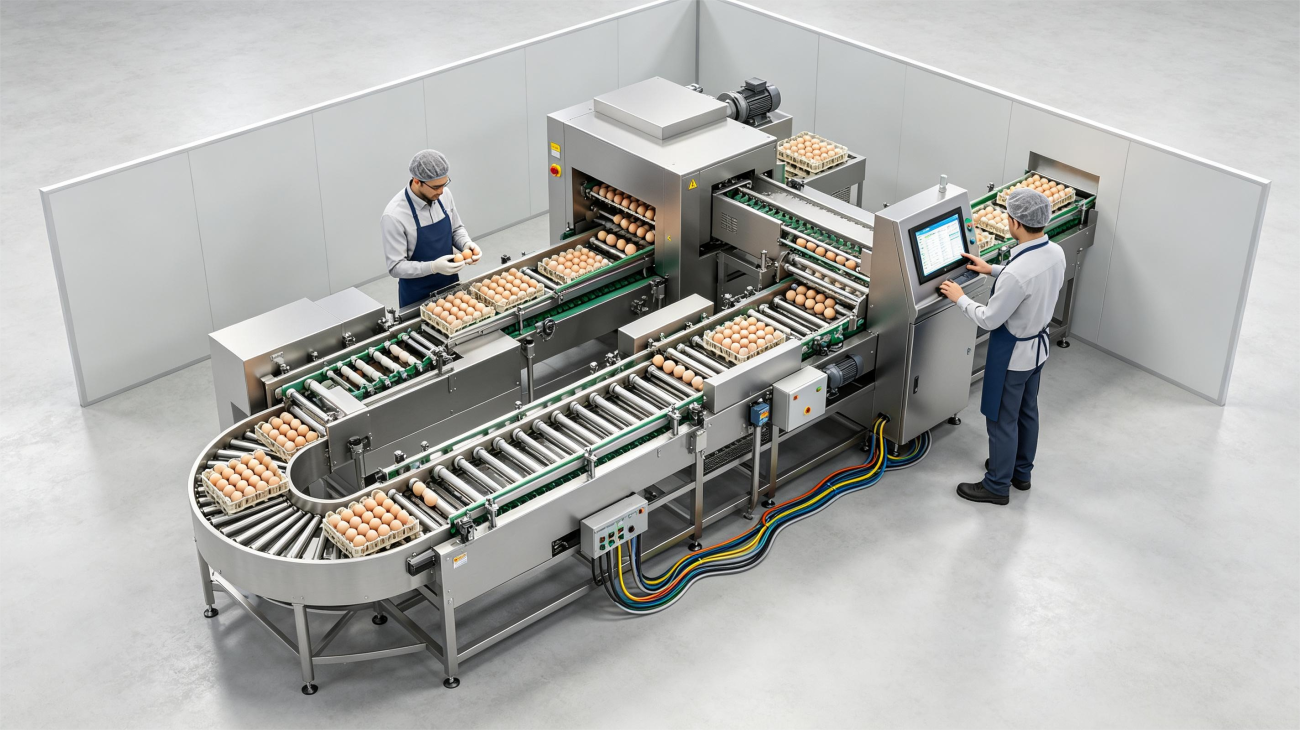
For example, Guangxing’s H-Type Automatic Layer Cage System combines housing with automatic feeding, drinking, manure removal and egg collection for medium and large commercial egg farms.
However, more cage tiers do not automatically create a better farm.
As bird numbers rise, heat, humidity and manure output also increase. Therefore, ventilation capacity, aisle space, egg-conveyor routing and manure discharge should be checked before the final cage layout is confirmed.
In addition, buyers who are still comparing A-type and H-type systems can continue to the Layer Chicken Cage System Guide for a broader selection comparison.
For large layer projects, high stocking capacity only creates value when the rest of the poultry-house systems can support it.
Brazil: Poultry Production Built Around Export Efficiency
Brazil stands out because it combines large production volumes with one of the strongest poultry export industries in the world.
According to the Brazilian Animal Protein Association (ABPA), Brazil produced approximately 15.289 million tonnes of chicken meat in 2025 and exported about 5.324 million tonnes.
As a result, Brazil remained the world’s largest chicken-meat exporter and one of its largest producers.
However, Brazil’s competitiveness does not come from farm size alone.
Its poultry industry also depends on:
- Feed availability
- Efficient broiler production
- Integrated farm management
- Processing capacity
- Biosecurity
- Export logistics
- Cost control
For a new farm investor, this creates an important lesson.
Uniform feed distribution, clean drinking water and stable poultry-house temperatures all affect flock performance. In turn, flock performance affects production cost.
Therefore, even if your farm will only serve a domestic market, many of the same operating principles still apply.
Thailand: Poultry Farming in a Hot and Humid Climate
Thailand produces less chicken meat than the United States, China or Brazil. However, it remains an important player in international poultry trade.
More importantly, Thailand offers useful lessons for farms operating in hot and humid climates.
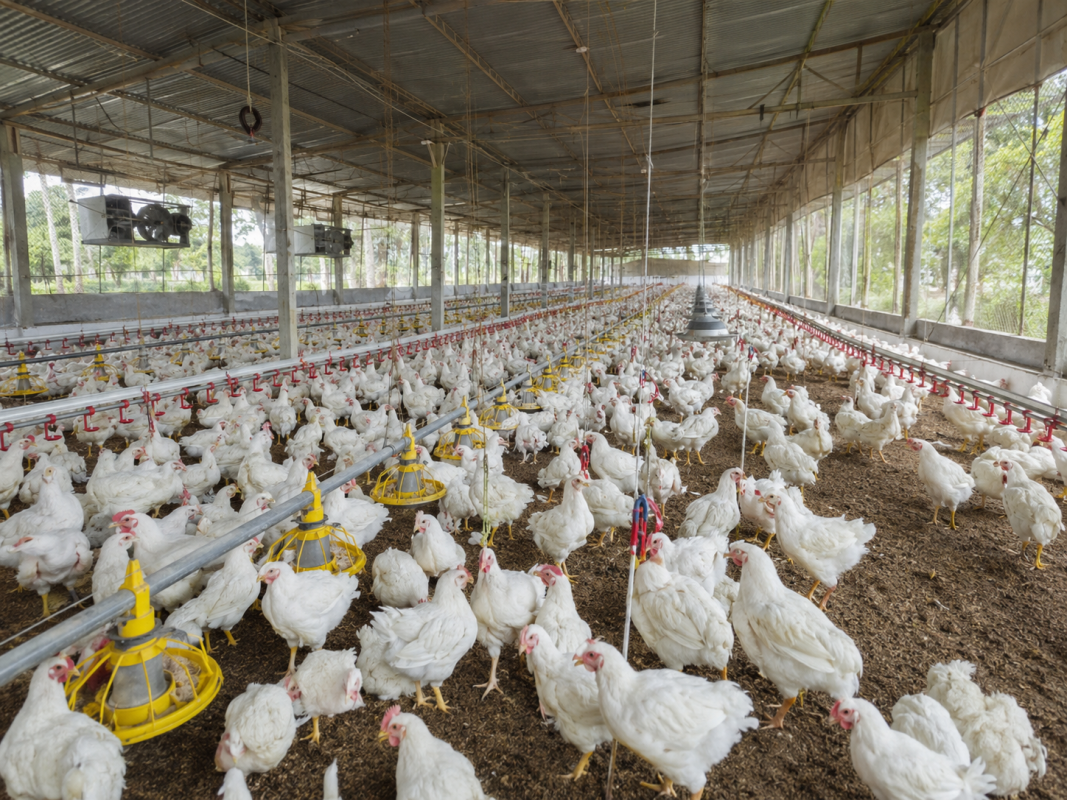
Commercial poultry houses in these conditions need to pay close attention to:
- Air velocity
- Tunnel ventilation
- Cooling
- Drinking-water availability
- Stocking density
- Temperature
- Backup power
For example, a poultry house designed for a mild European climate may perform poorly if a farm copies the same design into a tropical region.
Therefore, climate should become a design input from the beginning.
If high temperature is one of your customer’s main concerns, link this section to your article on Reducing Poultry Mortality During Hot Seasons.
That internal link gives the reader a practical next step instead of ending the discussion at a general climate statement.
India: Different Farm Sizes and Gradual Automation
India is another major poultry and egg-producing market.
One of its most useful characteristics is the wide range of farm sizes.
Small farms continue to operate alongside increasingly large commercial poultry businesses. As capacity increases, many farms gradually replace manual work with more automated equipment.
For example, a farm may first introduce nipple drinking and mechanical feeding. Later, it may add manure removal, egg collection and environmental monitoring.
Therefore, poultry automation does not always need to happen in one step.
A 10,000-layer farm and a 100,000-layer farm have very different investment and labor requirements.
For smaller farms, controlling initial cost may remain the priority.
By contrast, larger farms often gain more value from reducing repetitive labor and centralizing daily management.
This is why the right automation level should follow farm size rather than a simple goal of making everything “fully automatic.”
Europe: Technology Shaped by Animal-Welfare Requirements
European poultry farming is important for another reason.
The region has large poultry production, but welfare rules and consumer demand also influence housing technology.
As a result, European layer farms use a range of systems, including:
- Furnished housing
- Barn systems
- Aviary systems
- Cage-free systems
- Free-range production
This creates an important lesson for investors.
The most efficient housing system on paper may not be the correct system for the market where you plan to sell eggs.
Therefore, before investing in layer equipment, check:
- Local animal-welfare requirements
- Egg-market preferences
- Housing restrictions
- Labor availability
- Future expansion plans
For example, a conventional cage system may still suit one market, while another market may require barn, aviary or free-range housing.
For this reason, equipment selection should follow the target market, not only the farm’s desired capacity.
What Can Poultry Investors Learn From These Markets?
There is no single poultry-farming model that works everywhere.
Instead, study the market that most closely matches your own project.
| Your Project Goal | Market Worth Studying |
|---|---|
| Large-scale broiler production | United States |
| Large automated layer production | China |
| Export-oriented broiler business | Brazil |
| Hot-climate poultry farming | Thailand |
| Gradual farm automation | India |
| Welfare-oriented layer production | European markets |
First, decide whether your project is mainly about broilers, layers, breeders or pullets.
Next, consider the farm capacity and local labor situation.
Then, look at climate, electricity, regulations and future expansion.
For a broiler project, feeding, drinking, heating and ventilation usually come first.
For a large layer project, housing layout, manure removal and egg transportation become more important.
For example, once several cage rows or poultry houses send eggs to one collection point, an Automatic Egg Collection System can reduce manual handling and create a more organized transport process.
Meanwhile, if labor is expensive, calculate how many daily jobs automation can genuinely remove.
If electricity is unstable, however, backup power and emergency ventilation may create more value than another automatic function.
Do Not Copy a Successful Farm From Another Country
This is a common mistake in international poultry projects.
A farm owner sees a successful poultry project online and asks a supplier to reproduce exactly the same design in another country.
In practice, that rarely gives the best result.
For example, a broiler house in Brazil may operate under very different weather conditions from a farm in northern Europe.
Likewise, high labor costs may justify advanced automation in one market, while the same investment may not make financial sense for a smaller farm elsewhere.
In addition, a layer housing system accepted in one country may not meet welfare rules in another.
Therefore, before choosing equipment, confirm:
- Project country and exact location
- Layer, broiler, breeder or pullet
- Bird capacity
- Poultry-house dimensions
- Climate
- Automation target
- Power supply
- Labor availability
- Local regulations
- Manure-management plan
- Future expansion
After that, the equipment manufacturer can design around the actual project instead of sending a standard layout.
At this stage, buyers can also review Guangxing’s Automatic Poultry Raising Equipment range to compare cage, feeding, egg-collection and automatic-control options for different farm types.
Final Thoughts
The top poultry farming countries in the world succeed for different reasons.
The United States shows how connected equipment supports large-scale broiler production.
Meanwhile, China demonstrates how automation can help manage very large layer operations.
Brazil combines production efficiency with global export strength, while Thailand provides useful experience in poultry farming under hot and humid conditions.
At the same time, India shows how farms can modernize gradually, and European markets demonstrate how welfare requirements can reshape poultry housing.
Therefore, the real value of studying these countries is not the ranking itself.
It is understanding why their production systems work.
If you are planning a new commercial poultry farm, start with your bird type, farm capacity, poultry-house dimensions, climate and operating conditions.
Then select the feeding, drinking, housing, egg collection, manure handling and environmental-control systems that fit those conditions.
Ultimately:
The goal is not to copy the world’s largest poultry farm. It is to build a poultry system that can operate reliably and profitably in your own market.