


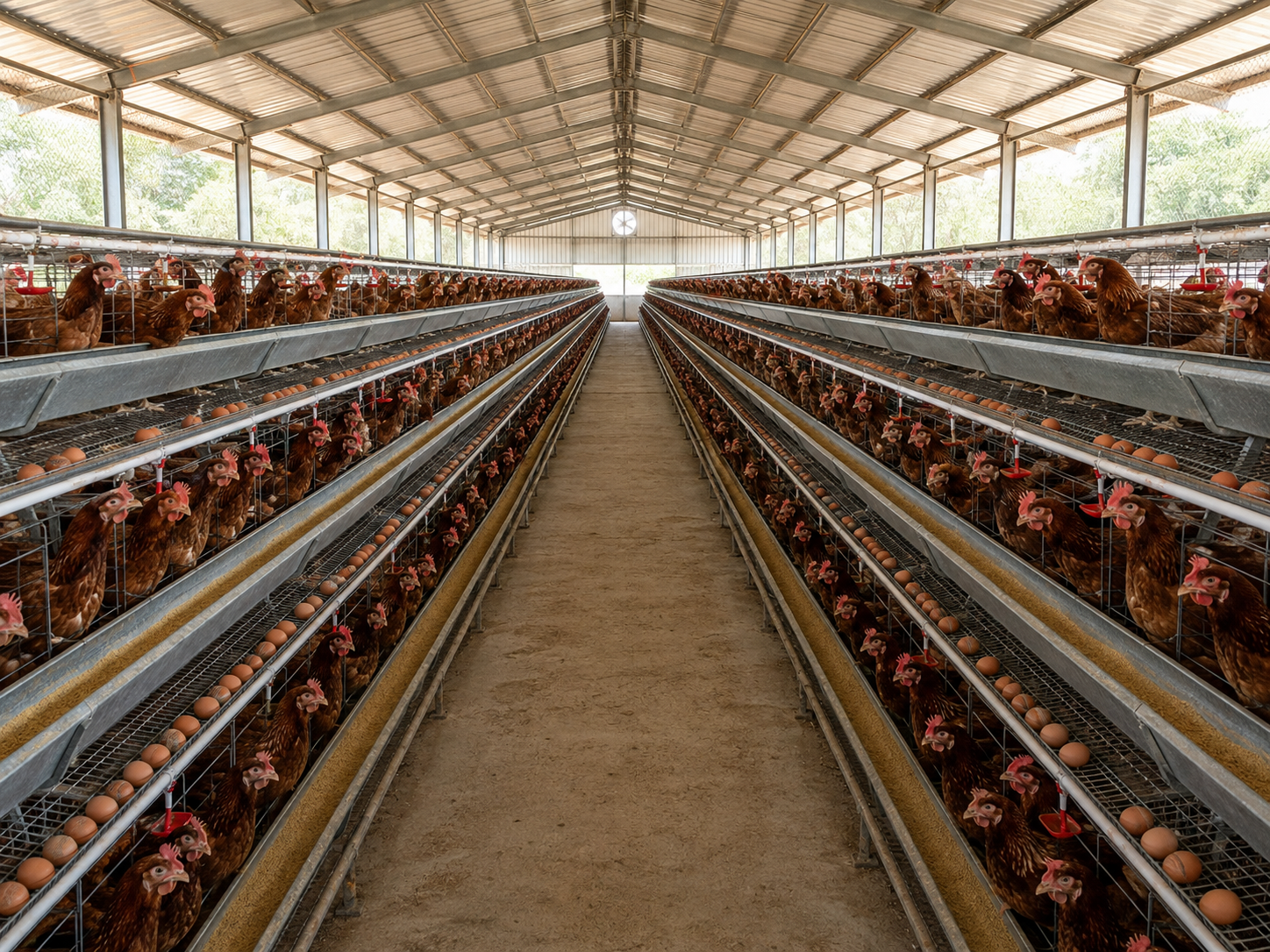
A 5,000-layer farm and a 100,000-layer farm have one thing in common: manure keeps coming, whether the treatment equipment is ready or not.
The difference is how quickly it becomes a problem.
On a small farm, a covered composting area may be enough. On a larger operation, missed collection or an undersized treatment system can leave tonnes of manure waiting for processing.
In the Philippines, Indonesia, and Malaysia, heavy rainfall adds another concern. Without proper roofing and drainage, even a relatively simple manure treatment operation can become difficult to manage.
So which chicken manure treatment solution makes sense for your farm?
Start with the manure quantity, then compare land, labor, equipment, and the cost of keeping the system running.
How Much Manure Does Your Poultry Farm Produce?
Before buying equipment, estimate daily manure output.
The University of Georgia Cooperative Extension notes that poultry manure production varies with feed intake, bird type, and farm management. Manure also loses moisture after collection, which changes its weight.
For initial planning, this guide uses 0.12–0.15 kg of fresh manure per laying hen per day as an illustrative range. It is not a fixed production standard.
| Laying hens | Estimated fresh manure per day |
|---|---|
| 5,000 | 0.6–0.75 tonnes |
| 20,000 | 2.4–3.0 tonnes |
| 50,000 | 6.0–7.5 tonnes |
| 100,000 | 12–15 tonnes |
These figures refer to fresh manure before significant drying. Actual quantities collected from manure belts may differ.
For example, a farm with 50,000 layers using an assumed rate of 0.13 kg per bird produces:
50,000 × 0.13 = 6,500 kg, or 6.5 tonnes per day.
That’s the starting figure, not the final fermentation equipment capacity.
Broiler farms need a different calculation because manure is mixed with litter and often collected between production cycles.
For more accurate sizing, weigh collected manure over representative operating days and measure its moisture content.
1. A 5,000-Layer Farm: Don’t Overbuild the System
A farm with 5,000 layers may produce approximately 0.6–0.75 tonnes of fresh manure daily.
At this size, an expensive automated treatment plant isn’t always necessary.
If the farm has sufficient space, covered windrow composting is worth considering. Manure is collected, mixed with suitable bulking materials, and managed in a dedicated composting area.
The basic requirements are a rainproof roof, impermeable floor, drainage, and space for turning and curing.
A small compost turner may help, but it isn’t automatically essential.
Another possibility is sending manure to an established local fertilizer processor, provided storage, transport, and disposal arrangements meet local requirements.
For a smaller operation, paying a contractor may cost less than maintaining dedicated processing equipment.
Before buying: Compare the cost of the roof, concrete work, labor, and manure transport—not just the price of a compost turner.
2. A 20,000-Layer Farm: Labor Starts to Matter
At 20,000 layers, estimated fresh manure production rises to 2.4–3.0 tonnes per day.
That’s a substantial amount to move manually.
Mechanical windrow turning or a trough composting system can reduce repeated handling. Where space is restricted or odor control is a priority, an enclosed fermentation system may also be considered.
But don’t assume one vertical fermentation tank is automatically the right answer.
The decision depends on daily feedstock volume, material moisture, residence time, available electricity, and the cost of operating the complete system.
For H-type layer houses, manure belts can help deliver material to a central collection point. The composting or fermentation equipment then needs a suitable loading arrangement.
Before buying: Compare monthly labor costs and available land against the investment and operating costs of greater automation.
A system that looks affordable on a brochure may need additional electrical work, foundations, and feeding equipment.
3. A 50,000-Layer Farm: Keep Manure Moving Every Day
A 50,000-layer operation may generate approximately 6.0–7.5 tonnes of fresh manure each day.
At this volume, manure handling becomes a regular production task rather than an occasional cleaning job.
The farm may consider mechanical composting or enclosed aerobic fermentation, depending on its operating conditions.
Automatic manure belts, centralized conveying, covered temporary storage, and mechanical loading can reduce repeated manual handling.
Space also matters. In a densely developed farming area, an enclosed system may offer advantages for exhaust collection and organized material handling.
However, an enclosed tank still needs room for loading, unloading, maintenance, exhaust treatment, and any additional curing.
And here’s a question worth asking before signing a purchase order:
Where will tomorrow’s manure go if the machine is stopped for maintenance?
A suitable buffer storage or alternative handling arrangement should be part of the design.
Before buying: Ask for verified daily processing capacity under your feedstock conditions, not simply the fermentation tank’s nominal volume.
4. A 100,000+ Layer Farm: Think Beyond Individual Machines
With 100,000 layers, daily fresh manure production may reach 12–15 tonnes under the assumptions used here.
Larger farms need to consider the complete handling route.
Manure must move from the poultry houses to collection, processing, odor management, and final storage or utilization.
Several composting lines or multiple fermentation units may be appropriate, but the number should come from a material balance rather than a rule based on bird numbers.
A centralized system may include automatic manure conveying, loading equipment, aerobic fermentation, exhaust treatment, and separate facilities for curing or fertilizer handling.
For a farm expecting future expansion, the layout should also allow additional treatment capacity.
There is another cost that deserves attention: what happens to the finished material?
Selling organic fertilizer may generate revenue, but that depends on product quality, local demand, packaging, and transport costs.
Don’t build a fertilizer production line based only on an optimistic selling price.
Before buying: Confirm daily treatment capacity, backup storage, maintenance access, and the actual destination of finished compost. The cheapest equipment package is not always the cheapest system to operate.
Compare the Main Treatment Options
| Farm size | Options to evaluate | Main investment considerations |
|---|---|---|
| 5,000 layers | Covered windrow or off-site processing | Roofing, drainage, labor, transport |
| 20,000 layers | Mechanical windrow, trough, or enclosed system | Turning, loading, electricity, space |
| 50,000 layers | Mechanized composting or enclosed fermentation | Conveying, automation, odor control |
| 100,000+ layers | Integrated, potentially modular treatment | Processing capacity, utilities, backup, downstream handling |
These are preliminary options, not fixed equipment packages.
There isn’t a reliable universal land-area or equipment-price figure for each farm size. Windrow dimensions depend on composting time, turning equipment, and material properties. Enclosed systems need supporting infrastructure beyond the tank itself.
In Southeast Asia, roofing and contaminated runoff management should be included in the initial budget rather than added after the rainy season causes problems.
What Can Guangxing’s 920,000-Layer Project Tell Us?
Guangxing has published a case study of its 920,000-layer manure fermentation treatment project.
The project uses ten GX-SANYU 11FFG-100 vertical aerobic fermentation tanks.
Each tank has an effective volume of 100 m³. The published specifications list approximately 21 kW of operating power, a typical fermentation cycle of around seven days, and incoming manure moisture of 65–70% under the project’s reference conditions.
The system also includes automatic feeding, mixing, aeration, heat exchange, and exhaust deodorization.
The useful lesson isn’t that every 92,000 layers need one fermentation tank.
It’s that large projects need coordinated collection, loading, treatment, and maintenance arrangements.
The 11FFG-100 vertical poultry manure composting system can be considered where enclosed aerobic treatment suits the farm’s needs.
Its 100 m³ effective volume is not equivalent to 100 m³ of daily manure throughput.

What to Prepare Before Requesting a Quotation
You don’t need a finished engineering plan before contacting a supplier. A few reliable figures will make the discussion much more productive.
Prepare your poultry capacity, measured daily manure output, moisture content, housing and collection method, available site area, power supply, and intended fertilizer use.
If you’re still learning the composting process itself, read our guide on how to treat chicken manure for moisture adjustment, fermentation management, curing, and troubleshooting.
A good treatment system should handle the waste your farm actually produces—not just look impressive in a catalogue.
Planning a poultry manure treatment project?
Contact Guangxing for capacity calculation, site layout design and quotation.