


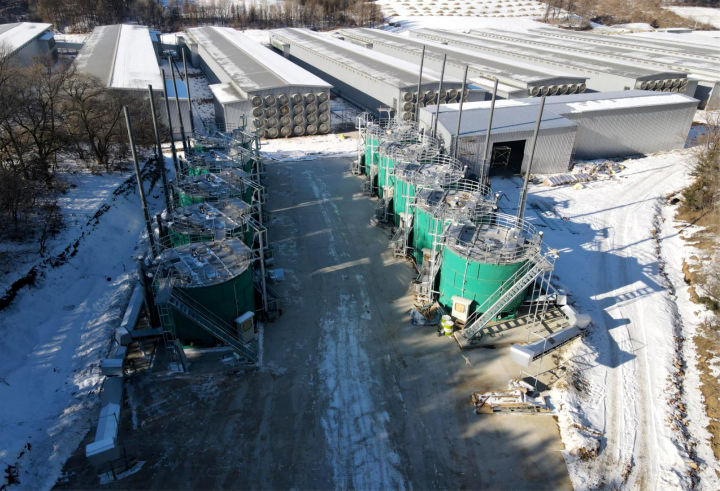
This is a large-scale project designed for the harmless treatment, volume reduction, and resource recovery of chicken manure from a commercial layer farm.
The project uses 10 GX-SANYU 11FFG-100 vertical intelligent aerobic fermenters. High-moisture chicken manure generated daily in the poultry houses is centrally collected and processed through automatic feeding, in-tank mixing, continuous aeration, heat exchange, exhaust-gas collection, and spray-tower deodorization. The treated material is converted into an organic fertilizer feedstock that can be further utilized.
This project is not simply the sale of individual fermentation tanks. It is a complete system covering:
Chicken manure collection → Aerobic fermentation → Odor treatment → Material discharge → Fertilizer utilization
1. Project Data
Farm type: Commercial layer farm
Maximum farm capacity: 920,000 laying hens
Equipment configuration: 10 sets of 11FFG-100 fermenters
Chicken manure moisture content in this project: 65%–70%
Effective volume of each tank: 100 m³
Reference installation space per unit: Approximately 8,000 × 8,500 mm
Process configuration: Vertical structure, top feeding, bottom discharge, andcontinuous aerobic fermentation
Total installed power per standard unit: 37.64 kW
Operating power: 21 kW
Typical average fermentation cycle: Approximately 7 days
Typical moisture content after treatment: Approximately 30%–40%

2. Why Are 10 Fermenters Required Instead of One?
A farm with 920,000 laying hens continuously generates a large quantity of chicken manure every day. Using multiple fermentation tanks in parallel provides several important advantages:
The total treatment demand is distributed across multiple units, creating modular processing capacity.When one unit requires maintenance, the remaining units can continue operating.
The system can be divided according to poultry houses, manure conveying routes, or project construction phases.Additional units can be added later as the farm expands.
The farm avoids the risk of the entire manure treatment system shutting down because of a fault in one oversized machine.
Therefore, the main value of this project is not limited to its large treatment capacity. It also provides continuous operation, flexible system configuration, and reduced project risk.

3. How the Process Operates
Chicken manure removed from the poultry houses is transported to a collection or temporary storage area.
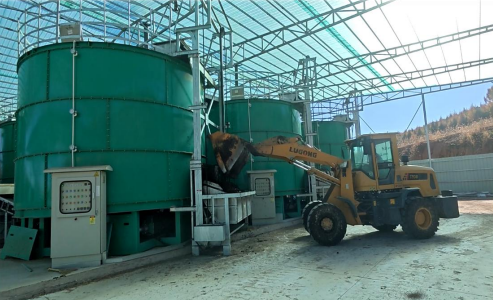
A wheel loader places the material into the automatic tipping feeding device.
The elevator lifts the chicken manure to the feeding inlet at the top of the fermentation tank.
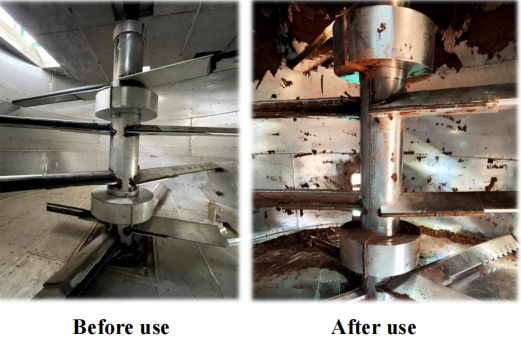
The hydraulic system drives the main shaft and mixing blades to continuously mix the material.
Upper and lower blowers supply air continuously, creating the aerobic conditions required for fermentation.
The heat exchanger recovers heat generated during fermentation and uses it to warm the fresh air entering the tank.
Fermentation exhaust gas is collected through a centralized outlet and transferred to the spray tower for deodorization.
The fermented material is discharged from the bottom of the tank and can be used as organic fertilizer feedstock or transferred to a downstream fertilizer-processing system.
4. The Project Is a Complete Manure Treatment System
The project is not simply a configuration of 10 fermentation tanks. It is an integrated system covering: