


Equipment scope, A-type vs H-type layouts, and a practical budgeting method for commercial layer farms.
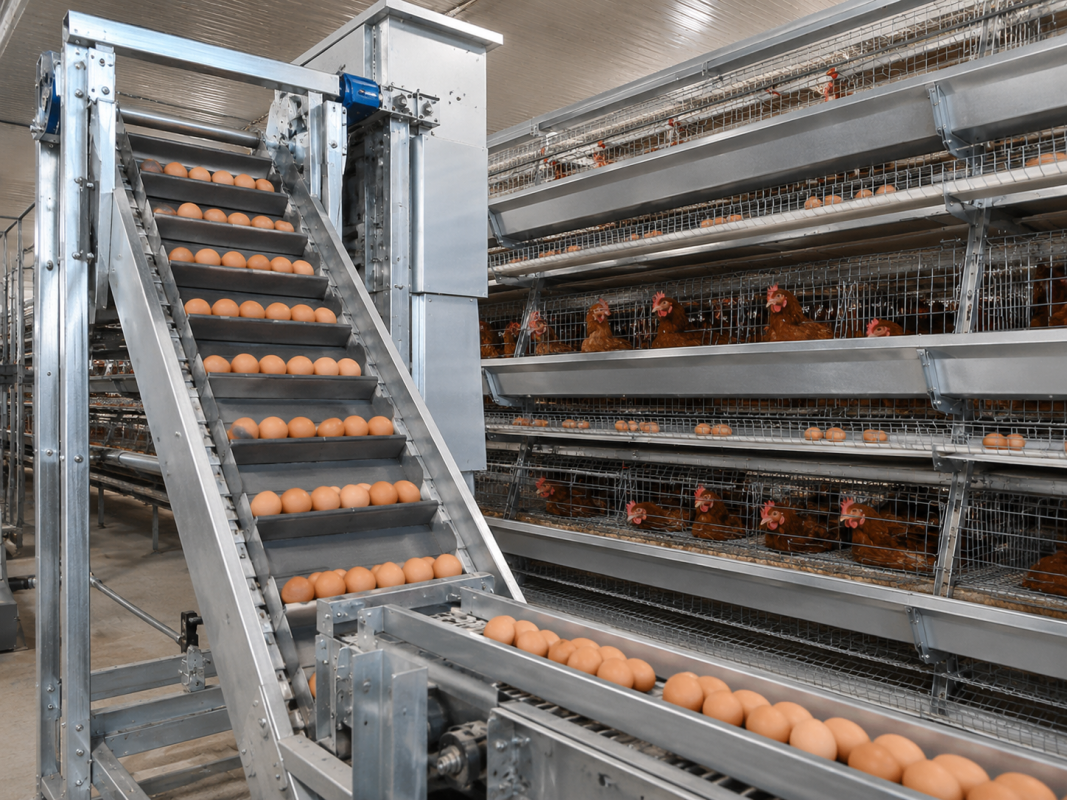
An automatic egg collection system for 50,000 layers does not have one reliable fixed price. The cost depends less on flock size alone and more on the number of independent collection drives, transfer points and conveyor routes. The distance to the egg room—the room where workers receive eggs for packing or further processing—also affects the final quotation.
For example, a single 50,000-bird house and two 25,000-bird houses may require very different equipment packages. Therefore, buyers should compare drive quantities, total belt length, conveyor routes and transfer equipment rather than rely on a general cost per bird.
This guide explains how to compare those packages, estimate operating savings and request a quotation that covers the complete collection route.
Planning note: The production rates, capacity allowance and labour figures below serve as illustrative calculations. They do not represent measured Guangxing project results or guaranteed equipment performance. Engineers must confirm final sizing against the farm layout and selected equipment.
1. What Equipment Does a 50,000-Layer Farm Need?
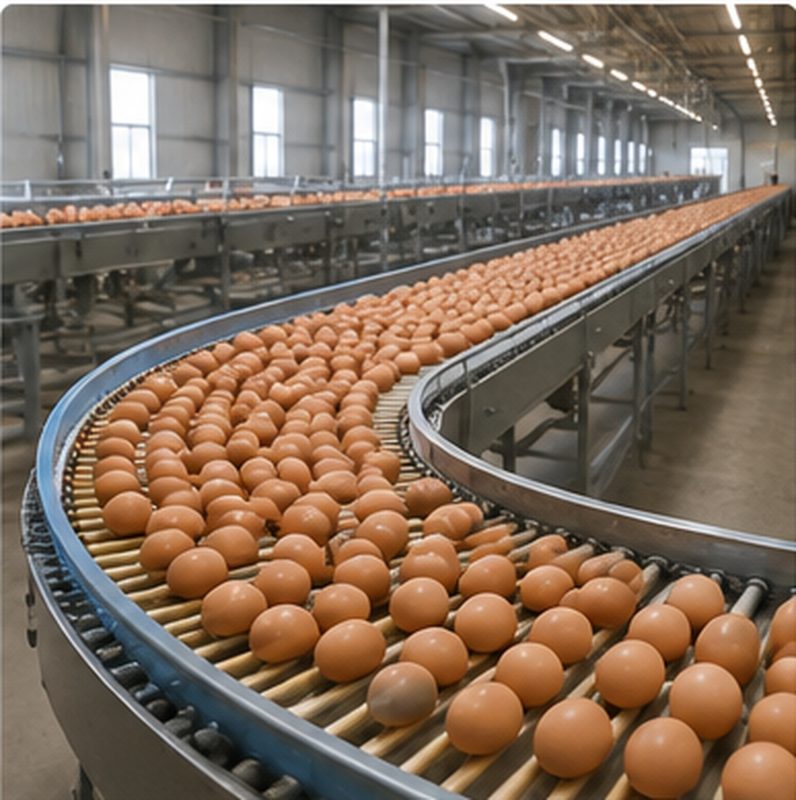
At a 90% laying rate, 50,000 hens produce approximately 45,000 eggs per day. At 95%, daily output reaches 47,500 eggs.
If the farm collects 47,500 eggs over four hours, the average throughput reaches 11,875 eggs per hour. To account for uneven egg arrival, an illustrative 20% planning allowance raises the preliminary combined handling capacity to approximately 14,250 eggs per hour.
However, this figure does not mean every belt must handle 14,250 eggs per hour. A cross conveyor receives eggs from several rows, while an individual belt serves a smaller section. As a result, engineers must check the collection sequence, simultaneous operation and rated capacity of each component.
A complete collection arrangement may include the following equipment:
| Equipment | Function | Sizing Basis |
|---|---|---|
| Egg collection belts | Carry eggs along cage rows | Row length and collection levels |
| Collection drives | Move the collection belts | Independently driven sections |
| Egg elevators and transfers | Move eggs between levels | Cage tiers and transfer layout |
| Cross conveyors | Connect collection points | Row arrangement and route length |
| Central conveyors | Carry eggs to a shared egg room | Building layout and distance |
| Electrical controls | Coordinate motors and collection sequence | Equipment and operating requirements |
Before selecting equipment, the farm owner and supplier should draw the complete collection route.
For instance, placing the egg room beside the poultry house may shorten the conveyor route. By contrast, a separate egg room may require longer conveyors, additional supports and another transfer point. Consequently, two farms with the same number of hens can receive different quotations.
2. How Much Should You Budget for Automatic Egg Collection?
In many single-house layouts, egg collection belts and their drives form one of the largest equipment cost groups. However, buyers gain more useful information by comparing the number of independently driven rows, collection points and the distance to the egg room.
These factors determine how much equipment the supplier must install and connect. In addition, the collection layout affects the number of transfer components and electrical connections.
Guangxing therefore prepares project-specific quotations rather than publishing one fixed price for every 50,000-layer farm.
For example, a quotation covering collection drives alone cannot compete on equal terms with an offer that includes belts, transfers, cross conveyors and electrical controls.
Three Equipment Packages to Compare
| Package | Equipment Scope | Best Suited To | Main Cost Driver |
|---|---|---|---|
| A. Basic Collection | Drives and compatible replacement components | Upgrading selected equipment on an existing farm | Collection points and compatibility |
| B. Complete In-House Collection | Belts, drives, transfers, cross conveyors and controls | New single-house installation | Driven sections, tiers and belt lengths |
| C. Central Collection | In-house equipment plus central conveying and route connections | Multiple houses or a shared egg room | Building arrangement and conveying distance |
Package A offers a partial upgrade rather than a complete collection system. Therefore, it makes sense only when the farm can retain its existing cage equipment.
Package B provides a clearer starting point for a new single-house project. Meanwhile, Package C adds the equipment that connects poultry houses to a shared egg room.
Where the Equipment Budget Goes
| Cost Category | What the Quotation Should Specify |
|---|---|
| Egg collection belts | Material, width and total installed length |
| Collection drives | Quantity, motor specifications and drive arrangement |
| Elevators and transfers | Type, quantity and rated capacity |
| Cross conveyors | Quantity, dimensions and route |
| Central conveying | Length, supports and connection points |
| Electrical controls | Cabinets, wiring and operating functions |
Suppliers should identify these items separately, even when they offer one package price.
Compare identical equipment boundaries. For example, one supplier may end its quotation at the poultry house wall, while another may include conveyors that carry eggs into the shared egg room. In that case, the lower quotation may simply exclude part of the collection route.
3. One 50,000-Bird House vs Two 25,000-Bird Houses
Two poultry houses do not automatically require twice as much collection equipment. Instead, the total depends on how each house collects eggs and how the routes connect.
| Design Item | One 50,000-Bird House | Two 25,000-Bird Houses |
|---|---|---|
| Egg collection belts | Calculate each belt route from row length and collection levels | Calculate per house, then combine totals |
| Collection drives | Count independently driven sections | Count sections separately in both houses |
| Row-end transfers | Count connections at collection row ends | Count connections in each house |
| Cross conveyors | Size for the house’s collection route | Design the route for each house |
| Merge or transfer point | Depends on the egg room layout | May be necessary where routes join |
| Central conveyor | Depends on egg room location | Often useful for a shared egg room |
| Controls | Centralized or distributed as required | Separate or coordinated operation may be necessary |
These rules help suppliers calculate equipment quantities. However, the actual cage arrangement determines the final drive counts and conveyor dimensions.
When comparing layouts, ask suppliers for the total installed belt length, number of drives, transfer points, conveyor lengths and control equipment quantities.
The egg room location matters as well. For instance, two houses may share one egg room, but their collection routes must meet somewhere. Therefore, the junction needs enough capacity to receive eggs from both houses without creating unnecessary stops or manual transfers.
A collection-route drawing often explains these differences more clearly than a quotation that lists only model names and prices.
4. A-Type or H-Type: Two Farms, Two Different Answers
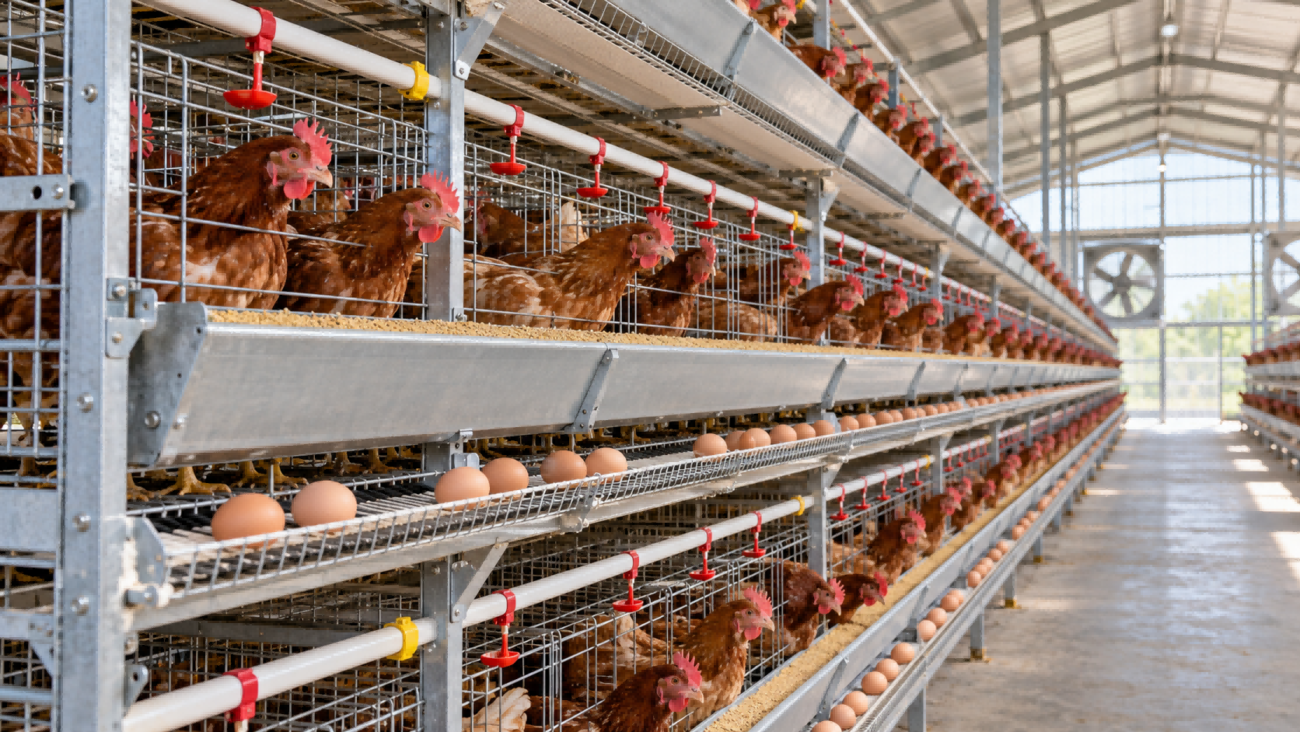
Farm A already has A-type layer cages. The farm can still use its existing collection belts and cage frames. However, workers spend too much time handling eggs at the row ends.
In this situation, the owner may save money by replacing compatible drives or adding suitable transfer equipment instead of purchasing a completely new cage and collection system.
First, the supplier should check whether the existing belts work with the proposed drives. Next, the team should measure the available space at the row ends. Finally, it should confirm whether eggs can reach the egg room without another manual transfer.
Farm B plans to build a new high-density layer house. An H-type automatic layer cage system can accommodate more birds vertically. Consequently, the farm may need less floor area for the same flock capacity.
However, eggs from several tiers still need to reach the main collection route. This arrangement may require more complex elevators, additional drives and coordinated controls.
Neither cage type guarantees the lowest overall cost. After all, upgrading an existing A-type farm and constructing a new H-type house involve different investments.
For a new farm, compare the cage system, building requirements, collection route and installation together. For an existing farm, identify the components that can remain in service before deciding what to replace.
Guangxing supplies automatic egg collection systems for commercial cage farming projects.
5. Can Automatic Egg Collection Reduce Operating Costs?
Automatic collection can reduce the time workers spend gathering eggs and moving them between collection points. However, the actual saving depends on how much manual work the equipment replaces.
Consider a farm that assigns three workers to egg collection. Each worker spends six hours per day across two collection rounds. Together, they contribute 18 labour-hours daily.
If automation cuts this workload by two-thirds, the farm saves 12 labour-hours per day. Workers can then use the remaining six hours for inspection, tray handling and other collection-related tasks.
Illustrative Labour-Saving Calculation
| Item | Example |
|---|---|
| Labour before automation | 18 hours/day |
| Labour after automation | 6 hours/day |
| Labour saved | 12 hours/day |
| Annual hours saved | 4,380 |
| Annual saving at USD 1.50/hour | USD 6,570 |
| Annual saving at USD 3.00/hour | USD 13,140 |
Of course, each farm should use its actual labour costs when calculating savings. If the owner reassigns employees rather than reducing payroll expenses, the reassigned hours do not automatically represent cash savings.
In addition, the farm should measure any reduction in handling damage or improvement in collection consistency against its previous results.
How to Estimate Payback
Simple payback (years) = Installed investment ÷ Annual net savings
To calculate annual net savings, add verified labour cost reductions and measured reductions in egg losses. Then subtract additional electricity, maintenance and operating expenses.
For example, a farm saving 12 labour-hours daily at USD 1.50 per hour could reduce annual labour costs by approximately USD 6,570, provided those hours translate into actual payroll savings.
Compare this amount with the installed cost quoted for your particular layout rather than relying on an industry-average payback period.
For a more detailed analysis, see our guide to the ROI of automatic egg collection systems.
6. What Additional Costs Should African Poultry Farms Consider?
For buyers in Nigeria, Ghana and Kenya, the factory equipment price represents only part of the project budget.
In addition to the equipment, buyers must consider shipping, import charges, inland delivery, electrical work and commissioning. Therefore, the purchase terms matter almost as much as the equipment list.
EXW, FOB and CIF: Who Pays?
The following table summarizes typical responsibilities under Incoterms® 2020.
| Cost or Responsibility | EXW | FOB | CIF |
|---|---|---|---|
| Export clearance | Buyer | Seller | Seller |
| Ocean freight | Buyer | Buyer | Seller |
| Marine cargo insurance | Buyer, if arranged | Buyer, if arranged | Seller provides required minimum cover |
| Destination unloading and port charges | Buyer | Buyer | Buyer, unless the seller’s freight contract includes discharge costs |
| Import clearance and duties | Buyer | Buyer | Buyer |
| Inland transport after destination port | Buyer | Buyer | Buyer unless agreed otherwise |
Under CIF, the seller pays the agreed freight and insurance to the destination port. However, risk generally transfers to the buyer when the goods go on board the vessel at the shipment port. FOB and CIF apply to sea and inland waterway transport.
Also, destination unloading and port charges do not always form one bundled fee. For example, the freight contract may cover discharge costs while the buyer still pays separate terminal, storage or other destination charges.
Before signing, confirm the named port, freight inclusions, destination charges and inland delivery responsibilities with the supplier and freight forwarder.
Power Supply, Installation and Spare Parts
First, confirm the farm’s voltage, frequency and available electrical capacity. The supplier can then select drives and controls that match the power system.
Where outages occur frequently, the collection system also needs a suitable stopping and restarting arrangement. Therefore, a qualified electrical contractor should verify wiring, electrical protection and backup-power requirements.
In addition, ask which spare parts the farm should keep on site. Drive and control components deserve particular attention because a failure can interrupt the collection route they serve.
Finally, confirm installation responsibilities, warranty coverage, replacement-part availability and technical support before placing the order.
7. What Should Be Included in a Supplier’s Quotation?
A useful quotation should explain both the equipment and the services included in the price. Therefore, buyers should compare offers against the same checklist.
| Check | What to Confirm |
|---|---|
| ☐ | Poultry house dimensions and cage layout |
| ☐ | Cage type, tiers and collection rows |
| ☐ | Egg collection belt specifications and quantities |
| ☐ | Number of collection drives |
| ☐ | Egg elevators and transfer equipment |
| ☐ | Cross and central conveyor dimensions |
| ☐ | Rated throughput and operating sequence |
| ☐ | Electrical controls and power requirements |
| ☐ | Installation and commissioning responsibilities |
| ☐ | Warranty, spare parts, delivery terms and lead time |
Start by asking for a layout drawing that traces the eggs from the cage rows to the egg room.
Next, check where the supplier’s equipment scope ends. Does the quotation include delivery into the egg room, or does the conveyor stop at the poultry house? If the egg room equipment stands at a different height, who supplies the final transfer?
These details often explain price differences better than the quoted total alone.
8. How Guangxing Configures a 50,000-Layer Project
Guangxing develops egg collection configurations around the poultry house layout, cage type, collection schedule and egg room location rather than flock capacity alone.
To begin, send the building dimensions, cage arrangement, number of tiers, expected egg output and a drawing showing the egg room. The team can then assess belt lengths, drive quantities and transfer routes.
If the project includes downstream processing, Guangxing can also plan the collection route alongside its egg grading and packaging equipment. However, not every farm needs a complete grading line.
9. Frequently Asked Questions
How much does an automatic egg collection system cost for 50,000 layers?
There is no single reliable price because equipment quantities change with the poultry house layout. First, define the number of houses, cage rows and tiers. Then confirm the collection points, conveyor distances and egg room location. Finally, compare itemized quotations using the checklist in Section 7.
Can I install automatic egg collection on existing A-type cages?
Possibly. First, inspect the existing cage dimensions, belts and drive arrangement. Next, check the available installation space. The supplier can then determine whether a retrofit is suitable.
Does a 50,000-layer farm need central egg collection?
Not always. For example, a single-house farm may use in-house collection equipment when the egg room sits nearby. However, multiple houses sharing one egg room may need additional connecting conveyors.
How many eggs should the collection system handle per hour?
At a 95% laying rate, 50,000 hens produce approximately 47,500 eggs daily. If the farm collects those eggs over four hours, the average reaches 11,875 eggs per hour. An illustrative 20% planning allowance raises the preliminary combined handling capacity to 14,250 eggs per hour.
However, engineers must check individual belts, elevators and conveyors separately for rated capacity and peak loading.
Is H-type egg collection more expensive than A-type?
Not necessarily. H-type systems may need more complex tier-transfer equipment, while A-type systems generally require more floor space. Therefore, buyers should compare the total installed cost, including cages, building requirements and collection equipment.
What information is needed for a quotation?
Start with the flock capacity, number of houses, building dimensions, cage type and number of tiers. In addition, provide expected egg output, collection schedule and egg room location. A layout drawing will help the supplier prepare a more accurate equipment list.
Final Thoughts: Budget for the Collection Route, Not Just the Flock Size
For 50,000 layers, the key cost question is not simply how much one collection machine costs. Instead, buyers need to know how many driven sections, transfer points and conveyors the farm requires to move eggs from the cages to the egg room.
First, compare those equipment quantities. Then check installation, delivery and operating costs. This approach helps buyers identify missing items and select a package that matches their farm layout.
Request a Project-Specific Quotation
Planning a new 50,000-layer farm or upgrading an existing poultry house?
Contact Guangxing Poultry Equipment Group with your cage layout, building dimensions, expected egg output and egg room location. Our team can review the requirements and discuss an appropriate collection configuration.
Request an itemized automatic egg collection system quotation



One thought on “How Much Does an Automatic Egg Collection System Cost for 50,000 Layers?”