


Poultry Equipment Manufacturers in Germany: 7 Suppliers, Factory Locations & Buying Guide
Looking for poultry equipment manufacturers in Germany? Germany is home to established manufacturers of poultry housing systems, feeding equipment, egg conveyors, drinking systems and farm automation. However, a German headquarters does not necessarily mean every machine and component is manufactured in Germany.
This guide compares seven German-based poultry equipment suppliers, identifies publicly documented manufacturing activities and explains how to choose equipment for German and international poultry projects.
1. Poultry Equipment Manufacturers in Germany: Quick Comparison
The first question is not which company is the biggest. It is which manufacturer supplies the particular type of equipment required for your farm, and where that equipment is actually made.
| Manufacturer | German location | Main equipment | Manufacturing evidence |
|---|---|---|---|
| Big Dutchman | Vechta-Calveslage | Layer, broiler, feeding and environmental systems | German engineering and operations; international business and supply network |
| Fienhage Poultry Solutions | Lutten | Layer, broiler, aviary and barn systems | Company confirms German-based development and production activities |
| Hellmann Poultry | Vechta | Layer housing, rearing and associated automation | Company states that it manufactures the majority of its products itself |
| SALMET-FIENHAGE | Ittlingen and Berge | Layer, rearing, broiler and manure systems | Company identifies two German production sites |
| SPECHT / Te So Ten Elsen | Sonsbeck | Poultry housing, feeding and ventilation | Company states that components used in its products are manufactured at its Sonsbeck factory |
| Farm Innovation Team | Germany | Broiler, layer, pullet and breeder housing | German engineering and Germany/EU production are described publicly |
| LUBING Maschinenfabrik | Barnstorf | Drinking, egg conveying and climate systems | Documented manufacturing activity in Barnstorf |
The companies differ in their scope. Some deliver integrated poultry-house systems, while others specialize in components such as drinking nipples or egg conveyors. Fienhage and SALMET-FIENHAGE also have a business relationship, so they should not be treated as unrelated corporate groups.
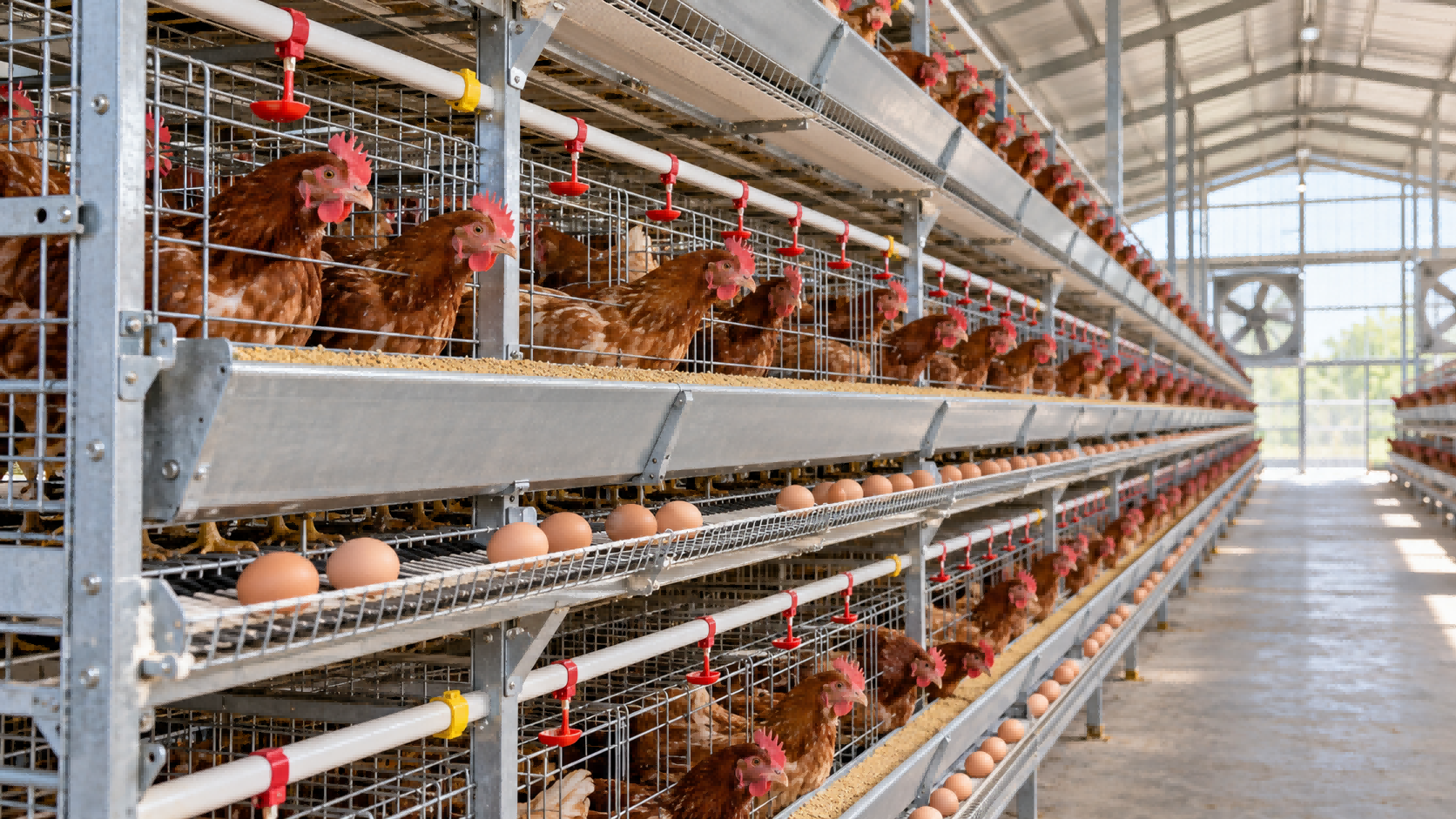
2. Seven German Poultry Equipment Suppliers: What Each Company Offers
1. Big Dutchman
Big Dutchman is one of the best-known suppliers of equipment for poultry and pig production. Its range covers layer and broiler housing, feeding equipment, ventilation, environmental control, manure handling and farm-management technology.
The company has substantial German operations alongside an international business and supply network. Consequently, the manufacturing origin of an individual control cabinet, housing component or complete installation should be checked against the actual order.
Best suited to: Integrated poultry projects requiring a wide range of equipment, technical planning and coordinated installation support.
Buyer's question: Which major components will be manufactured in Germany, and which will come from other factories or external suppliers?
2. Fienhage Poultry Solutions
Fienhage develops and produces housing equipment for laying hens and also produces and sells equipment for broiler production. Its product range includes housing systems for different farming arrangements.
The company's public information confirms manufacturing activity in Germany, but it does not establish that every purchased motor, controller or other component originates there.
Best suited to: Farmers comparing alternative layer housing, aviary equipment and broiler-house systems.
Buyer's question: What is produced directly at Fienhage facilities, and which parts are sourced from external manufacturers?
3. Hellmann Poultry
Hellmann specializes in poultry housing, particularly equipment for laying hens and rearing systems. Its company information states that the majority of its products are manufactured in-house.
This is useful evidence of actual production, but the word "majority" matters. It is not a declaration that every mechanical or electronic component is German-made.
Best suited to: Buyers seeking layer or pullet housing with manufacturer-led technical support.
Buyer's question: Which equipment is manufactured in-house, and what spare parts can be supplied throughout the system's service life?
4. SALMET-FIENHAGE
SALMET offers equipment for layer production, pullet rearing, breeder management, broiler housing and manure treatment. The company publicly identifies production sites in Ittlingen and Berge.
Its company history also records early work on accessories for cage systems imported from the United Kingdom. That history illustrates why manufacturing and importing should be examined by product and period rather than by brand name alone.
Best suited to: Buyers comparing German poultry housing manufacturers with documented factory operations.
Buyer's question: Which modules for the proposed system are produced at the company's German sites?
5. SPECHT / Te So Ten Elsen
SPECHT manufactures poultry housing equipment and provides project planning, assembly and installation support. Its official website states that the components used in its products are manufactured at its Sonsbeck factory.
This is among the clearest published German factory-origin statements in this comparison. However, the manufacturer's statement is not a substitute for confirming the origin of all upstream materials and purchased electrical parts on a particular order.
Best suited to: Buyers who place a high priority on German manufacturing documentation, custom housing design and installation support.
Buyer's question: Can the company provide a product-specific country-of-origin declaration and a list of externally sourced components?
6. Farm Innovation Team (FIT)
Farm Innovation Team describes integrated housing solutions for broilers, pullets, layers and breeders. Its public materials refer to German engineering and production in Germany and the European Union.
That makes FIT relevant to this manufacturer search, although the country of manufacture still needs confirmation for each specified system.
Best suited to: Projects exploring different housing configurations and integrated equipment.
Buyer's question: Which specified equipment is made in Germany, elsewhere in the EU or by external partners?
7. LUBING Maschinenfabrik
LUBING is a specialist in poultry drinking systems, egg conveyors and climate equipment. Its company history documents the development and production of drinking and egg-conveying systems in Barnstorf.
LUBING is therefore especially relevant when the purchasing requirement concerns a particular subsystem rather than an entire poultry farm.
Best suited to: Farmers and integrators sourcing drinking equipment, egg transport systems or specialized replacement components.
Buyer's question: Are the requested components compatible with the existing housing and control systems?
3. Are German Poultry Equipment Manufacturers Really Manufacturing in Germany?
"German brand", "German-designed", "assembled in Germany" and "Made in Germany" do not describe the same supply chain. A poultry house may combine fabricated steelwork, motors, electronics, drinking components, fans and control systems from different suppliers.
Some German companies have well-documented domestic manufacturing operations. Others operate international manufacturing and sourcing networks. Neither situation should be assumed to apply equally to every product.
| Component | What to verify before purchase |
|---|---|
| Housing structure | Fabrication country, steel specification, coating and installation details |
| Feeding motors and drives | Manufacturer, model, production origin and spare-part availability |
| Drinking nipples and fittings | Materials, model compatibility, actual manufacturer and replacement parts |
| Egg conveyors | Belt material, drive units, motor data and maintenance requirements |
| Ventilation equipment | Tested airflow, energy consumption, noise, controls and production location |
| Electrical control cabinets | Assembly location, component schedule, safety documentation and wiring drawings |
Six documents worth requesting
- Product-specific country-of-origin information.
- Major-component bill of materials with makes and models.
- Detailed technical specifications and drawings.
- Applicable EU conformity and safety documentation.
- Written spare-parts and warranty arrangements.
- Installation, commissioning and maintenance scope.
A complete system may contain components from several countries. The aim is not to prove that every bolt comes from Germany. It is to understand which parts determine reliability, safety, operating cost and long-term serviceability.
4. What Does the German Poultry Market Actually Need?
A supplier's product catalogue does not tell the whole story. Equipment selection in Germany is strongly influenced by housing rules, retailer expectations, farm operating costs, animal welfare and environmental requirements.
Egg production
German official statistics report around 13.7 billion eggs produced in 2025 by businesses with at least 3,000 laying-hen places. The market includes barn, free-range and organic housing systems.
For new projects, farmers should prioritize lawful housing designs, nest access, egg collection, lighting, litter management and flock monitoring.
Broiler production
Broiler farmers must balance welfare, weight gain, ventilation, litter condition, feed efficiency and labour.
The equipment choice should reflect the intended stocking density, production programme, buyer requirements and applicable permits.
Consumer and retailer requirements
Retailers and customers may demand particular housing methods, animal-welfare certifications, traceability or supply-chain documentation. These requirements can exceed legal minimums.
Modernization and labour
Automated feeding, egg transport, climate monitoring and cleaning systems can reduce repetitive tasks, but operating reliability and local maintenance support matter as much as automation level.
According to German federal agricultural statistics, organic housing accounted for 14.1% of laying-hen places in 2025. This is one reason cage-free aviary, barn and organic-compatible equipment deserve particular attention in Germany.
Source: Germany's official poultry-housing statistics
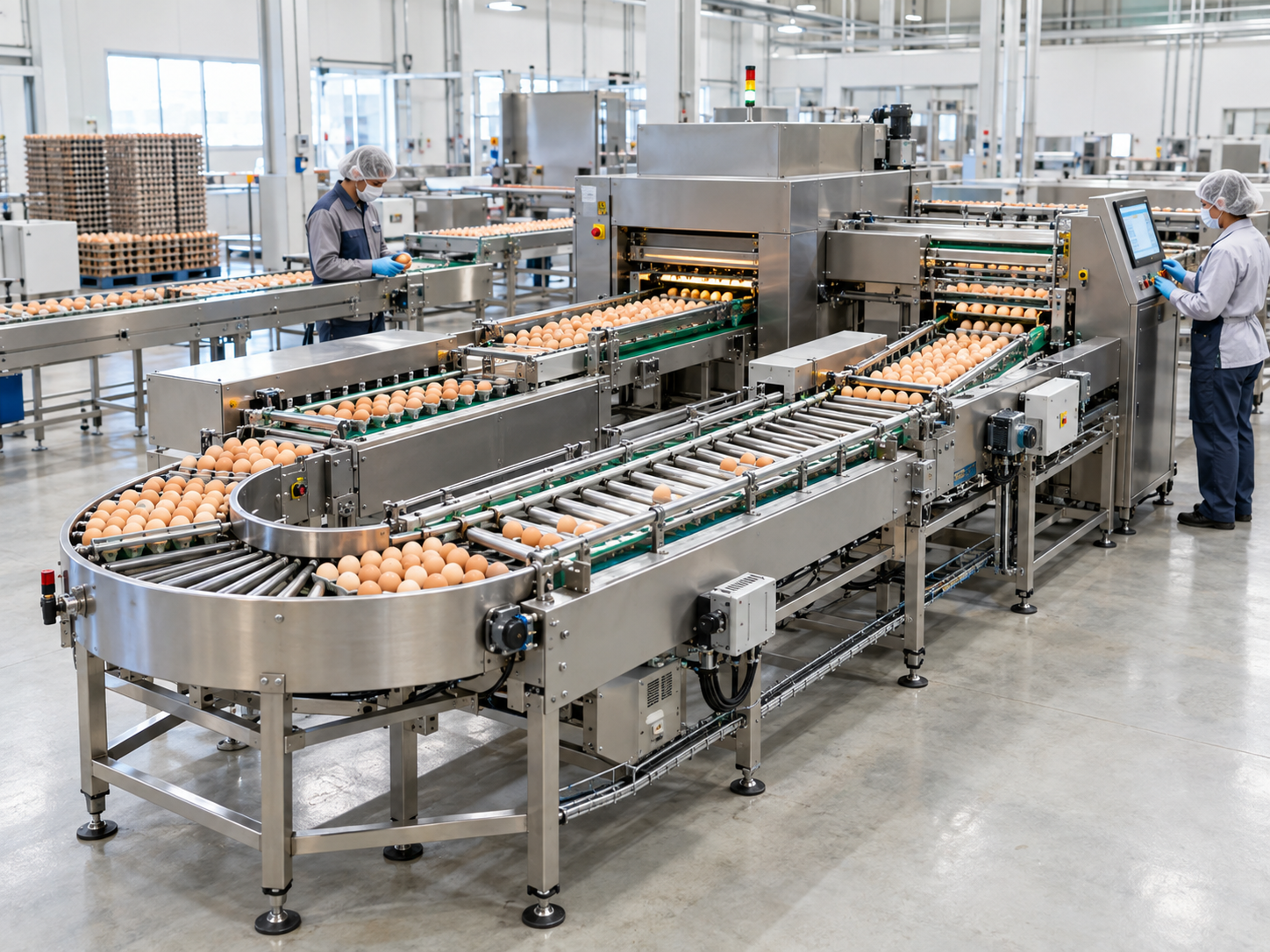
5. German Poultry Welfare and Environmental Rules Affect Equipment Selection
Laying-hen cages: an essential distinction
Germany's rules for laying hens are more restrictive than the general EU framework in important respects. The country's small-group cage housing transition ended for most operators at the end of 2025, with limited case-specific transitional arrangements possible through the end of 2028.
Consequently, a standard commercial A-frame or H-type layer cage should not be presented as the default solution for a new laying-hen farm in Germany. Check the intended housing category and current legal requirements before designing or purchasing equipment.
The European Commission's laying-hen rules establish minimum EU standards, but German national requirements must also be considered.
European Commission: Laying-hen welfare
German poultry housing guidance
Ammonia, odour, dust and manure
Poultry farms also need to address ammonia emissions, odour, dust, manure storage and nutrient management. Depending on the project and its location, German TA Luft requirements, environmental permitting and fertilizer rules may affect the required equipment.
A proposal may need to consider manure removal frequency, litter moisture, storage arrangements, emission-reduction technology and available land or external manure-disposal contracts.
Do not assume that installing a manure belt or a composting machine by itself guarantees environmental compliance. An environmental consultant and the responsible authority should review the site-specific requirements.
German Environment Agency: Ammonia, odour and dust
German Environment Agency: Manure and fertilizer management
6. How Germany's Climate Changes Poultry Equipment Requirements
Germany has a temperate climate, but poultry-house requirements vary with region, season and building design. Equipment should work reliably during winter cold, humid periods and increasingly important summer heat events.
| Condition | Design implication |
|---|---|
| Cold winters | Insulation, heating capacity, minimum ventilation and condensation control |
| Humid weather | Moisture management, controlled airflow and dry litter |
| Summer heat | Ventilation capacity, emergency alarms and reliable power backup |
| Heavy rain and exposed sites | Roof drainage, weather protection and durable building details |
| High environmental sensitivity | Site-specific ammonia, dust, odour and manure management |
For a German poultry project, simply copying an equipment specification designed for a hot, dry climate may be inappropriate. Mechanical ventilation needs winter minimum-airflow capability, as well as suitable summer airflow.
Cooling pads and other evaporative systems should be evaluated against local temperature and humidity conditions, rather than included automatically. The complete house requires a climate-specific engineering calculation.
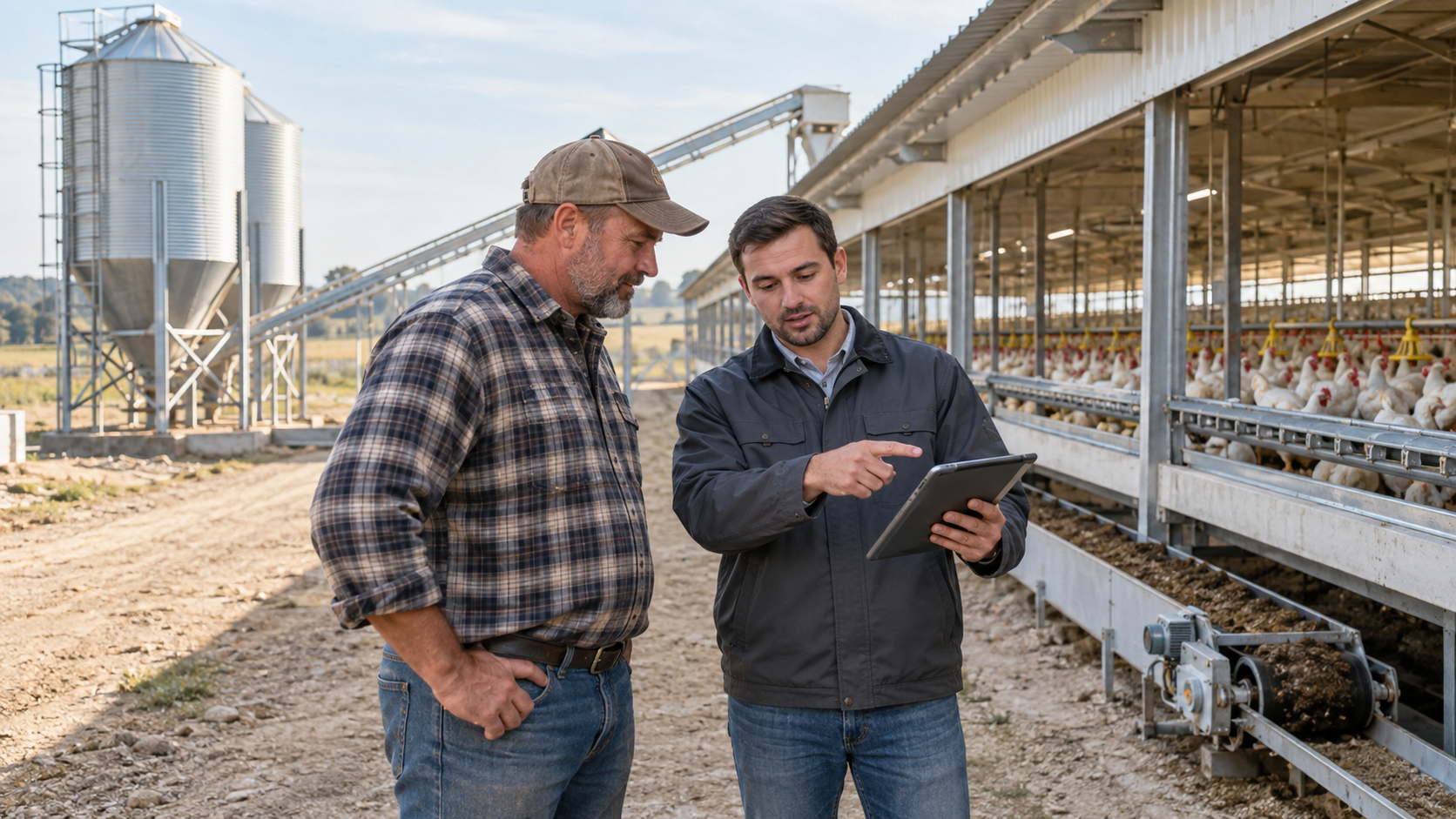
7. German vs Chinese Poultry Equipment: Should Buyers Consider Both?
German manufacturers are established options for poultry equipment purchasing, particularly when buyers want nearby technical support, documented factory operations and experience with local housing requirements.
Chinese manufacturers can also be considered for international poultry projects, especially when buyers need a customized equipment package or are comparing multiple suppliers for a large installation.
However, the comparison must be made on equivalent technical scope, not brand country alone.
| Buying factor | German manufacturer | Chinese manufacturer |
|---|---|---|
| Production origin | May be domestic or international; verify product | Verify factory, component origin and manufacturing scope |
| Technical suitability | Check actual product and experience with the required housing model | Check ability to engineer the required housing and automation system |
| Price | Request detailed installed quotation | Compare factory, freight, tax, installation and support costs |
| Spare parts | Verify local stock and lead time | Verify regional stock, shipping time and emergency arrangements |
| Service | Confirm contract, geographic coverage and response commitment | Confirm local partners, remote support and commissioning responsibilities |
| German project compliance | Must meet applicable local requirements | Must meet the same applicable local requirements |
Where Guangxing fits into the comparison
Guangzhou Guangxing Poultry Equipment Group is a Chinese poultry equipment manufacturer offering cage housing, automatic feeding, drinking, manure removal, egg collection and environmental control equipment.
For projects in countries where the proposed housing systems are permitted, buyers may consider the following Guangxing solutions:
- H-type automatic layer cage system for suitable layer-farming markets.
- Multi-tier broiler cage system for projects where this housing method is legally and commercially appropriate.
- Automatic feeding systems for compatible poultry-house configurations.
- Automatic egg collection equipment for compatible layer installations.
- Poultry environmental control systems for ventilation and operational monitoring.
For a project located in Germany, Guangxing's housing products should not be proposed without first assessing German welfare rules. Individual feeding, drinking, egg-handling or environmental-control components might be considered only after confirming technical compatibility, product requirements, compliance documentation and local service.
For projects outside Germany, a German and a Chinese supplier can be compared using the same capacity, housing method, technical specifications and delivery conditions.
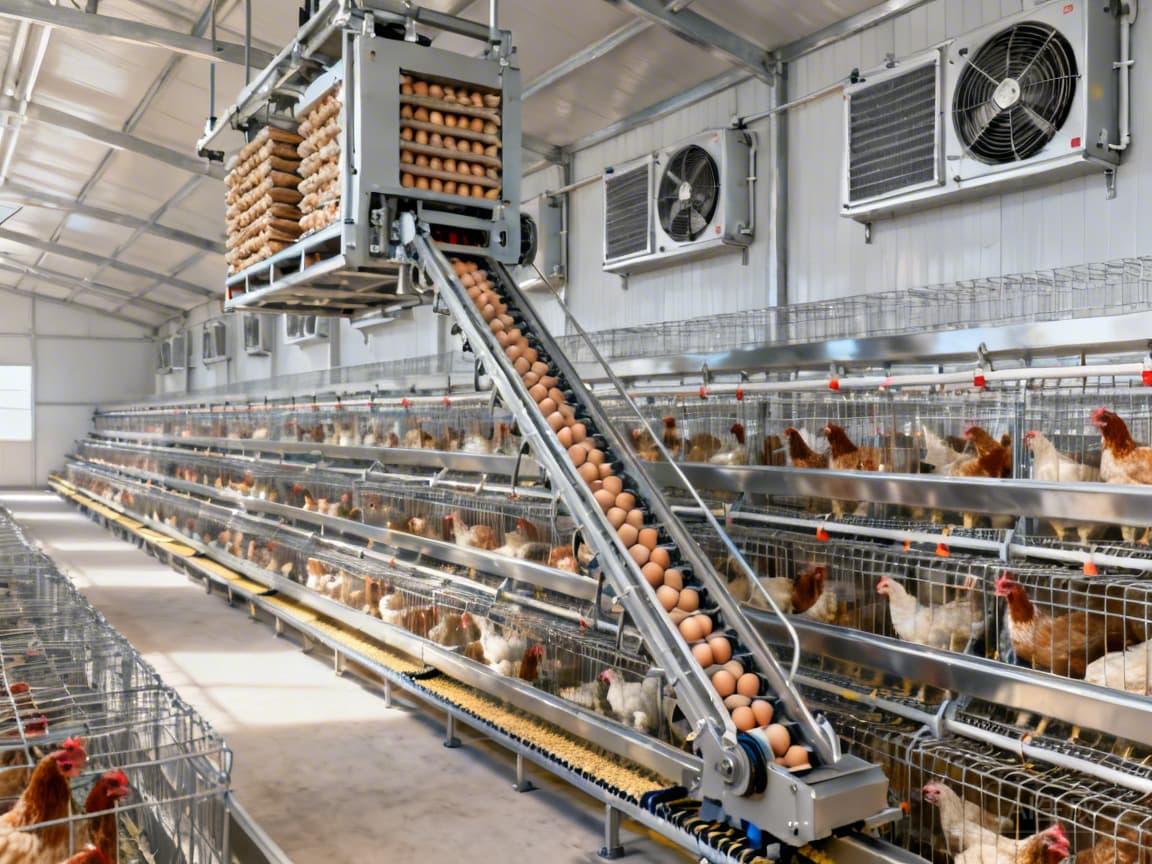
Compare total installed cost, not only equipment price
A lower factory quotation may not produce a lower project cost if freight, import duties, installation, spare parts and service are higher. Similarly, a higher initial price may be justified when it reduces operational risk over the equipment's working life.
For a fair comparison, request the same bill of quantities, performance specifications, installation scope and warranty conditions from each supplier.
For further procurement guidance, see Guangxing's poultry equipment price and buying guide .
8. How to Choose a Poultry Equipment Manufacturer in Germany
A good supplier shortlist should consider more than the company's age, factory size or online reputation. It should match the proposed farm's housing requirements and long-term operating needs.
Before requesting quotations
- Identify layers, broilers, pullets or breeders.
- Specify capacity and intended housing method.
- Confirm project country and local regulations.
- Prepare building dimensions and site conditions.
- Define expected automation and service levels.
Before signing a contract
- Request an itemized equipment schedule.
- Confirm critical-component manufacturers.
- Check drawings, safety and conformity documents.
- Compare commissioning and staff training.
- Verify spare-parts lead times and warranty exclusions.
Choose the manufacturer by application
| Your main requirement | Suppliers worth investigating |
|---|---|
| Integrated layer or broiler project | Big Dutchman, Fienhage, SALMET-FIENHAGE, FIT |
| Layer housing and rearing | Hellmann, Fienhage, SPECHT, SALMET-FIENHAGE |
| Drinking equipment and egg conveyors | LUBING and relevant subsystem suppliers |
| German-made housing components | SPECHT, Hellmann and SALMET merit detailed factory-origin inquiries |
| China-based alternative for permitted international projects | Guangxing and other qualified manufacturers |
This is a starting shortlist, not an endorsement or confirmation that each company supplies every product listed. Request current technical catalogues directly from the supplier.
Comparing German and Chinese Poultry Equipment for Your Project?
Tell us your project country, bird capacity, housing method, available building dimensions and automation requirements. Guangxing can discuss equipment configurations and provide a quotation for systems within its product range.
For German or EU projects, technical and legal suitability must be checked before procurement. We do not present standard layer cage systems as approved new housing solutions in Germany.
Contact Guangxing for Equipment Planning9. Frequently Asked Questions
Who are the main poultry equipment manufacturers in Germany?
Relevant German-based suppliers include Big Dutchman, Fienhage, Hellmann Poultry, SALMET-FIENHAGE, SPECHT, Farm Innovation Team and LUBING. The most suitable company depends on whether you need complete housing, feeding systems, drinking equipment, egg conveying or other equipment.
Are all poultry equipment components made in Germany?
Not necessarily. Some manufacturers document German factory production, while others have wider international operations and supply networks. Ask for product-specific origin and component information.
Which German company manufactures poultry drinking equipment?
LUBING is a well-known specialist supplying poultry drinking systems and egg-conveying equipment.
Are traditional layer cages permitted for new farms in Germany?
Germany has restrictive laying-hen housing regulations, including the 2026 phase-out of small-group cage housing for most operators. Do not assume an A-frame or H-type layer cage is suitable for a new German installation.
Can poultry farmers buy equipment from China instead of Germany?
Yes, buyers can evaluate Chinese suppliers for suitable projects, subject to import rules, product requirements and local housing regulations. Compare the complete installed system, spare parts and service, not just the purchase price.
What should I check when importing poultry equipment into Germany?
Check the applicable product safety and conformity requirements, customs classification, import documentation, electrical compatibility and local installation responsibilities. Not all equipment is subject to the same conformity procedures, so obtain advice based on the actual product.
Research Sources and Verification
The comparison is based primarily on manufacturer websites and official German or European information. Country-of-origin statements are attributed to the relevant company and are not independent factory audits.
- SPECHT — Company and manufacturing
- Hellmann — Company and production
- SALMET — German production locations
- Fienhage — Company profile
- Big Dutchman — Company
- Farm Innovation Team — Poultry housing
- LUBING — Company history
- German official poultry statistics
- German laying-hen housing guidance
- German Environment Agency
Editorial note: Information reviewed in November 2026. Product ranges, company relationships and regulatory requirements may change. Confirm manufacturing origins, current catalogues and project permissions before procurement.