


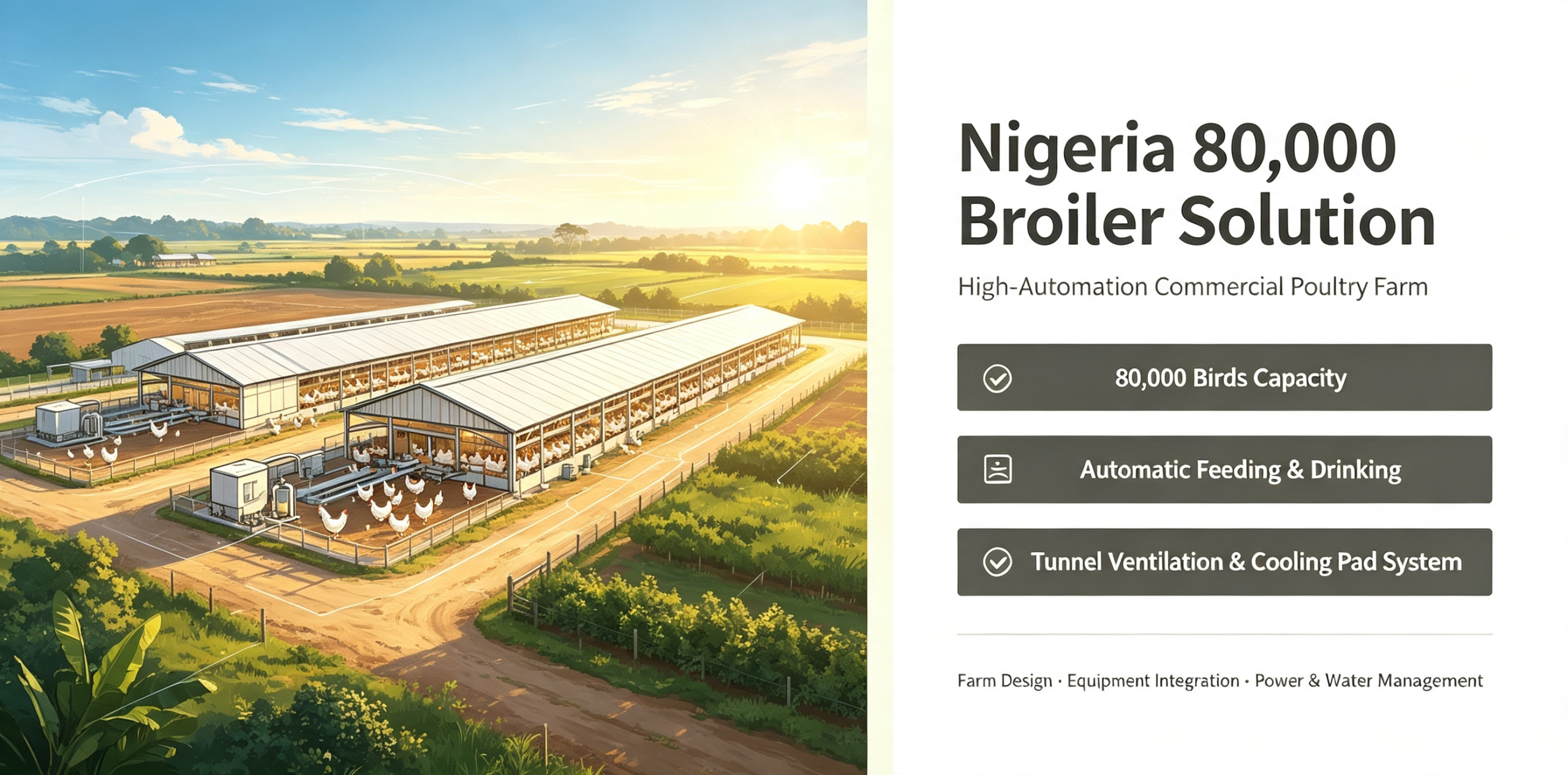
An 80,000 broiler farm in Nigeria is already large enough that equipment should not be purchased one machine at a time.
- This is where many projects go wrong.
- A buyer may first ask for the price of feeders, then ask another supplier for fans, and later begin looking for a generator and water tanks. On paper, every item appears to be covered. When installation starts, however, the fan capacity may not match the poultry house, the generator may be undersized, or the feeding line may not fit the house layout.
- For a farm of this size, we prefer to start from four questions:
How many birds will be kept in each house?
What is the target market weight?
Will the birds be raised on litter or in cages?
What electricity, water and land are actually available at the site?
- Once these are known, the equipment list becomes much easier to calculate.
If you are still comparing different farm capacities, our Nigeria Broiler Farm Solutions for 5,000–200,000 Birds provides a broader comparison. This page focuses specifically on what changes when the target capacity reaches approximately 80,000 broilers.
1. Start With the Production Model, Not the Equipment List
- “80,000 birds” tells us the farm capacity, but it does not tell us how large the poultry houses need to be.
- Target live weight matters just as much.
- Consider a simple example.
- If a house holds 20,000 broilers and the farm plans to sell them at an average live weight of 2.2 kg, that building has to manage approximately:
20,000 × 2.2 kg = 44,000 kg of live bird weight
- toward the end of the cycle.
- If the customer instead produces a heavier 2.8 kg bird, the same house may be carrying approximately 56,000 kg of live weight.
- That difference affects heat production, airflow, drinking demand, feeding space and the density that the building can safely support.
- This is why we do not recommend working backward from a fixed “birds per square metre” number taken from another farm.
- The final stocking plan should take into account the broiler breed, market weight, house type, ventilation performance and applicable local requirements.
- For an 80,000-bird project, dividing production into several houses is normally more practical than placing the entire flock in one building.
- A possible planning structure is:
Example Layout | Capacity |
House 1 | 20,000 birds |
House 2 | 20,000 birds |
House 3 | 20,000 birds |
House 4 | 20,000 birds |
Total | 80,000 birds |
- This is an example rather than a standard Guangxing house specification. Depending on the land and raising method, another project may use three, five or more houses.
- That distinction is important when requesting quotations.
2. Floor Rearing or Multi-Tier Broiler Cages?
- This decision should be made early because almost everything downstream changes with it.
- For a litter-based farm, birds move freely on the floor. The house normally uses pan feeding lines, nipple drinking lines, heating or brooding equipment, tunnel ventilation, cooling pads and environmental control.
- The structure is familiar to many commercial broiler operators, but it requires sufficient floor area.
- Litter condition also becomes part of daily management. Poor drinking-line adjustment, excessive humidity or inadequate ventilation can quickly create wet litter areas.

- Where land is expensive or the investor wants more production capacity from the same building footprint, a cage system may be considered.
Guangxing’s broiler chicken cage farming system combines cage rows with feeding, drinking, manure removal and environmental-control equipment.
For a more equipment-focused specification, see the Automatic Multi-Tier Broiler Cage System.
- The cage option changes the project in several ways:
- more birds can be arranged vertically
- manure can be removed by belts below each tier
- feed is normally supplied through cage feeding troughs rather than floor pans
- ventilation has to move air through several vertical levels
- building height becomes more important

- This is also why a quotation for a floor broiler farm should not simply be converted into a cage-farm quotation by changing the bird capacity.
- They are two different production systems.
3. What We Would Check Before Designing the Poultry Houses
- For a greenfield 80,000-bird project, poultry house orientation and spacing should be considered before civil work begins.
- The farm normally needs space not only for the houses but also for:
- feed trucks
- silos
- water storage
- generator room
- electrical control
- staff and changing facilities
- disinfection
- mortality handling
- manure or litter movement
- loading vehicles
- future expansion
- One practical mistake is placing poultry houses first and trying to squeeze the supporting areas into whatever land remains.
- For example, a feed truck needs a practical route to the silo. Manure vehicles should ideally not have to use the same clean traffic route used to enter production areas. Generator exhaust and noise also need to be considered when deciding where the power room will sit.
- If steel buildings are part of the project, our guide to steel structure poultry houses explains insulation, corrosion and equipment-integration issues in more detail.
- For Nigeria, insulation should not be treated as a minor building option.
- A cheap metal roof may reduce initial construction cost, but if the roof absorbs large amounts of solar heat every afternoon, the ventilation and cooling system has to remove that extra heat for years.
- The cheapest building is not always the cheapest farm to operate.
4. Feeding 80,000 Broilers Is a Logistics Problem
Automatic feeding is usually discussed as a labor-saving system. At 80,000 birds, however, there is another issue: feed movement.
- Feed has to move from delivery truck to storage, from storage to the poultry house, and finally from the main line to the birds.
- For a floor farm, the flow may look like this:
Feed truck → outdoor silo → auger/cable conveying → indoor feed line → feed pans
- For a multi-tier cage farm:
Feed truck → silo → feed conveying → feeding trolley/chain system → cage troughs
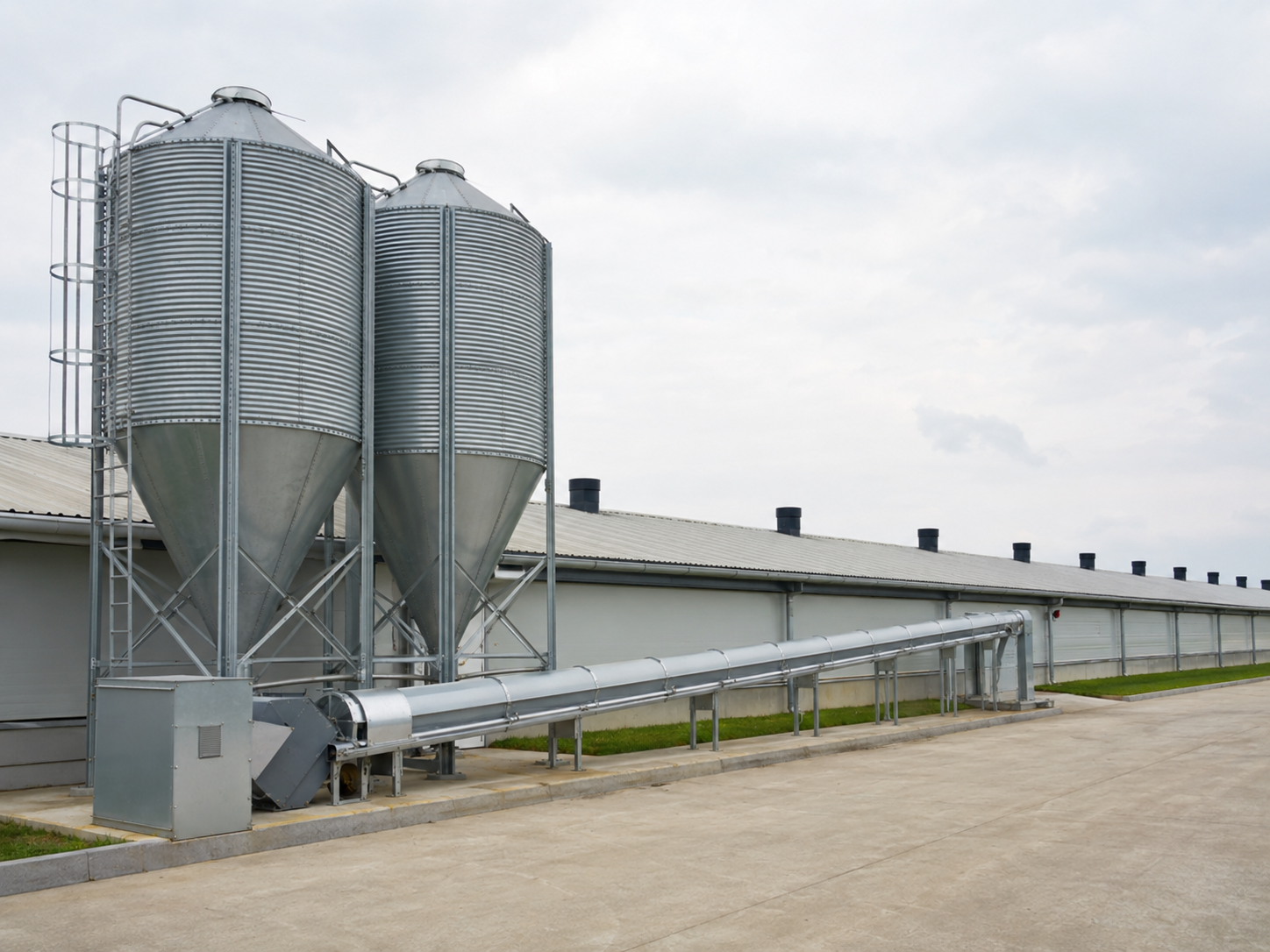
- These two systems should not be mixed in one generic equipment list.
- Silo size also deserves attention.
- Rather than asking, “What silo size is normally used for 80,000 chickens?”, a better calculation is:
daily feed consumption × required reserve days = minimum working storage requirement
- Then add operating margin and consider how reliably feed can be delivered to the site.
- A farm located near a reliable feed mill may operate differently from one where feed trucks travel a long distance or deliveries become difficult during certain periods.
- This is an example of why the site location matters even when the bird number is identical.
5. Water Supply Needs Two Separate Calculations
- Many poultry equipment quotations contain one line saying “automatic drinking system.”
- That is not enough for a farm this size.
- There are actually two water loads:
1. Water consumed by the birds
2. Water used by evaporative cooling and other farm operations
- Both can peak during hot weather.
- This creates an important design problem: the day when the broilers drink the most water can also be the day when the cooling pads need the most water.
- A good project therefore starts upstream.
- We normally want to know:
- Where does the water come from?
- What is the available flow rate?
- Is there a borehole?
- Is the supply intermittent?
- How much storage is available?
- Has water quality been tested?
- How far are the tanks from the poultry houses?
- Inside the house, pressure regulators, filters and flushing points have to be accessible for maintenance. Each production house should also be considered separately so that a fault in one drinking line does not become a farm-wide problem.
- Water meters are particularly useful.
- A sudden drop in consumption can indicate a drinking-system fault or flock problem long before workers notice it visually.
The important point is simple: do not size the water system only from the nominal capacity of the tank.
- The pump, pipeline diameter, filtration capacity and refill rate matter too.
6. Ventilation Is Where an 80,000-Bird Project Can Become Expensive to Get Wrong
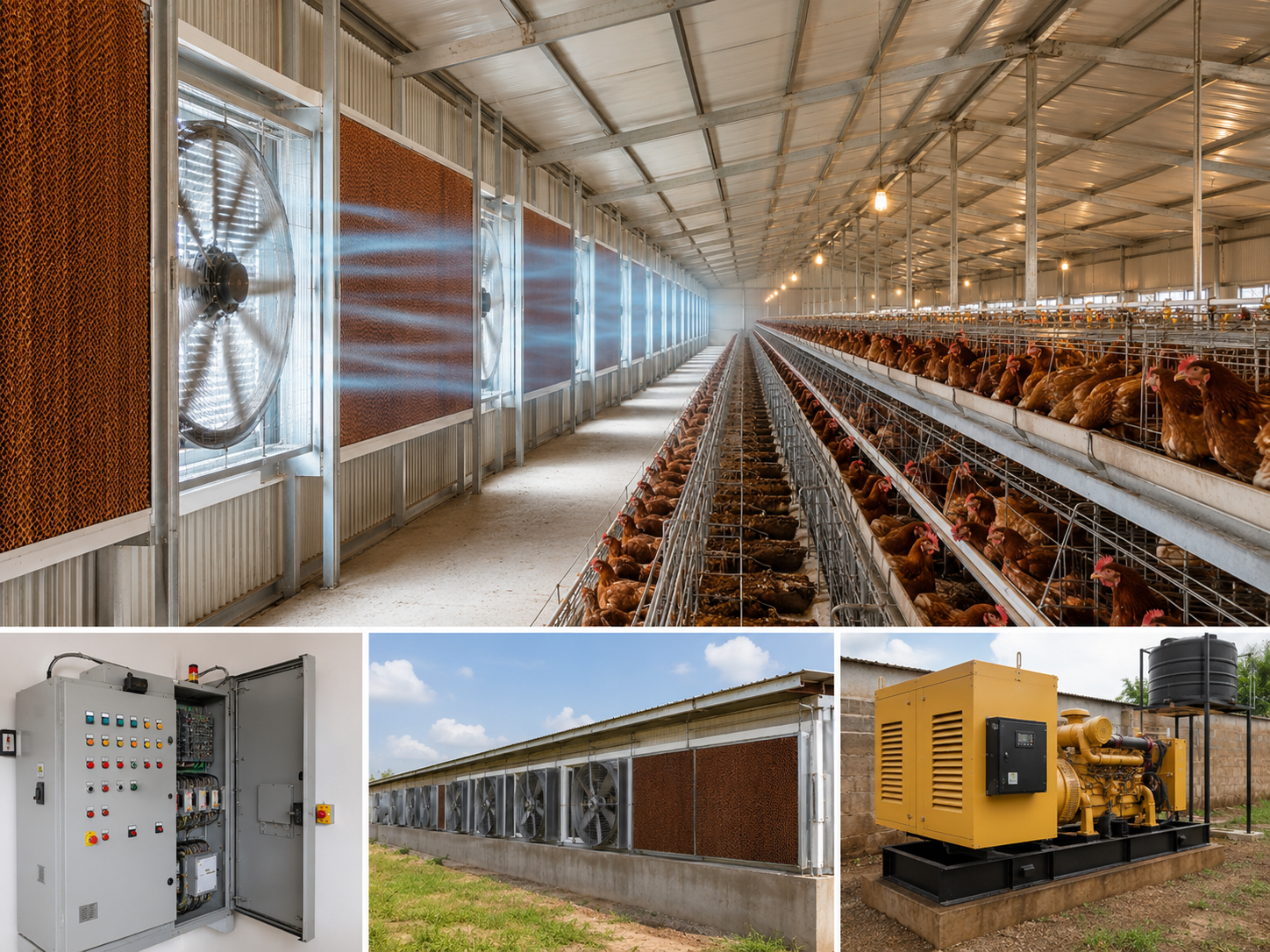
- Fans are easy to count.
- Airflow is harder.
- Suppose one supplier quotes 20 fans and another quotes 24. It is tempting to compare the two prices directly.
- But the number of fans tells very little unless we also know:
- actual fan air delivery
- poultry house cross-sectional area
- house length
- target air velocity
- static pressure
- inlet or cooling-pad area
- fan performance under operating pressure
- That is why we would not confirm the final fan quantity before receiving the house dimensions.
- In a tunnel-ventilated house, the objective is to move air through the entire occupied zone rather than simply install a large number of fans at one end.
- Long houses, obstructed airflow, dirty cooling pads and poorly sealed buildings can all reduce actual performance.
- This becomes more important near market age because the house contains substantially more live bird mass than it did during brooding.
For automatic control, Guangxing can integrate fans, cooling pads, sensors and other equipment through a Poultry House Environmental Control System.
For a four-house farm, we prefer thinking in terms of independent house control.
- If House 2 has a sensor or control fault, Houses 1, 3 and 4 should not have to stop operating with it.
7. Cooling Pads Do Not Replace Good Ventilation
- Cooling pads are useful, but they are sometimes overestimated.
- The pad is only one part of the cooling system.
- Air has to pass evenly through the wet pad, enter the poultry house and then move through the bird area before reaching the exhaust fans.
- If the house leaks heavily through doors, roof gaps or wall openings, some air bypasses the pad.
- If the pad surface is too small for the airflow being pulled through it, resistance increases.
- Water quality also matters because mineral deposits can gradually block the pad material.
- So when we evaluate cooling for a Nigerian project, we look at:
pad area + fan capacity + building tightness + water supply + control logic
- rather than simply quoting a certain number of metres of cooling pad.
8. The Generator Should Be Sized From the Emergency Load
- For an enclosed commercial poultry house, backup power is not optional equipment in the same sense as an extra storage shed.
- If grid power fails on a hot afternoon, ventilation may immediately become the priority load.
- This is why generator sizing should be based on electrical demand.
- A useful first step is to separate equipment into two groups.
- tunnel fans
- minimum ventilation fans
- environmental controller
- drinking-water pumps
- essential cooling pumps
- alarm and control circuits
- feeding motors
- manure removal equipment
- some lighting circuits
- non-critical workshop equipment
- Not every motor has to start at the same second.
- By designing start sequences, electrical controls and emergency priorities properly, the project may avoid unnecessarily oversizing the generator while still protecting the flock.
- We would therefore ask for the final motor list before recommending generator capacity.
- “80,000 birds = X kVA generator” is too crude for a serious project.
9. What Happens If One House Stops?
- This question is rarely included in equipment brochures, but it matters.
- At 80,000 birds, the project should not only be designed for normal operation.
- It should also be designed around failure.
- Ask:
What if the main water pump stops?
What if one temperature sensor reads incorrectly?
What if a feed motor trips?
What if the generator does not start automatically?
What if one fan bank loses power?
- The response does not always require expensive redundancy. Sometimes the answer is a bypass valve, manual control switch, spare sensor, independent circuit or emergency water connection.
- These small details often contribute more to farm reliability than adding another layer of software.
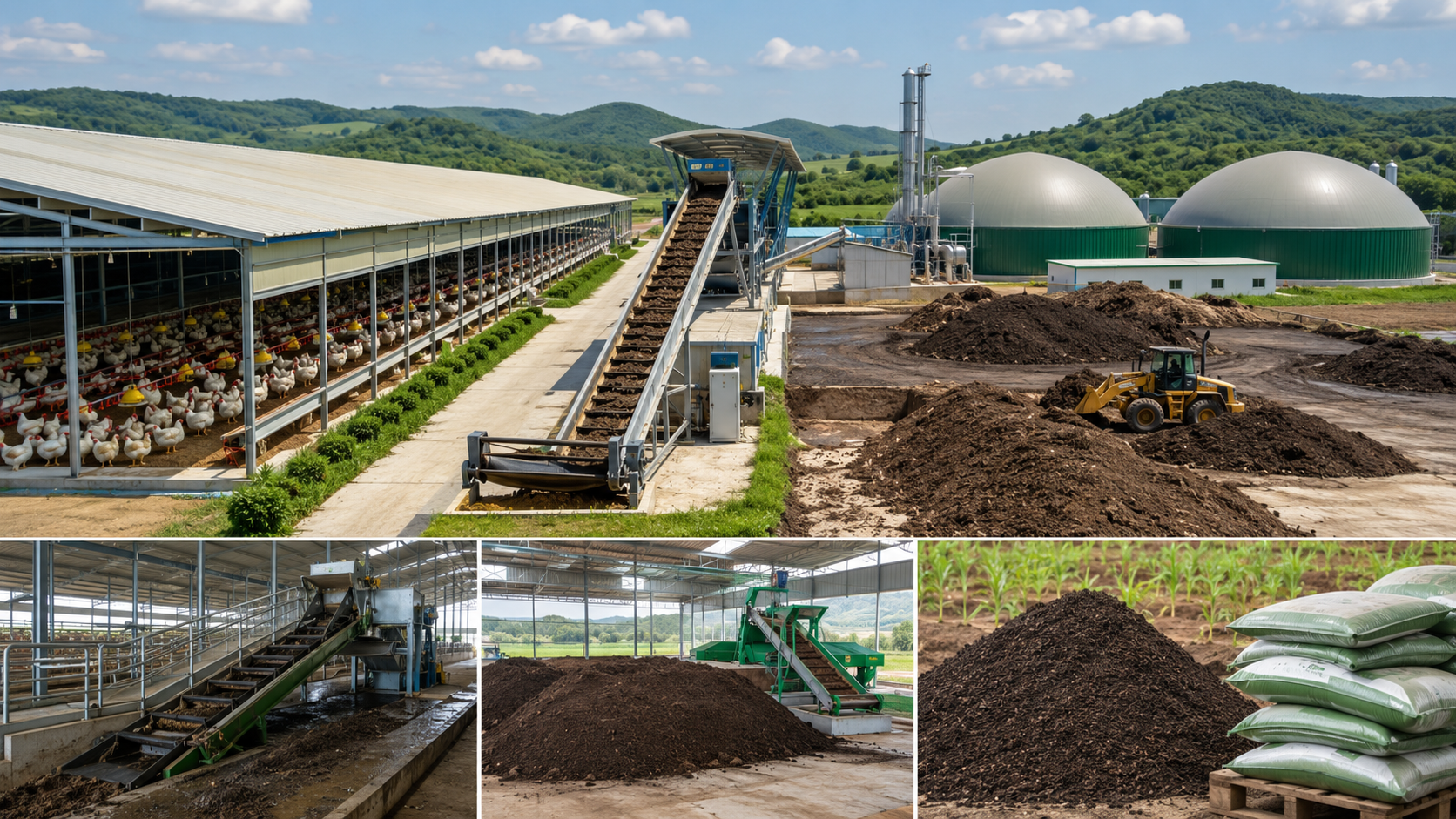
10. Manure and Litter Need a Route Out of the Farm
- With floor rearing, litter is usually removed at the end of the production cycle.
- With multi-tier cage rearing, manure belts can remove manure more frequently.
- Either way, the material has to go somewhere.
- A large farm should decide before construction whether waste will be:
- temporarily stored
- sold to nearby crop farms
- composted
- fermented
- transported to a separate treatment area
Where centralized treatment makes commercial sense, Guangxing also supplies the 11FFG-100 Vertical Poultry Manure Composting System.
- It is better to plan this area before the internal roads are built.
- Otherwise, manure trucks may end up crossing clean production routes simply because there is no other way to reach the storage area.
11. What Actually Determines the Cost of an 80,000 Broiler Farm?
- We do not recommend publishing one fixed “80,000 broiler farm price.”
- It can create the wrong expectation.
- A meaningful budget should be divided into several packages.
Cost Area | What It May Include |
Poultry houses | Steel structure, roof, insulation, walls, doors |
Broiler equipment | Floor or cage raising equipment |
Feeding | Silos, conveying and feeding system |
Drinking | Tanks, pumps, filtration, pressure control, nipple lines |
Climate | Fans, air inlets, cooling pads, controller |
Electrical | Cabling, distribution boards, control panels, generator |
Brooding | Heating and chick-zone equipment |
Waste | Litter/manure collection and treatment |
Logistics | Packing, sea freight, inland transportation |
Services | Installation guidance, commissioning and training |
- Two 80,000-bird farms can therefore have very different budgets.
- A customer who already owns four suitable houses does not have the same investment requirement as an investor buying land and building the entire farm from zero.
- Likewise, a floor-rearing project and a fully automated multi-tier cage farm should not be compared using only “cost per bird.”
12. Suggested 80,000-Bird Project Workflow
- For a new project, a more sensible sequence is:
1. Confirm the target production capacity and market weight
2. Survey the land and available infrastructure
3. Decide between floor and cage production
4. Calculate poultry-house capacity
5. Complete the farm layout
6. Calculate feeding, drinking and ventilation requirements
7. Calculate the total electrical load
8. Confirm generator and water-storage requirements
9. Finalize the equipment list
10. Prepare shipment and installation plan
- The sequence matters.
- Buying equipment before Steps 1–6 are complete often creates additional modification work later.
13. Why Guangxing Does Not Use One Standard 80,000-Bird Package
- A standard package is easy to sell, but farms are rarely standard.
- A project near Lagos may face a different combination of heat, humidity, land cost and infrastructure from a farm elsewhere in Nigeria.
- One customer may already have poultry houses.
- Another may need a complete greenfield project.
- One investor may prefer floor production because the local team already understands litter management. Another may want multi-tier broiler cages to reduce land use and automate manure handling.
For that reason, Guangxing treats 80,000 birds as the starting capacity, not as the final equipment specification.
- Our job is to turn that capacity into a workable combination of house layout, raising equipment, feeding, drinking, ventilation, environmental control, power and waste handling.
14. FAQ
How many poultry houses do I need for 80,000 broilers?
- Four houses of approximately 20,000 birds each can be used as an initial planning concept, but this should not be treated as a fixed design. Final house capacity depends on usable floor or cage area, target market weight, ventilation design and the selected production system.
Can 80,000 broilers be kept in one poultry house?
- Technically, large poultry houses can hold substantial numbers of birds, but concentrating the entire project in one building increases the effect of equipment, ventilation or power failures. A multi-house design is usually easier to manage and provides better operational separation.
Is automatic feeding necessary?
- At this scale, automatic feeding is strongly worth considering. The greater issue is not only labor cost but also how consistently several tonnes of feed are moved, distributed and monitored across multiple houses.
Does the farm need cooling pads?
- That depends on local climatic conditions, house design and ventilation strategy. For enclosed tunnel-ventilated projects in hot conditions, evaporative cooling is commonly considered together with high-capacity ventilation.
What information is needed before Guangxing can calculate fan quantities?
- At minimum, we need poultry-house length, width, internal height, bird capacity, raising system and basic climate information. Final fan quantities should be based on airflow calculations rather than bird number alone.
Can Guangxing supply the whole project?
- Depending on the agreed scope, Guangxing can provide poultry raising systems, feeding and drinking equipment, environmental control, manure handling, poultry-house-related solutions, installation guidance, commissioning support and technical training.
15. Planning an 80,000 Broiler Farm in Nigeria?
Before asking for a final equipment price, send us your project location, land or poultry-house dimensions, target market weight and preferred raising method.
- Even a simple hand drawing of the site is useful at the early stage.
- Our engineering team can use this information to prepare a preliminary farm layout and equipment configuration, so you can see what the project actually requires before committing to the purchase.
Contact Guangxing for an 80,000-bird broiler farm layout and equipment quotation.

