


1. Before Asking for Equipment Prices, Confirm the Farm Conditions
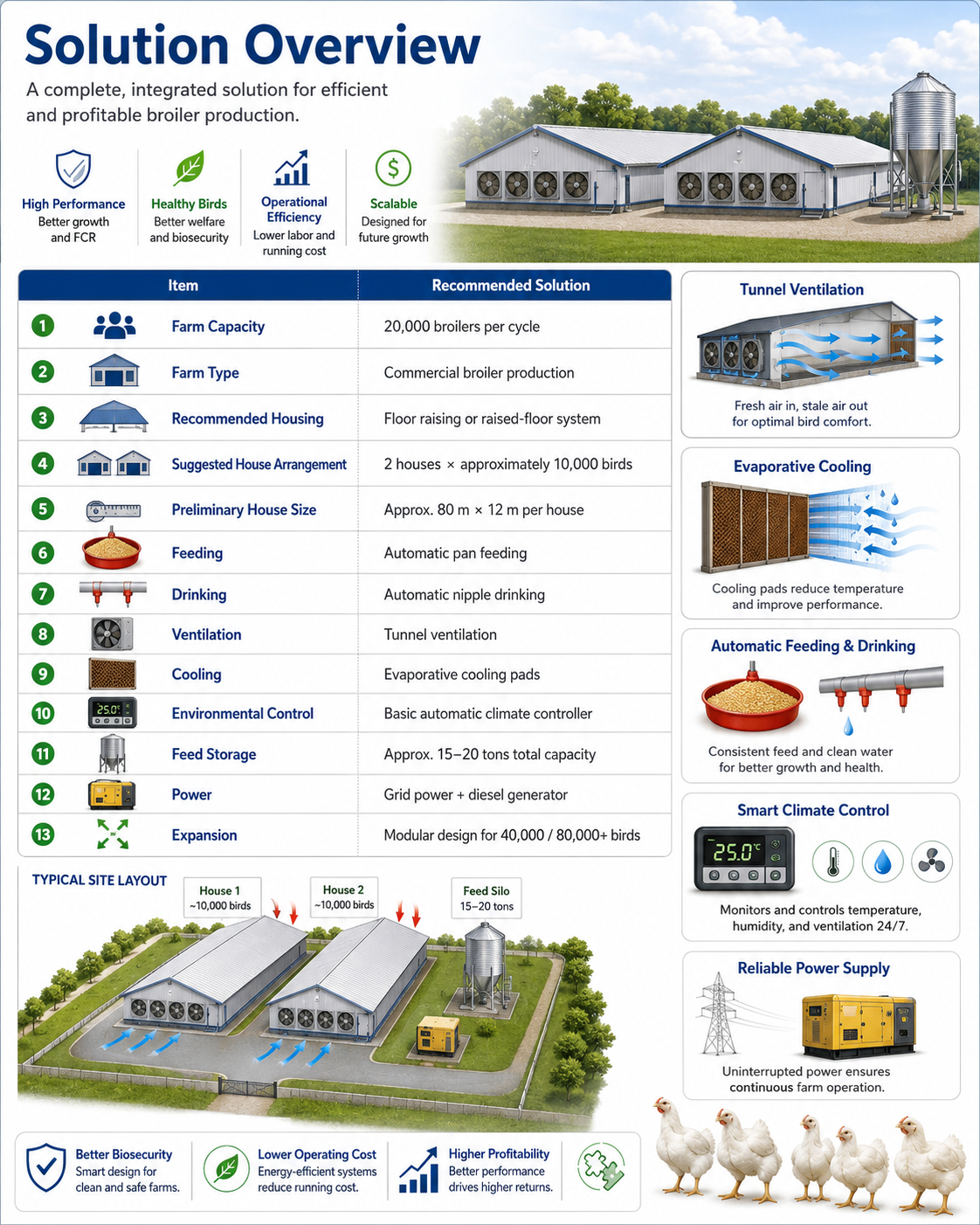
Planning a 20,000 broiler farm in Nigeria involves more than deciding how many feeders, drinkers and ventilation fans to purchase.
- Before preparing an equipment quotation, we normally confirm several more important factors:
Where will the farm be built? What is the target market weight? How reliable are the water and electricity supplies? Is 20,000 birds the final capacity or only the first stage of expansion?
- These factors directly affect house size, feed storage, water reserve, ventilation capacity and the overall farm layout.
- For many projects at this scale, a practical starting configuration is:
2 broiler houses × approximately 10,000 birds + automatic pan feeding + nipple drinking + mechanical ventilation + environmental control + feed silos + water storage + backup power.
- The final configuration, however, should still be calculated around the actual site rather than selected from a standard equipment package.
2. Preliminary Configuration for a 20,000-Bird Broiler Farm
Item | Planning Reference |
Farm capacity | 20,000 broilers per cycle |
Poultry houses | Usually 2 houses × about 10,000 birds |
Raising system | Floor-rearing or broiler cage system |
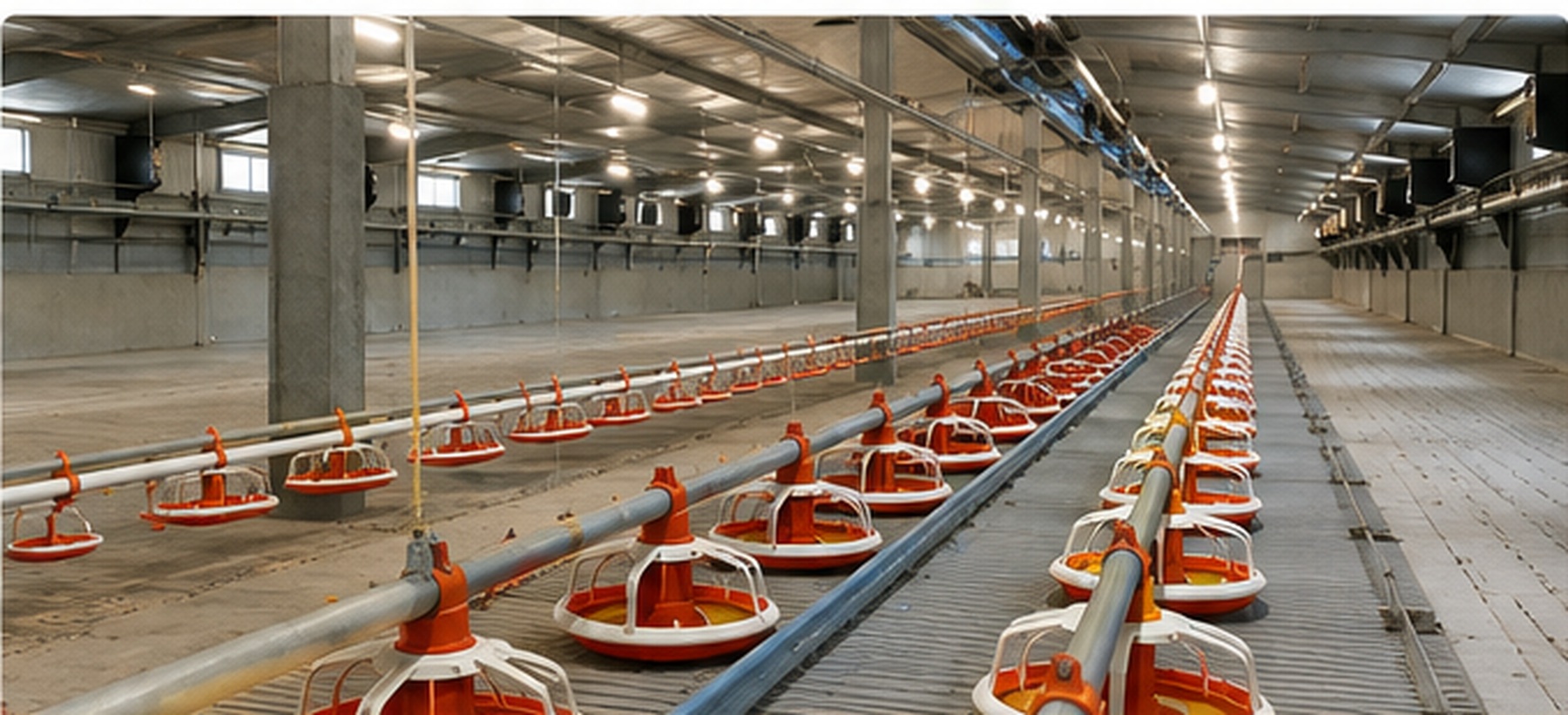
Feeding | Automatic pan feeding |
Drinking | Automatic nipple drinking |
Feed storage | About 15–20 tons of working storage |
Ventilation | Mechanical or tunnel ventilation |
Cooling | Cooling pads according to local climate |
Water | Storage + filtration + pressure regulation |
Control | Automatic environmental controller |
Power | Grid power + backup generator |
Expansion | Reserve land and utility capacity |
- These figures are intended for preliminary planning only and should not be treated as final engineering specifications.

3. Calculate House Size From Market Weight, Not Bird Numbers Alone
- Simply saying that a house will contain 10,000 broilers is not enough to determine its correct size.
The target market weight also needs to be considered.
- In commercial broiler production, stocking density should be evaluated according to live weight per square metre, local climate, house design and environmental control capability.
Using 30 kg/m² only as a preliminary planning reference:
Target Market Weight | Total Live Weight of 10,000 Birds | Theoretical Usable Floor Area |
2.0 kg/bird | 20,000 kg | about 667 m² |
2.2 kg/bird | 22,000 kg | about 733 m² |
2.5 kg/bird | 25,000 kg | about 833 m² |
- This is why we do not recommend copying another farm's house dimensions simply because it also keeps 10,000 broilers.
- If the target market weight increases from 2.0 kg to 2.5 kg, the heat load, feed consumption, water demand and usable floor area all change.
- The expected market age and target weight should therefore be confirmed before finalizing the house dimensions.
4. Why Do We Often Recommend Two 10,000-Bird Houses?
- Technically, all 20,000 broilers can be housed in one larger building.
For many first-stage commercial farms, however, two houses of approximately 10,000 birds each are easier to manage.
- The main advantage is operational independence.
- If one house experiences a temporary problem with its feeding equipment, controller or electrical circuit, the other house can continue operating.
- Two houses also allow chick placement to be staggered, so the farmer does not have to market all 20,000 birds at the same time.
- This arrangement is not necessarily cheaper. Two houses normally require additional walls, plumbing and electrical distribution.
The main consideration is therefore not the lowest construction cost, but reducing the risk of a single technical problem affecting the entire flock.
5. A 20-Ton Feed Silo Does Not Hold Feed for the Entire Production Cycle
- Many buyers see a recommendation for 15–20 tons of feed storage and assume that this is the total feed required for an entire flock of 20,000 broilers.
In practice, it should be treated as working storage between feed deliveries.
House A: 1 × 10-ton feed silo
House B: 1 × 10-ton feed silo
- This allows the two houses to operate more independently and also makes it easier to use different feed formulations when the flocks are at different ages.
- The better question is therefore not:
- “What silo size do I need for 20,000 broilers?”
- It is:
“How many days of feed should the farm be able to hold if the next delivery is delayed?”
- A farm located close to a reliable feed supplier may need less storage.
- A more remote project, or one with less predictable delivery schedules, may benefit from a larger feed reserve.
An automatic pan feeding quotation should also clearly state the number of feed lines, number of pans and the allocation for each poultry house, rather than simply listing “Automatic Feeding System – 1 Set.”

6. Water Planning Is More Than Choosing a Tank Size
- Commercial broiler farms normally use nipple drinking systems rather than open drinkers.
Using approximately 12 broilers below 3 kg per nipple as an initial management reference:
20,000 ÷ 12 ≈ 1,667 nipples
- The final quantity should include an appropriate margin and should also take nipple flow rate, line length, water pressure and equipment specifications into account.
- Water storage is equally important.
For farms that depend on boreholes, pumps or an unreliable external water supply, we generally recommend planning enough reserve capacity to cover approximately 24 hours of peak drinking-water demand.
- A 5 m³ tank may appear sufficient during the brooding stage, but it can become inadequate as the birds approach market weight.
For many 20,000-bird projects, we would begin the engineering discussion with around 15–20 m³ of effective water storage, and then adjust this according to local temperature, borehole output and whether the cooling pads share the same water source.
- A practical water system should include:
storage → filtration → pressure regulation → medication → nipple drinking lines
- We also recommend installing a separate water meter for each poultry house.
- A sudden rise or drop in daily water consumption can help the farm manager identify flock or drinking-system problems earlier than simply checking the water-tank level.
7. Ventilation Should Be Calculated From Airflow, Not Bird Numbers
- One of the most common questions buyers ask is:
“How many 50-inch fans do I need for 20,000 broilers?”
- Bird numbers alone are not enough to provide a reliable answer.
- We also need the house length, width and height, required air speed, actual fan performance and the resistance created by cooling pads and air inlets.
- The correct calculation sequence is:
house dimensions → required airflow → actual fan performance → fan quantity
- rather than:
20,000 birds → a fixed number of fans
- Ventilation is also about more than cooling.
- It helps control humidity, ammonia, carbon dioxide and litter condition.
- For a commercial broiler farm in Nigeria, the environmental controller should at least be able to operate fans in stages and coordinate ventilation with evaporative cooling.
- A 20,000-bird farm does not necessarily need a highly complicated IoT platform.
A reliable environmental controller with both automatic and manual operating modes is often more valuable than adding unnecessary software functions.

8. Backup Power Should Be Planned From the Beginning
- Once a broiler house depends on mechanical ventilation, backup power should no longer be treated as an optional accessory.
- The priority loads normally include:
ventilation fans, water pumps, the environmental controller and essential feeding equipment.
- Generator capacity should be calculated from the actual electrical load and motor starting current rather than selected from a simple rule such as “20,000 birds = a fixed kVA rating.”
- A manual emergency operating method should also be retained.
- For example, if the environmental controller fails, the key ventilation fans should still be capable of manual operation.
- For projects with a limited budget, it is usually better to secure:
ventilation + drinking water + backup power
- before investing in additional software features.
- These systems directly affect whether the flock can remain safe during an unexpected failure.
9. Floor-Rearing or Broiler Cages for 20,000 Birds?
For many investors building their first 20,000-bird commercial broiler farm, a floor-rearing system remains a practical option.
- It generally requires less equipment investment and is relatively straightforward to maintain.
- If land is limited, higher stocking capacity is required, labor costs are becoming difficult to manage, or the farm is expected to expand rapidly, an automatic broiler cage system can also be evaluated.
- Guangxing's multi-tier broiler cage system can integrate cage structures, automatic feeding, nipple drinking, manure removal and environmental control.
- However, we do not recommend choosing cages simply because they offer a higher level of automation.
- The better approach is to compare the two systems according to:
land availability + investment budget + labor cost + future capacity
10. What Should a Serious 20,000-Bird Quotation Include?
- When comparing supplier quotations, do not look only at the final price.
- First confirm whether the suppliers are quoting the same project scope.
- A practical quotation should clearly indicate whether it includes:
- poultry-house equipment
- automatic feeding
- environmental control
- commissioning
- steel structure
- automatic drinking
- electrical equipment
- sea freight or other transportation
- feed silos
- ventilation and cooling pads
- installation guidance
- Civil works, boreholes, generators, local electrical installation, import duties and working capital may need to be calculated separately.
- This distinction is important.
An equipment-only quotation will naturally appear cheaper than a turnkey quotation that includes the poultry house, installation and supporting infrastructure.
- The two prices should not be compared as if they cover the same scope.
- If the project requires one supplier to coordinate both poultry-house design and farming equipment, a turnkey poultry farm solution can be considered.
11. Plan the First 20,000 Birds With Future Expansion in Mind
- Many 20,000-bird projects do not remain at that size permanently.
- A common expansion path may be:
20,000 → 40,000 → 80,000 birds
- Reserving space for additional poultry houses on the first master plan costs very little.
- Moving the generator room, feed-delivery road, drainage system, main water line or feed-storage area after the farm is already operating can be much more expensive.
- If future expansion is likely, the equipment supplier should know this before the first layout is prepared.
- Water, electricity, roads, feed storage and waste-handling areas should all be planned with future capacity in mind.
12. What Information Do We Need Before Preparing the Final Equipment List?
If you are planning a 20,000 broiler farm in Nigeria, the most useful project information includes:
project location + available land dimensions + target market weight + raising system + water source + power situation + future capacity
- If the poultry houses have already been built, please provide the internal:
length, width and height.
- A simple site drawing or several photos are also very helpful.
- With this information, the house layout, feeding lines, drinking lines, ventilation capacity and supporting infrastructure can be calculated around the actual project instead of simply sending a standard “20,000-bird equipment package.”
13. Get a 20,000 Broiler Farm Layout and Equipment Quotation
- If you already have land for your project in Nigeria, send us the following information:
project location, available land dimensions, planned capacity and target market weight.
- Guangxing can use this information to prepare a preliminary farm layout and recommend a suitable equipment configuration.
- If the first stage is 20,000 birds but the farm may later expand to 40,000 or 80,000 birds, please let us know at the beginning.
- This allows the first layout to reserve enough space for future poultry houses, roads, water supply, electrical infrastructure and feed delivery, reducing the need for expensive modifications later.
