


Raising healthy day-old chicks—often referred to as “chicks day” by poultry farmers—is one of the most critical stages in the entire poultry production cycle. Whether you operate a commercial broiler farm, manage a layer operation, or plan to start a new poultry business, the first 24 hours and the first 7 days determine up to 80% of the flock’s lifetime performance. Proper management during this period leads to higher survival rates, stronger immunity, better growth, and higher feed conversion efficiency.
As a global supplier of smart poultry equipment, guangxiniot.com.has supported thousands of farms across Asia, Africa, South America, and the Middle East. This guide combines practical experience, real farm cases, and modern poultry technology to help farmers handle every detail on “chicks day.”
1. What Is “Chicks Day”? Why It Matters
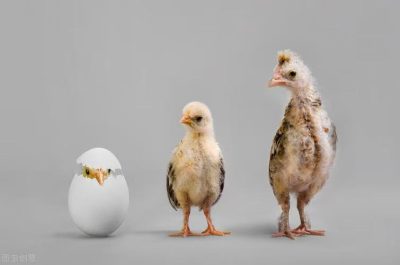
“Chicks day” refers to the period when day-old chicks arrive on the farm after hatchery delivery. This stage includes:
Receiving chicks from the hatchery
Preparing the brooding house
Ensuring immediate access to warmth, water, and feed
Monitoring health indicators
Establishing environmental control
These first hours can determine:
Chick vitality and uniformity
Mortality in the first week
Grower or layer performance
Feed efficiency and weight gain
Long-term disease resistance
In other words, successful poultry farming begins long before the birds grow—it begins on chicks day.
2. Preparing the Brooding House Before Chick Arrival
Farm preparation is the foundation of a strong start. At Guangxin IoT, our customers consistently report that proper pre-heating and disinfection can reduce early mortality by 20–30%.
2.1 Cleaning and Disinfection
Remove old litter, dust, and manure
Wash all surfaces with detergent
Disinfect using spray or fumigation
Let the room dry completely
2.2 Pre-Heating the House
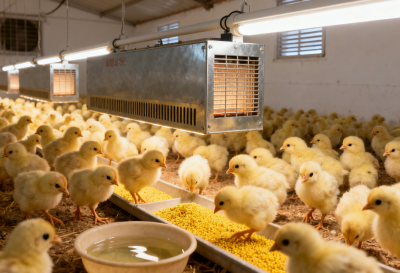
Day-old chicks cannot regulate their body temperature. Heat must be ready 24 hours before chick arrival.
Recommended brooding temperature:
| Age | Temperature |
| Day 1 | 32–34°C |
| Week 1 | 30–32°C |
| Week 2 | 28–30°C |
Heating should create warm, even temperature zones. Guangxin’s smart heating and air-inlet control systems ensure temperature uniformity across large broiler or layer houses.
2.3 Litter Preparation
Use clean, dry wood shavings or rice hulls
Depth: 5–10 cm
Ensure absorbency to prevent wet spots
2.4 Equipment Check
Make sure all systems work properly:
Brooder heaters
Feeders and drinkers
Ventilation fans
Lighting system
Temperature and humidity sensors
A well-prepared house ensures the chicks transition smoothly from the hatchery to the farm.

3. Receiving Chicks: Best Practices for Chicks Day
When chicks arrive, time is critical.
3.1 Immediate Placement
Place chicks quickly under the brooder or heating area. Delays cause stress, dehydration, and increased mortality.
3.2 First Drink: Water Is More Important Than Feed
Chicks should drink clean, warm water (28–30°C) before eating feed.
Additives recommended for first 24 hours:
Vitamin C
Electrolytes
Glucose
Probiotics (optional)
3.3 Feed Access
Use clean chick feeders or paper trays.
Ideal starter feed:
Crumble form
20–22% protein
Balanced amino acids
High digestibility
3.4 Checking Chick Quality
Healthy chicks on arrival should have:
Bright eyes
Strong legs
Clean, dry down
Active movement and chirping
Full, soft crop after 2–3 hours
If more than 10% of chicks are weak or dehydrated, contact the hatchery immediately.
4. Environmental Control: Key to First-Week Success
Smart environmental management dramatically improves flock uniformity and growth.
4.1 Temperature Management
Watch chick behavior:
Huddling under the heater → Too cold
Gathering far away from heater → Too hot
Spread evenly and quiet → Ideal
4.2 Ventilation
Fresh air is crucial, but avoid drafts.
Modern farms use Guangxin IoT’s automatic ventilation controllers, which adjust:
Fan speed
Air inlet openings
Ammonia levels
Humidity levels
4.3 Humidity
Optimal humidity is 60–70% during early brooding.
Low humidity → dehydration
High humidity → respiratory issues
4.4 Lighting Program
Recommended schedule:
First 24 hours: 23 hours light
After Day 2: reduce to 18–20 hours
Light intensity: 20–30 lux
Good lighting improves feed intake and chick activity.
5. Feeding and Drinking System Setup
5.1 Drinking Lines
Day-old chicks require low drinking pressure.
Guangxin nipple drinker systems provide:
Drop-free nipples
Adjustable pressure
Water filters
Anti-leak design
Proper water intake reduces the risk of pasty vent, dehydration, and early mortality.
5.2 Feeding Systems
Use chick trays or automated feeding lines.
Advantages of Guangxin automatic feeding systems:
Shorter feeding time
Uniform feed distribution
Reduced feed waste
Better chick uniformity
6. Health Management on Chicks Day
6.1 Vaccination Schedule
Common Day 1 vaccines:
Marek’s Disease
Newcastle (depending on region)
IB (Infectious Bronchitis)
Consult your local veterinary guideline.
6.2 Early Health Checks
Monitor:
Crop filling rate (should reach 95% in 3 hours)
Chick behavior
Litter dryness
Droppings
If problems appear early, adjust temperature or water immediately.

7. Common Problems and Solutions on Chicks Day
Problem 1: Chicks Not Eating or Drinking
Possible causes:
Temperature too low/high
Lighting insufficient
Water too cold
Solutions:
Adjust brooder height
Increase light intensity
Warm the drinking water
Problem 2: High Early Mortality
Possible causes:
Poor hatchery quality
Insufficient brooding temperature
Drafts or chilling
Poor hygiene
Solutions:
Improve pre-heating
Install automatic climate control
Check ventilation airflow
Use Guangxin’s disinfecting fogging system
Problem 3: Pasty Vent
Reasons:
Overheating
Low water intake
Imbalanced feed
Solutions:
Reduce temperature
Add electrolytes and glucose to water
Improve feed quality
8. Real Case Study: How Guangxin Helped a 30,000-Bird Farm Reduce First-Week Mortality
A customer in East Africa operating a 30,000-bird broiler farm faced high early mortality rates of 6–8%. Guangxin IoT engineers recommended:
Installing automatic temperature controllers
Upgrading to new nipple drinking lines
Improving pre-heating procedures
Using Guangxin’s chick-start brooding setup
Staff training for receiving chicks
After applying these improvements:
First-week mortality dropped to 2.1%
Feed intake improved by 11%
Market weight increased by 120–150 g per bird
This proves how scientific management on “chicks day” brings measurable profit improvements
9. Why Choose Guangxin IoT Poultry Equipment for Chick Brooding?
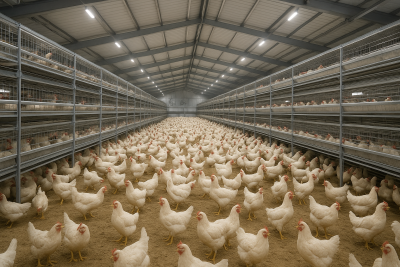
Guangxin IoT provides a complete range of smart poultry farming solutions, including:
Automatic feeding systems
Nipple drinking systems
Layer and broiler cage systems
Ventilation and cooling
Climate control and sensors
Smart farm monitoring (mobile app)
Our equipment ensures:
High chick survival rate
Uniform growth
Lower labor cost
Better biosecurity
Higher long-term profitability
Conclusion: A Strong Chicks Day Determines a Strong Flock
Chicks day is more than just receiving day-old chicks; it is the beginning of the entire production cycle. With proper preparation, environmental control, advanced equipment, and professional management, farmers can significantly boost survival rates, flock uniformity, and final performance.
For poultry farmers looking for reliable, automated, and globally proven equipment, Guangxin IoT offers a complete solution—from brooding to grow-out to laying.
If you need chick brooding equipment, farm design, or a complete turnkey poultry project, feel free to contact us anytime.


