


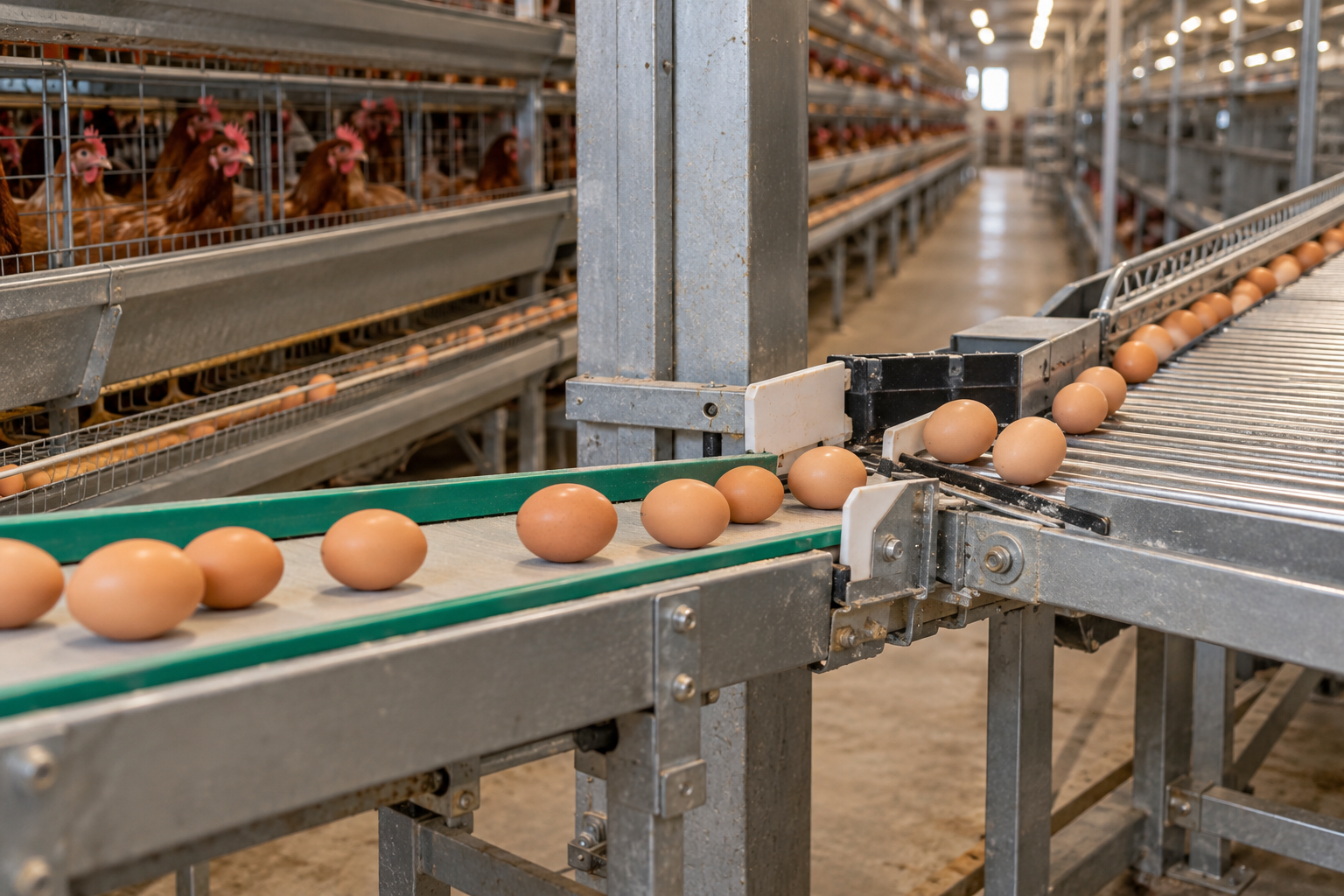
Automatic Egg Collection Machine for 10,000+ Layer Farms
Automate egg collection, central conveying, quality inspection, grading and packing with an integrated egg handling solution designed around your farm's daily production.

Why Do Farms with 10,000 or More Layers Need Automatic Egg Collection?
When a layer farm reaches 10,000 birds or more, collecting eggs is no longer just a daily manual task. Eggs must move from multiple cage rows to a collection point without unnecessary handling, delays or repeated transfers.
The challenge becomes more complex when a farm operates several poultry houses. Workers may need to collect eggs from different buildings, transport them to one packing room, inspect quality, separate different sizes and prepare products for wholesale or retail customers.
An automatic egg collection machine can connect the egg belts inside the poultry house with a central conveying system. Depending on the farm's sales model, the process can continue through inspection, grading, coding and packing.
How Many Eggs Does a 10,000-Layer Farm Produce Per Day?
Bird capacity is the starting point. Daily egg output determines the required collection and processing capacity.
10,000 × 90% = 9,000 eggs per day
This is an illustrative planning example, not a guaranteed production figure. Actual output changes with flock age, breed, health, nutrition and farm management.
How Does Processing Time Affect Machine Selection?
If the farm needs to process 9,000 eggs during an eight-hour working shift, the simple average requirement is 1,125 eggs per hour. However, the final equipment should also account for the timing of egg collection, peak arrivals, conveyor accumulation and cleaning or maintenance interruptions.
| Planning item | Illustrative value | Why it matters |
|---|---|---|
| Layer population | 10,000 hens | Starting point for production planning |
| Assumed laying rate | 90% | Used to estimate daily egg output |
| Daily egg output | 9,000 eggs | Defines the daily handling volume |
| Processing window | 8 hours | Determines the average hourly requirement |
| Average hourly requirement | 1,125 eggs/hour | Initial calculation, not final machine rating |
Automatic Egg Collection Machine for Multi-Row Layer Houses
In a commercial layer house, eggs are first transferred from the cage-level collection belts. A properly designed collection arrangement brings eggs from different rows to the designated conveying route.
For multi-tier H-type cage houses or large A-type installations, the number of rows, cage tiers, house length and location of the egg room all affect the collection design.
Guangxing offers standard automatic egg collection systems and central egg collecting systems. The product page describes customizable system length, tiers and conveyor layouts, with compatibility for 3–8 tier A-type and H-type cage arrangements.
View Guangxing Automatic Egg Collection System →
Standard Egg Collection or Central Egg Collection?
Standard Automatic Egg Collection
Suitable for farms where eggs are collected and transferred through a relatively straightforward poultry-house layout.
- Collection from cage rows
- Egg belt conveying
- Transfer to a designated collection point
- Suitable for selected small and medium farm layouts
Central Egg Collecting System
Suitable for larger farms with multiple rows, multiple tiers or several poultry houses feeding a shared egg handling area.
- Centralized egg conveying
- Connection between multiple collection routes
- Reduced repeated manual transfers
- Connection to downstream egg processing
From Egg Collection to Grading and Packing: How Does the Complete Line Work?
A large layer farm may need more than an egg collection machine. The downstream process depends on how eggs will be sold or used.
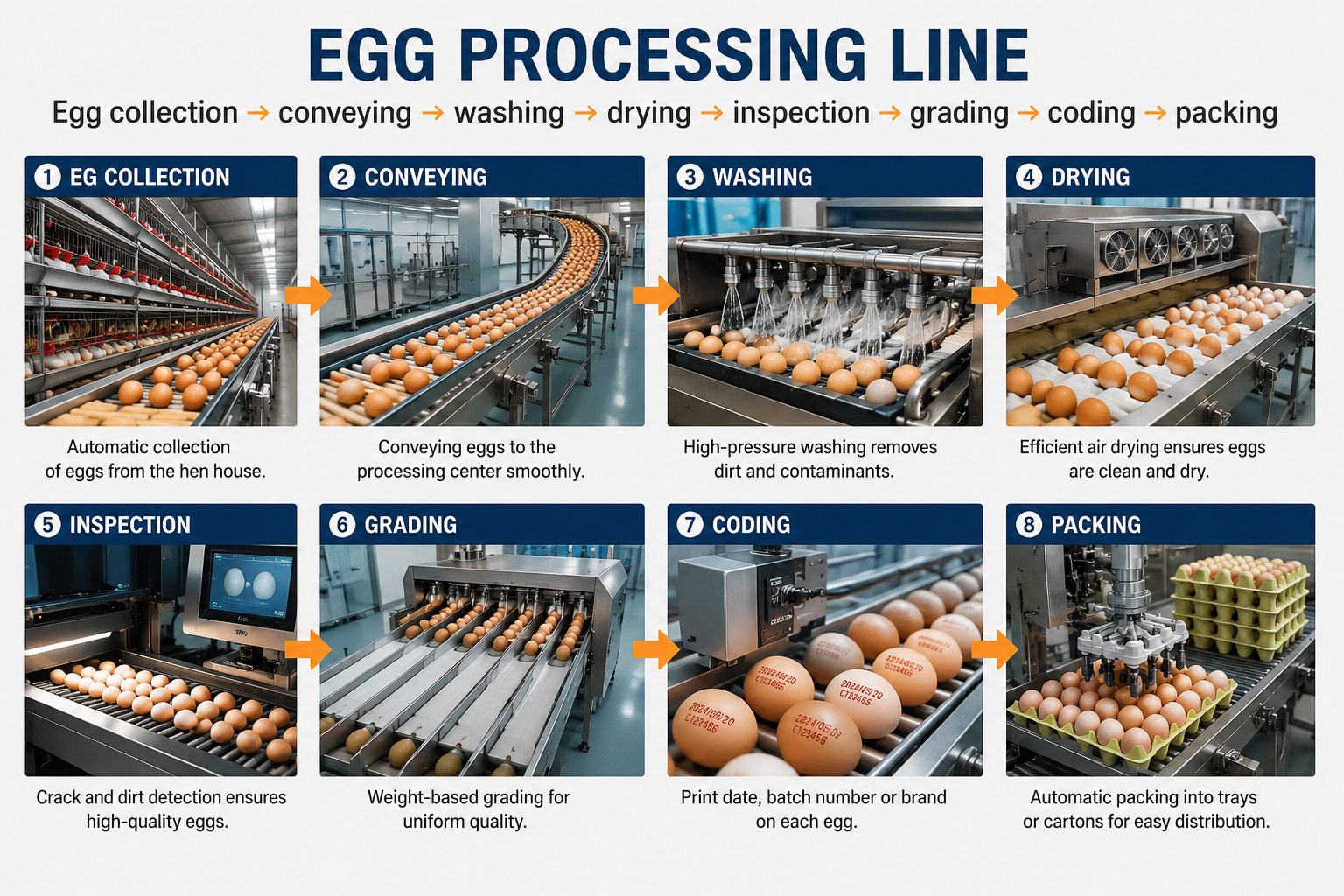
Egg Collection
Collect eggs from cage-level belts inside the poultry house.
Central Conveying
Transfer eggs to the egg room or processing workshop.
Washing
Include only where appropriate for local regulations and the sales market.
Drying
Match drying capacity with the washing line where washing is used.
Quality Inspection
Identify cracked, dirty or other defective eggs using suitable inspection equipment.
Weight Grading
Separate eggs into weight categories required by the market.
Coding
Print dates, batch information or other required identification.
Packing
Load eggs into trays, cartons or other selected packaging formats.
Automatic Egg Crack and Defect Detection Before Packing
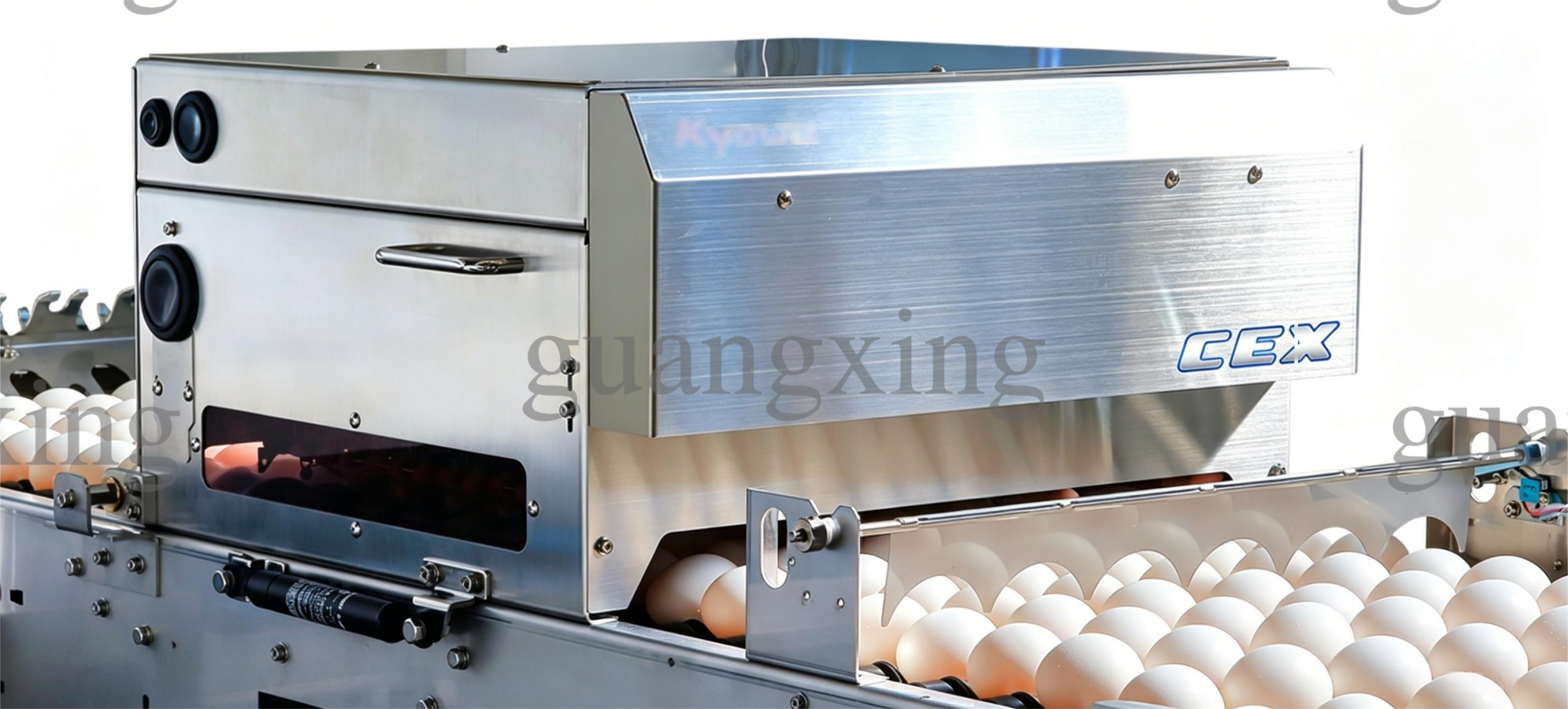
Eggs that appear normal from the outside may still have micro-cracks, dirt contamination or internal defects. If these eggs enter the normal packing channel, they can affect finished product quality and customer acceptance.
Guangxing's abnormal egg detection range includes three inspection modules:
- CEX: Cracked egg detection using vibration analysis.
- DEX: Dirty eggshell inspection using image recognition.
- BEX: Internal abnormal egg inspection using visible-spectrum and near-infrared technology.
These modules can be selected according to the inspection requirements of the processing line. They are not necessarily all required in every farm.
View Egg Crack and Defect Detector →Automatic Egg Grading and Packing for Wholesale and Retail Markets
Once eggs pass the required inspection stages, a grading and packing line can classify eggs by weight and prepare them for different customers.
Egg Grading
Separate eggs into weight categories according to the buyer's product specifications and destination market.
Egg Coding
Add production dates, batch identification or other information where required.
Automatic Tray Packing
Load eggs into selected 30-cell plastic or paper trays.
Automatic Egg Tray Packing Machine
Guangxing's published automatic egg tray packing machine has an adjustable processing capacity of 20,000–30,000 eggs per hour. It supports standard 30-cell plastic and paper trays.
This machine is relevant to farms and egg processing facilities that need automatic egg arranging and tray loading. It should be selected only after checking the actual production volume and the capacity of upstream equipment.
View Automatic Egg Tray Packing Machine →
When Should a Layer Farm Consider an Automatic Egg Breaker Machine?
Not every egg needs to enter the shell-egg packing channel. Farms supplying bakeries, central kitchens, food factories or liquid egg processors may have a separate requirement for egg breaking and liquid egg production.
Automatic Egg Breaker Machine
Guangxing's GX-EB series is designed for industrial egg processing applications. The published product specification gives a processing range of 5,000–20,000 eggs per hour, subject to the final configuration.
- Automatic egg cracking and shell separation
- Whole egg liquid collection
- Optional egg yolk and egg white separation
- PLC touch-screen control and IoT monitoring
- Food-contact construction in 304 stainless steel, with 316 option
The egg breaker can be connected to downstream liquid egg processing equipment, such as pasteurizers and mixing tanks, when these are included in the customer's project.
View Automatic Egg Breaker Machine →
Which Egg Collection and Processing Solution Fits Your Farm?
10,000–20,000 Layer Farm
Start with the daily egg output, cage-row layout and available packing hours. A standard collection arrangement may be sufficient for a straightforward single-house layout.
Review: Egg belts, transfer conveyors, collection point and required packing equipment.
20,000–50,000 Layer Farm
Multiple rows or poultry houses may require central egg conveying to reduce repeated manual transfers and organize the egg room more efficiently.
Review: Central collection, conveyor routing, inspection, grading and tray packing.
50,000–100,000+ Layer Farm
Large operations need coordinated collection and processing capacity. Several houses may feed a shared egg grading and packing center.
Review: Centralized collection, line balancing, quality inspection, packing and future expansion.
Integrated Egg Processing Business
Businesses supplying both shell eggs and liquid egg products may need separate processing routes for grading and packing and for egg breaking.
Review: Egg sorting, defect removal, packing, egg breaking and downstream liquid processing.
Guangxing's Large-Scale Layer Farm Equipment Experience
Guiyang Qingzhen 300,000-Layer Project
Guangxing's published project profile describes a large layer farm in Qingzhen, Guizhou, with approximately 313,000 laying hens and reported daily egg production of around 210,000 eggs.
The project includes automatic egg collection and conveying, egg sorting, washing, grading, packaging and defective egg detection equipment as part of its wider farm arrangement.
This project illustrates why egg collection and the downstream processing workshop should be planned together, rather than treating them as unrelated machines.
View Guiyang Project Details →What Information Should You Prepare?
A useful equipment proposal begins with farm data, not only the number of birds.
Automatic Egg Collection Machine for Large Layer Farms: FAQs
What size egg collection machine does a 10,000-layer farm need?
It depends on the actual daily egg output, collection schedule, cage layout and processing hours. For example, 10,000 hens at an illustrative 90% laying rate produce approximately 9,000 eggs per day. The collection and packing system should be designed around this production flow.
Can one central egg collection system serve multiple poultry houses?
Yes, a central collection arrangement can be designed to transfer eggs from multiple houses to a shared collection or processing area. The conveyor route, elevation changes, transfer points and total hourly output must be checked during engineering design.
Can automatic egg collection connect to an egg grading and packing line?
Yes. The egg collection system can be planned with downstream conveying and suitable grading and packing equipment. The connection height, line speed, egg orientation and processing capacity should be coordinated.
Does every commercial egg farm need an egg washing machine?
No. Washing requirements depend on the destination market, applicable regulations, customer specifications and the farm's sales model. The washing module should be selected only after these requirements are confirmed.
Can the system detect cracked and dirty eggs automatically?
Guangxing offers separate cracked egg, dirty egg and abnormal egg inspection equipment. The required detection modules should be selected according to the defects to be identified and the processing line's operating speed.
Can a farm use an automatic egg breaker for liquid egg production?
Yes. Guangxing's GX-EB series supports whole egg liquid collection and optional yolk-white separation. Its published processing range is 5,000–20,000 eggs per hour, subject to the selected configuration and project requirements.
Looking for an Automatic Egg Collection Solution for Your Layer Farm?
Whether you operate 10,000, 30,000 or more than 100,000 laying hens, the right equipment starts with your daily egg output, poultry-house layout and sales requirements.
Share your farm capacity, cage arrangement, daily egg production and required processing functions. Guangxing can review the project requirements and discuss a suitable egg collection and downstream processing configuration.