Don't Just Focus on Production Capacity! 2026 Farming Facility Selection Tips and Real Cost Reduction Logic
- Many egg farms failed to profit after upgrading industrial egg packaging equipment, primarily due to incorrect machine selection, overlooked hidden losses, and blind following of high-end configurations.
- By 2026, the egg industry will face intense low-price competition, rising labor costs, and tightened food safety standards.
- Choosing the right packaging equipment will help you maintain profits more effectively than relying on speed alone.

- In the process of long-term communication with major egg and poultry breeding and processing enterprises, we have found a common phenomenon of stepping on the pit:
- The vast majority of breeders only focus on the two surface parameters of equipment hourly production capacity and purchase price when purchasing industrial egg packaging equipment.
- They completely ignored core profit indicators such as equipment adaptability, batch production damage stability, long-term operation and maintenance costs.
- This article will combine the latest industry standards in 2026, trends in equipment technology iteration, and a large number of frontline implementation cases.
- Deeply dismantling hidden pitfalls of equipment, core generation differences between old and new equipment, and precise selection logic for different scenarios.
- Only to help major breeding and processing enterprises truly achieve cost reduction and profit increase, and avoid the loss trap of blind procurement.
Why is your automated packaging equipment becoming more and more unprofitable as you use it?
- The current market for egg packaging equipment is highly competitive, with many manufacturers reducing core configurations and cutting production costs to lower prices and attract uninformed purchasing customers.
- Based on the actual data of the egg processing industry in 2026, many egg farms' profits have decreased instead of increasing after automation upgrades.
- The core issue focuses on four implicit losses:
False low damage rate:
- The prototype test data looks good.
- When encountering soft shell eggs and irregular eggs in mass production, the damage rate directly doubles.
- Daily losses quietly consume net profits.
Poor adaptability:
- Only standard eggs can be packaged.
- The size of eggs during seasonal changes is uneven.
- Local eggs and small egg products are directly stuck, missed, and mixed.
The implicit cost of operation and maintenance is high:
- Low price models rely on universal accessories for sensors and motors, resulting in a high failure rate.
- Shutdown maintenance directly delays peak season orders.
Does not meet the traceability requirements of the new regulations:
- Old equipment lacks intelligent coding and batch binding functions.
- Unable to connect with supermarkets and e-commerce compliance traceability systems, high-end channels are directly restricted.
- Simply put, ordinary low-end industrial egg packaging equipment can only roughly complete the basic process of egg packaging, only solving the problem of manual labor.
- The newly upgraded intelligent devices in 2026 will address the core challenges of mass production in the industry:
- Strictly control production losses
- Ensure stable production throughout the day
- Adapt to food compliance standards
- Long term compression of operation and maintenance costs
What is the core of the true upgrade of the new generation of industrial egg packaging equipment in 2026?
- Many buyers have a misconception that equipment iteration is only about improving operating speed.
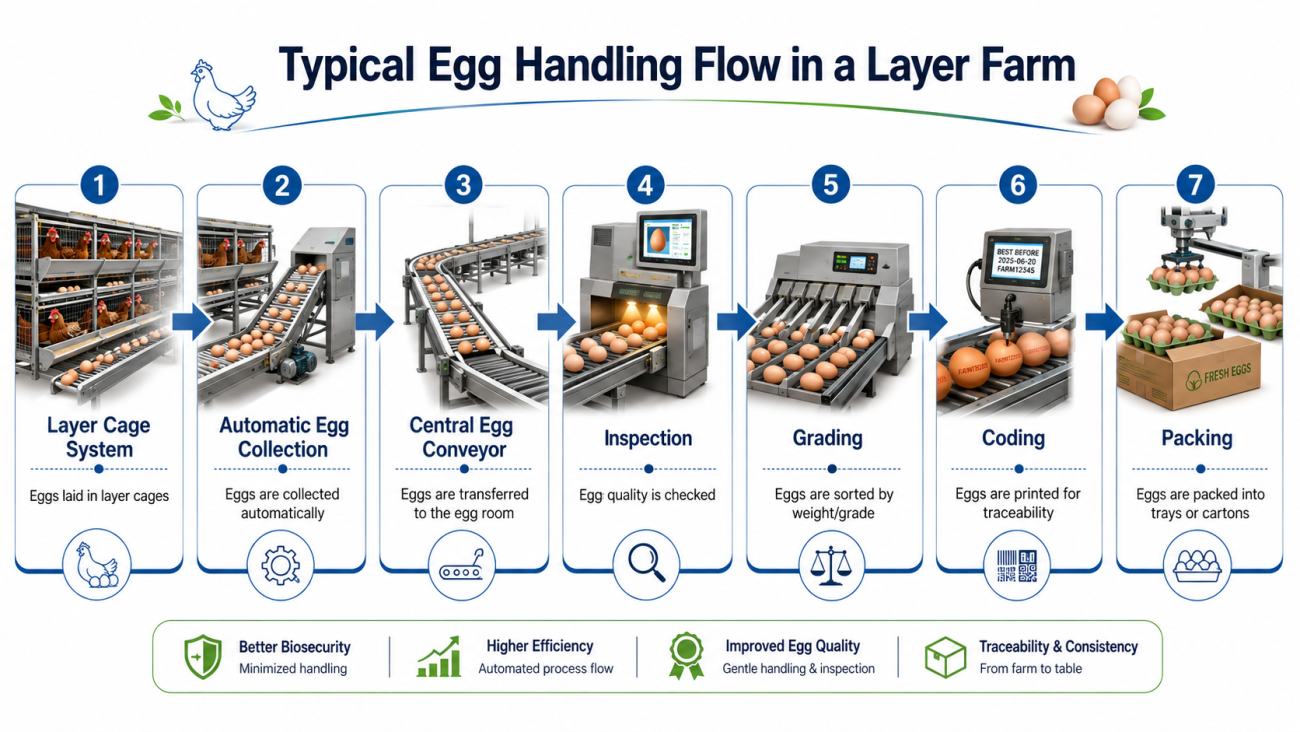
- In fact, the core technological innovation of industrial egg packaging equipment in the past two years has completely departed from the track of simply speeding up, focusing on upgrading the four practical dimensions:
- High precision intelligent quality inspection
- Full scene flexibility adaptation
- Low failure, energy-saving, and stable production
- Full process compliance traceability
- Each upgrade directly addresses the production shortcomings of traditional equipment, creating a substantial technological gap between old and new devices.
Flexible adaptive feeding
- Solve the problems of seasonal card machines and egg shaped adaptation.
- Traditional equipment can only adapt to regular commercial eggs.
- When the seasons change and the size of free range chicken eggs varies, it is prone to squeezing, cracking, jamming, and leakage during transportation.
- The new generation of equipment upgrades its flexible and adjustable conveying structure, eliminating the need for frequent manual adjustments and allowing for adaptive size floating egg products.
- No hard squeezing throughout the entire process, completely solving the problem of mass production loss of non-standard egg products.

Constant temperature air drying disinfection and sterilization
- Eliminate residual water stains and hidden risks of excessive mold growth.
- Ordinary air drying equipment has uneven wind speed and local water accumulation.
- Eggs stored for 3-5 days are prone to mold growth, and supermarket inspections are highly likely to fail.
- The new industrial model is equipped with a partitioned constant temperature hot air circulation system, which accurately controls temperature and humidity, ensuring even air drying without residue.
- At the same time, it is equipped with food level disinfection and sterilization module to meet the fresh food hygiene standards from the source and effectively extend the shelf life.
Hyperspectral intelligent quality inspection
- Far beyond the human eye, intercepting invisible defective eggs.
- This is the biggest technological upgrade point for equipment in 2026.
- Traditional light transmission detection can only identify obvious cracks, while the new device is equipped with a hyperspectral visual recognition system, which can accurately capture defects such as micro cracks, dark cracks, internal yellowing, and blood spots that are completely unrecognizable to the eye.

Dynamic intelligent grading
- Eliminate mixed packaging and adapt to orders of multiple specifications.
- Old equipment has fixed grading levels and can only distinguish between different sizes, making it impossible to adapt to customized orders.
- The new generation of devices supports dynamic customization of grading parameters, allowing for free setting of weight and size ranges.
- The system intelligently divides and categorizes orders of multiple specifications without the need for downtime or parameter changes.
- Flexible adaptation to diverse needs such as e-commerce premium eggs, supermarket standard eggs, wholesale bulk eggs, etc.
Ultra low differential flexible pallet
- The mass production damage rate is controllable and traceable.
- The true low loss in the industry is not prototype testing data, but stable production data.
- The new mechanical gripper adopts a buffering and shock-absorbing structure, with ultra-low drop and gentle egg dropping.
- Regardless of high-speed or low-speed operation, it can stably control the damage rate, completely solving the industry's common problem of "faster and more broken" during high-speed mass production.
- At the same time, the big head should be placed facing up uniformly, and the freshness and packaging regularity should be upgraded synchronously.
.png)
Integrated coding traceability
- Open up the compliance threshold for high-end channels.
- Now supermarkets, community group buying, and brand e-commerce all require batch traceability.
- The new industrial production line integrates an online intelligent coding system, which can print production dates, batches, places of origin, brand codes in real time, and synchronize data and production processes.
- No need for secondary manual labeling, saving labor and fully complying with the latest food traceability standards, making it easy to connect with high-end supply chains.
Tangible Business Benefits
- Not only does it save labor, but it also relies on "controlling losses to earn profits".
- 👉
- Controllable damage rate directly increases the net profit of individual products.
- 👉
- Stable mass production to prevent downtime and losses during peak seasons.
- 👉
- Fewer personnel on duty to reduce personnel management risks.
- 👉
- Compliant production, avoiding food safety sampling risks.
2026 Precision Selection Comparison Table
| Production Scenario | Matching Equipment Model | Hourly Output | Core Matching Advantages | Target Users & Demands |
|---|---|---|---|---|
| Small family poultry farms & independent breeders | Compact intelligent all-in-one packaging machine | 3,000–5,000 eggs | Small footprint, simple debugging, low maintenance cost, compatible with irregular free-range eggs, cost-effective | Farms with daily output under 30,000 eggs, local wholesale focus, limited budget |
| Medium standardized egg farms | Standard intelligent grading & packaging line | 5,000–20,000 eggs | Ultra-precise defect detection, flexible adjustable grading, built-in traceability coding, low breakage stable operation, fit multi-channel orders | Medium processing plants supplying supermarkets & online egg stores, requiring both neat packaging and full compliance |
| Large deep-processing & branded egg factories | Full automatic high-speed intelligent production line | 20,000–60,000 eggs | 24-hour nonstop mass production, full digital traceability system, compatible with downstream palletizing & warehousing equipment, large-scale stable throughput | National branded egg suppliers, mass industrial production with nationwide distribution networks |
The equipment operation issue that farmers are most concerned about in 2026
Is the faster the industrial egg packaging equipment, the better?
- Absolutely not.
- This is the biggest misconception among 90% of farmers.
- High speed equipment has extremely high requirements for egg shape regularity, site power supply, and operation and maintenance capabilities.
- Forcing ordinary small and medium-sized farms to use high-speed lines will only result in problems such as high-speed egg crushing, frequent machine jamming, and skyrocketing failure rates.
- Mass production stability and damage control are far more important than no-load speed.
Why is the damage rate of the same device 0.3% for others, but over 2% for mine?
- The core gap is not in the machine brand, but in the equipment adaptability.
- Many universal models are only compatible with standard product eggs.
- If there are seasonal eggs, free range eggs, soft shelled eggs, or unevenly sized eggs in your venue, ordinary equipment will continue to squeeze, falsely detect, and violently drop the eggs.
- The new generation of flexible adaptive devices can adapt to non-standard egg products and stably control low damage rates.
Is it necessary for small farms to have equipment with spray code traceability?
- Very necessary.
- By 2026, all supermarkets, community group purchases, and e-commerce channels will be required to trace their origins, and eggs without batches or origin codes will be directly rejected.
- Even for small farms, packaging equipment with integrated coding can directly connect with high-end channels, get rid of the price competition of low-end wholesale, and easily raise product premiums.
Where are the pitfalls of low-priced miscellaneous packaging equipment?
- The difference cannot be seen with the naked eye, and there is a huge gap in mass production.
- Low price equipment is generally reduced in configuration: ordinary transparent detection, hard conveying structure, no constant temperature air drying, and general inferior sensors.
- In the short term, it may save money, but in the long term, there may be problems such as defective products, excessive mold growth, peak season downtime, and frequent replacement of parts.
- The annual cost of wear and tear far exceeds the price difference of the equipment.
What is the core upgrade difference between the old and new generations of egg packaging equipment?
- Old equipment focuses on "being able to package and have fast speed".
- The 2026 new smart devices focus on stable wear and tear, strong adaptability, compliance, and low maintenance.
- The biggest technical difference lies in the following five core functions:
- Hyperspectral invisible defect detection
- Flexible adaptive feeding
- Constant temperature disinfection and sterilization air drying
- Dynamic custom grading
- Integrated traceability coding
2026 Egg Packaging Upgrade: Stable Loss is More Important Than Speed
- If your egg farm is facing problems such as high egg packaging damage rate, frequent equipment jamming and shutdown, inability to connect with high-end traceability channels, and high labor costs.
- Or if you are unsure which model is suitable for your production scenario, feel free to leave a message for consultation at any time.