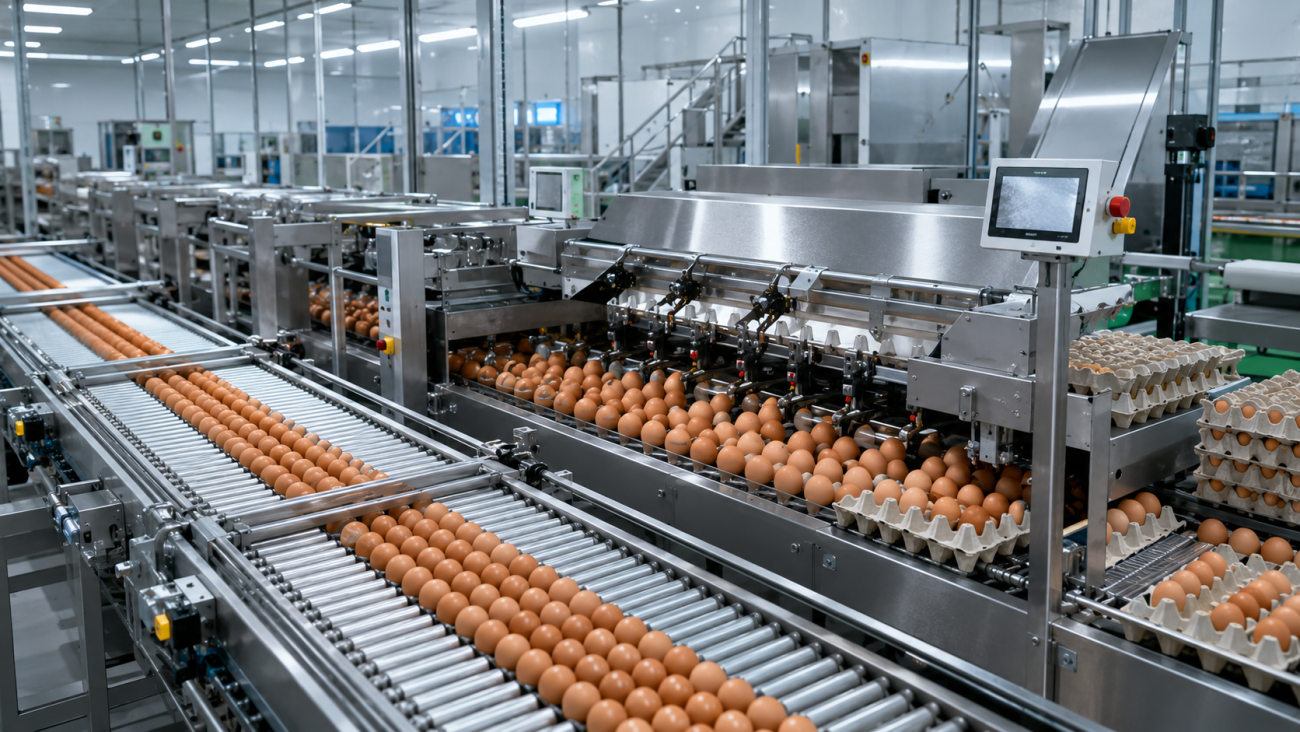
- The egg handling and packaging equipment market is changing as commercial layer farms become larger, labor becomes more expensive, and buyers demand more consistent egg quality, traceability and packaging.
- For modern egg producers, egg handling is no longer limited to moving eggs from the poultry house to a storage room. A complete system may include automatic egg collection, central egg conveying, crack inspection, candling, washing, drying, grading, coding, tray loading, carton packing and downstream palletizing.
- At the same time, there is no single machine or automation level that is right for every farm. A 20,000-layer farm has very different requirements from a farm with 500,000 or one million laying hens.
- This guide examines the egg handling and packaging equipment market in 2026, including market trends, major equipment categories, leading suppliers, automation options and practical purchasing considerations for commercial egg farms.
1. Egg Handling and Packaging Equipment Market Overview
- Egg handling and packaging equipment generally refers to machines used after eggs are laid and before they enter wholesale, retail or food-processing channels.
- Depending on the farm and market, the production flow may begin inside the poultry house with an egg belt and continue through central collection, inspection, grading and final packaging.
- One important point when evaluating market reports is that the terms egg handling equipment, egg grading equipment, egg packaging equipment and egg processing machinery are not always defined in the same way.
- Some research reports include only graders, washers and packers, while others include breaking, pasteurization and liquid egg processing equipment. This explains why published global market-size estimates can differ substantially.
- For example, one current industry estimate places the narrower global egg processing machine market at about USD 897.9 million in 2026 and forecasts approximately 4.3% annual growth through 2034. Broader reports that include additional egg-processing technologies calculate much larger market values. Therefore, buyers should compare the scope and definition of a market report before using headline figures for investment decisions.
2. Why Is Demand for Egg Handling Equipment Growing?
Several structural changes are increasing demand for automated egg handling and packaging systems.
- The first is farm scale. As layer farms move from tens of thousands of birds toward hundreds of thousands or even millions of layers, manual egg collection, sorting and packing become increasingly difficult to manage.
- The second factor is labor. Egg handling is repetitive work that requires continuous staffing during production. Automatic collection, grading and packing systems can reduce the number of manual transfer points and allow employees to focus on equipment supervision, quality control and farm management.
- Food safety and product standardization are also important. Commercial buyers increasingly expect eggs to be graded consistently and packed according to defined specifications. In the United States, USDA standards establish shell egg grades and weight classes, while USDA programs also cover grading and packing operations.
- In the European Union, marketing standards cover areas including egg marking, quality and weight grading, packing stations, packaging, storage, transport and retail presentation.
- These requirements encourage larger commercial producers to move toward more controlled and traceable handling processes.
3. What Equipment Is Included in an Egg Handling and Packaging Line?
- A commercial egg handling line does not necessarily mean one large machine. It is normally a combination of several systems connected according to farm capacity and the final sales channel.

- A small farm may only need an egg collector and simple packer. A large commercial operation may connect several poultry houses to one central egg processing room.
4. Automatic Egg Collection Is the Starting Point
- For a commercial layer farm, efficient egg handling starts before eggs reach the grading machine.
- Eggs first have to leave the poultry house with as little unnecessary handling as possible. In cage systems, egg belts collect eggs from each tier and deliver them to elevators or cross conveyors.
- For farms with several poultry houses, a central egg conveyor can combine production from multiple houses and transport eggs directly to a common grading and packing center.
- Reducing unnecessary transfer points is important because every additional transfer introduces another opportunity for impact, accumulation or operator handling.
- For this reason, farm layout should be considered together with the egg processing room rather than purchasing the grader as an isolated machine.
5. Egg Grading and Inspection Are Becoming More Important
- Grading is one of the most important stages between egg production and commercial sale.
- Modern egg graders can classify eggs according to weight and direct different grades to separate packing lanes. Depending on the equipment configuration, additional modules can include candling, crack detection, dirty-egg inspection and coding.
- This allows farms to separate different products for different customers.
- For example, larger eggs may be sold through premium retail channels, standard grades can be supplied to supermarkets, and eggs that do not meet shell-quality requirements can be separated before final packaging.
-
The exact grading standard should always follow the regulations and commercial requirements of the target market rather than using one universal grading definition.
6. How Much Capacity Does an Egg Farm Need?
- Equipment capacity should be calculated from actual egg production rather than layer population alone.
- A farm should consider laying rate, peak production, daily operating hours, the number of houses feeding the line and the amount of reserve capacity required for future expansion.
- A practical planning framework is:

- These ranges are planning references rather than universal equipment standards. Actual machine capacity should leave enough operating margin to process peak output without creating an egg backlog.
7. Different Farm Sizes Need Different Automation Strategies
- For smaller commercial farms, the priority is usually reducing repetitive labor without building an unnecessarily complex packing center.
- Automatic egg collection combined with a compact packer or small grader may provide sufficient automation while controlling initial investment.
- Medium-sized farms often benefit most from integrating collection, grading and packing.
- At this scale, manually transferring eggs between different processes can become a production bottleneck. A continuous conveyor-based workflow improves operating consistency and makes future expansion easier.
- Large farms should consider the entire egg flow from poultry house to finished package.
- A typical high-automation design may connect multiple layer houses through central egg conveyors to inspection, grading, coding, packing, tray stacking and palletizing equipment.
- At this level, line balancing becomes extremely important. Installing a very fast grader does not improve productivity if upstream collection or downstream packing cannot match its throughput.
8. Leading Egg Handling and Packaging Equipment Suppliers
- The global market includes specialized egg-processing brands as well as poultry equipment manufacturers that provide integrated farm solutions.
- Moba
- Moba is one of the established global specialists in automated egg grading, packing, processing and handling systems. Its equipment portfolio covers different stages of industrial egg processing and packaging.
- Moba is particularly relevant to high-capacity grading and packing centers where advanced automation and integration are key purchasing considerations.
- SANOVO Technology Group
- SANOVO provides egg grading solutions across a wide capacity range. Its current official product range includes grading equipment starting around 27,000 eggs per hour and extending to systems capable of up to 288,000 eggs per hour.
- This makes the company particularly strong in medium and large industrial egg processing installations.
- Prinzen / Vencomatic Group
- Prinzen focuses strongly on egg handling and farm packing systems for table eggs and hatching eggs. Vencomatic Group describes its Prinzen range as egg handling solutions designed around gentle transportation and packing.
- The product range also includes compact farm packers and downstream automation.
- Guangxing takes a somewhat different approach because egg handling equipment can be integrated with the poultry production system itself.
- The company provides automatic poultry equipment as well as automatic egg collection, central egg conveying and egg grading and packing equipment. Its egg processing product range includes collection systems, grading and packing lines, tray packing equipment and crack detection equipment.
- This makes Guangxing particularly suitable for projects where the customer wants to coordinate poultry house design, layer cage equipment, egg collection and downstream handling through one project plan rather than purchasing each section independently.
9. Why More Farms Consider Egg Equipment from China
- European and North American manufacturers remain important in the high-end egg processing equipment market, particularly for very large grading centers and highly specialized applications.
- However, more poultry investors in Africa, Southeast Asia, South Asia, the Middle East and Latin America are also evaluating Chinese suppliers.
Price is one reason, but it should not be the only reason.
The bigger advantage can be system integration.
- A commercial egg project may require layer cages, feeding equipment, drinking systems, manure removal, ventilation, environmental control, egg collection, central conveyors and egg grading and packing equipment.
- Purchasing these systems from several unrelated suppliers can create interface problems during installation.
- When a poultry equipment manufacturer can coordinate the poultry houses, egg conveyors and egg processing area together, project planning becomes simpler and the customer has clearer responsibility for system integration.
- Chinese suppliers can therefore be especially competitive in new farms and expansion projects where a complete poultry equipment package is required.
10. Guangxing Integrated Egg Handling Solution
- For poultry investors building a new commercial layer farm, Guangxing can combine the egg handling system with the poultry housing equipment rather than treating egg processing as a completely separate project.
- A typical integrated solution can connect:
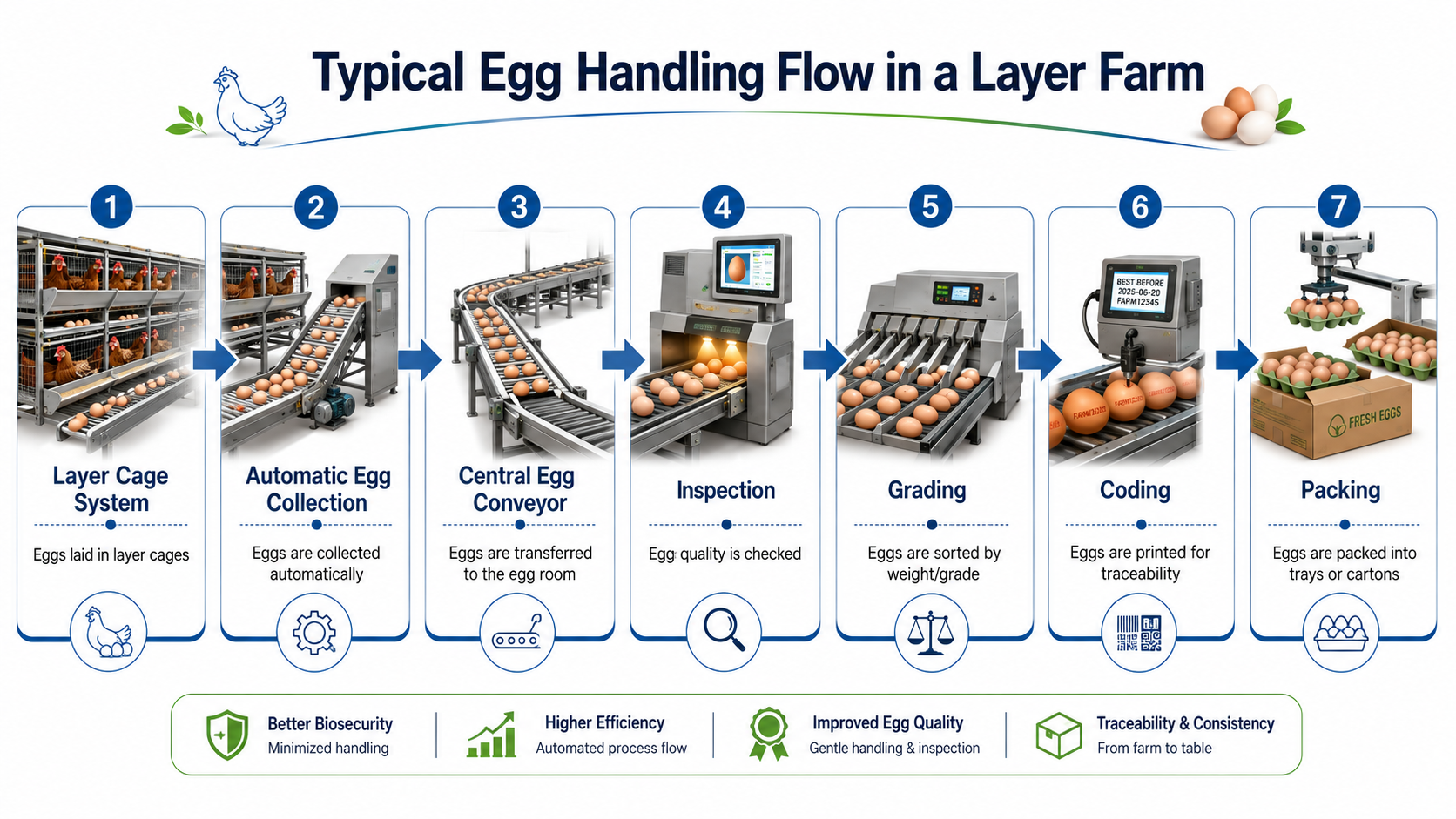
- Depending on project requirements, additional washing, drying, crack inspection or downstream packing modules can be included.
- Guangxing's official product portfolio includes automatic egg collection systems and automatic egg grading and packing lines, while the company also manufactures complete automatic poultry raising equipment.
- This approach is particularly useful for customers developing a completely new farm because the capacity of the layer houses and the capacity of the egg processing area can be planned together.
Instead of asking only, How much does an egg grader cost?, the better question is:How should the entire egg flow be designed for my farm?
- That question usually leads to a more efficient long-term investment.
11. FAQ
What equipment is needed for an automatic egg packing line?
- A typical automatic line can include egg collection, conveying, inspection, grading, coding and packing. Washing, drying, crack detection, tray stacking and palletizing can be added according to local regulations and customer requirements.
How do I choose egg grading machine capacity?
- Calculate peak daily egg production first, then divide it by the realistic number of processing hours. Add sufficient spare capacity for production peaks, cleaning, maintenance and possible farm expansion.
Should a farm buy a grader or a complete egg line?
- If eggs are already collected efficiently and only grading is a bottleneck, a stand-alone grader may be sufficient. For a new farm or major expansion, designing collection, conveying, grading and packing together usually provides better system compatibility.
What is the difference between an egg packer and an egg grader?
- An egg packer mainly places eggs into trays or cartons. An egg grader measures and separates eggs according to criteria such as weight before directing them to different packing lanes. Some modern machines integrate both functions.
Can Chinese egg handling equipment be used for large commercial farms?
- Yes, but buyers should evaluate the manufacturer rather than the country of origin alone. Important factors include production capacity, engineering capability, materials, control components, spare parts, installation support and the supplier's experience with complete poultry projects.
12. Conclusion: Choose an Egg Handling System, Not Just a Machine
- The egg handling and packaging equipment market is moving toward larger capacity, better automation, improved traceability and closer integration with commercial poultry farms.
- For buyers, however, the most important decision is not choosing the fastest grader or the cheapest packing machine.
- The objective should be to create a balanced egg flow from the laying house to the finished package.
- A 30,000-layer farm, a 200,000-layer farm and a one-million-layer project require very different solutions. Farm layout, daily egg production, target packaging, local regulations, labor costs, future expansion and investment budget should all be considered before equipment is selected.
- Guangzhou Guangxing Poultry Equipment Group provides automatic poultry raising equipment together with egg collection, central egg conveying and egg grading and packing solutions, allowing new commercial layer projects to coordinate poultry production and downstream egg handling in one overall plan.
- If you are planning a new layer farm or upgrading an existing egg packing center, provide your number of laying hens, daily egg production, poultry house quantity, preferred package type and destination country.
- Based on this information, the appropriate egg collection, grading and packaging capacity can be configured for your project.