


The price of a chicken manure fermentation tank can look reasonable on the first quotation. Then you add the concrete foundation, manure elevator, odor treatment equipment, electrical installation and overseas shipping.
Suddenly, the project costs a lot more than expected.
And the expenses don’t stop after installation. There are electricity bills, replacement parts, routine inspections and the cost of handling the material coming out of the tank.
For poultry farm owners, understanding the chicken manure fermentation tank cost means looking beyond the machine itself.
Here’s what should go into the budget, and where buyers often underestimate the expense.
How Much Does a Chicken Manure Fermentation Tank Really Cost?
There isn’t a meaningful fixed price for every farm. A small treatment unit and a 100 m³ vertical fermentation tank serve very different operations.
Even two tanks of the same size can come with different equipment packages.
One supplier may quote only the fermentation vessel. Another includes the feeding system, aeration equipment, deodorization unit and commissioning.
Before comparing prices, check what’s actually included.
| Equipment | What to Check |
|---|---|
| Fermentation tank | Capacity, materials, insulation |
| Mixing system | Drive, hydraulic components, mixing blades |
| Aeration | Blowers, airflow control |
| Manure loading | Hopper, elevator, conveyors |
| Odor treatment | Exhaust collection, deodorization |
| Electrical controls | Sensors, control cabinet, wiring |
| Installation | Foundations, commissioning, labor |
Freight terms can also make a significant difference. A FOB price from China is not the same as the cost of getting the equipment installed and running on a farm in Nigeria, the Philippines or Saudi Arabia.
Ask for a quotation that separates equipment, freight, installation and commissioning. You’ll have a much clearer picture of where the money goes.

Electricity: The Cost Buyers Usually Ask About First
Take the GX-SANYU 11FFG-100 vertical fermentation tank as an example.
The published specifications list 37.64 kW of installed power and a reported operating power of 21 kW.
Installed power isn’t the same as actual electricity consumption. Motors and blowers don’t necessarily run at full load throughout the day.
Suppose a unit averages 21 kW for 12 hours daily, and the local electricity tariff is $0.12 per kWh.
The estimated daily electricity cost would be:
21 kW × 12 hours × $0.12 = $30.24
Over 30 days, that’s roughly $907.
This is a calculation example, not a measured operating record. Actual electricity use needs to be checked against the equipment’s running schedule, load and any auxiliary heating requirements.
For buyers comparing quotations, one question is especially useful:
How many kilowatt-hours does the complete system consume when processing a specified amount of fresh manure?
That tells you more than the installed motor power printed on a brochure.
Maintenance, Labor and the Cost of Preparing Manure
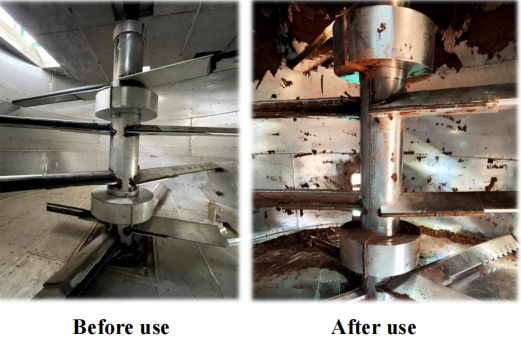
A fermentation tank works in a tough environment. Warm, wet manure, mechanical movement and corrosive gases are not particularly kind to equipment.
Mixing blades wear. Bearings and seals need attention. Blowers and hydraulic components have to be inspected.
None of this is unusual for industrial machinery, but overseas buyers should ask about replacement parts before the equipment ships.
If a mixing component fails during operation, how quickly can you get a replacement? Can the farm’s maintenance staff install it, or will they need help from the manufacturer?
There’s also the incoming manure to think about.
Fresh chicken manure isn’t always ready to go straight into a fermentation tank. Moisture content varies between farms, and some material may need carbon-rich bulking agents to improve its structure.
Penn State Extension’s guidance on poultry manure composting explains how moisture, oxygen and carbon balance affect the biological process.
Very wet manure can become compacted and restrict airflow. Foreign objects may also damage loading or mixing equipment.
The operator still needs to check incoming material, monitor the tank and handle the discharge. Automation reduces manual work; it doesn’t eliminate it.
What Does It Cost to Treat One Ton of Chicken Manure?
This is usually a better way to compare equipment than looking at the purchase price alone.
Imagine a farm collecting 10 tons of fresh manure per day.
Over a 30-day month, the treatment system handles 300 tons.
Here’s a hypothetical monthly operating budget.
| Expense | Monthly Cost |
|---|---|
| Electricity | $1,200 |
| Labor | $650 |
| Maintenance allowance | $250 |
| Bulking materials and consumables | $400 |
| Total | $2,500 |
The calculation is straightforward:
$2,500 ÷ 300 tons = $8.33 per ton
That is the operating cost per ton of incoming manure in this example.
It doesn’t include equipment depreciation, financing, taxes or all possible downstream processing expenses. The figures are illustrative, not actual performance data for the 11FFG-100.
When reviewing a supplier’s figures, also check whether the cost is calculated per ton of fresh manure or per ton of finished material.
Those are not the same thing.
Fermentation Tank vs. Windrow and Trough Composting
Not every poultry farm needs a vertical fermentation tank.
For farms with enough land and relatively low labor costs, conventional composting can be a practical alternative.
Here’s how the three approaches compare.
| Factor | Vertical Tank | Windrow Composting | Trough Composting |
|---|---|---|---|
| Initial investment | Higher | Lower | Medium–high |
| Land needed | Compact | Large | Medium–large |
| Energy use | Mixing, aeration | Turning equipment | Turning, ventilation |
| Labor | Process monitoring | Regular pile management | Equipment operation |
| Odor control | Enclosed exhaust treatment | More exposed | Depends on enclosure |
| Processing | Controlled in-vessel stage | Usually longer | Depends on system |
These are typical differences rather than fixed cost rankings.
A windrow system may work well where land is inexpensive and there is enough room to turn and manage the piles. A trough system provides more organized mechanical handling, but it still needs space for the composting area.
Vertical tanks are attractive when land is tight or the farm wants a more enclosed process.
For farms still comparing manure treatment methods, our guide to fermentation tanks and drying systems explains another important option.
The US EPA also provides information on manure management and emissions reduction, including composting practices and their environmental considerations.
What a 920,000-Layer Farm Can Tell Us About Equipment Sizing
A farm housing hundreds of thousands of birds generates manure every day. Whatever treatment method it uses must be able to keep up.
One Guangxing project, designed for 920,000 laying hens, uses ten GX-SANYU 11FFG-100 vertical aerobic fermentation tanks.
Each tank has an effective volume of 100 m³.
The published project specifications give an incoming moisture range of 65–70%, with a typical treatment cycle of seven days. The reported discharge moisture is 30–40%.
The system also includes automatic manure loading, aeration, heat exchange and exhaust deodorization.
Using ten tanks gives the facility separate treatment units rather than one large machine. If one unit is being serviced, the remaining tanks can continue operating.
One detail is easy to misunderstand when comparing equipment brochures.
A 100 m³ tank does not process 100 m³ of fresh manure every day.
The vessel volume describes how much material it can hold. Daily throughput must be calculated using manure density, loading conditions and the time the material remains in the system.
View the 920,000-Layer Manure Treatment Project

Can a Chicken Manure Fermentation Tank Pay for Itself?
It can make financial sense, but the calculation starts with the farm’s existing manure disposal costs.
Some farms pay contractors to remove fresh manure. Others spend money storing it, transporting it or managing complaints about odors.
Treating manure on-site may reduce part of that expense.
There’s also the possibility of selling the treated material for fertilizer production.
But here’s where buyers need to be careful.
Material discharged from a fermentation tank is not automatically finished commercial fertilizer. Depending on the intended product and local rules, further curing, screening, testing, granulation or packaging may be necessary.
Those steps cost money.
A Simple Payback Example
Suppose a farm invests $150,000 in a complete manure treatment system.
After operating expenses, the farm expects to save $18,000 annually on manure disposal and earn another $12,000 in net fertilizer-related income.
That works out to $30,000 in annual net benefit.
$150,000 ÷ $30,000 = 5 years
This is a hypothetical calculation, not a quoted equipment price or a guaranteed return.
A five-year simple payback also says nothing about financing costs, taxes or the time value of money.
If the farm has no reliable buyer for the treated material, fertilizer revenue shouldn’t be included.
Some countries offer grants or financial support for manure recycling and environmental improvements. Before counting on a subsidy, check the local eligibility requirements, funding availability and application process.
3 Critical Risks to Evaluate Before Placing Your Order
1. The manure may need preparation.
Too much moisture, compacted lumps or foreign objects can interfere with the process. Ask what incoming material the equipment is designed to handle and whether additional mixing or screening is required.
2. Local environmental rules may affect the budget.
Odor emissions, wastewater, fertilizer quality and site permits can all influence equipment selection. An enclosed tank alone doesn’t guarantee regulatory compliance.
3. After-sales support matters.
Before the equipment leaves the factory, confirm the spare-parts package, warranty, commissioning arrangements and technical support. This matters particularly for farms without local service technicians.
Frequently Asked Questions
How much does a 100 m³ chicken manure fermentation tank cost?
The price varies with construction materials, mixing and aeration equipment, automation and auxiliary systems. Request a quotation showing both the tank price and the total installed scope.
How much electricity does a manure fermentation tank use?
The GX-SANYU 11FFG-100 has a published operating power reference of 21 kW. Actual energy consumption must be calculated from the running schedule and the complete equipment configuration.
Is chicken manure fermentation profitable?
It can reduce disposal expenses and create fertilizer feedstock with commercial value. Whether it produces a financial return depends on treatment costs and the market for the material.
How long does it take to recover the investment?
There is no standard payback period. Compare the complete project investment with realistic annual net savings and income.
Get a Cost Estimate for Your Poultry Farm
Before you compare fermentation tank prices, it helps to know how much manure your farm collects and what you want to do with it after treatment.
Guangzhou Guangxing Poultry Equipment Group supplies vertical fermentation equipment and integrated poultry manure handling systems.
If you’re planning a new farm or upgrading an existing treatment area, send us the number of birds, your estimated daily manure volume and the country where the project will be installed. Moisture measurements and a rough site layout will make the initial assessment more useful.
We can discuss equipment sizing, loading and deodorization requirements, and the information needed for a project quotation.