


How Long Do Pigs Stay in Farrowing Crates? Full Timeline and Benefits
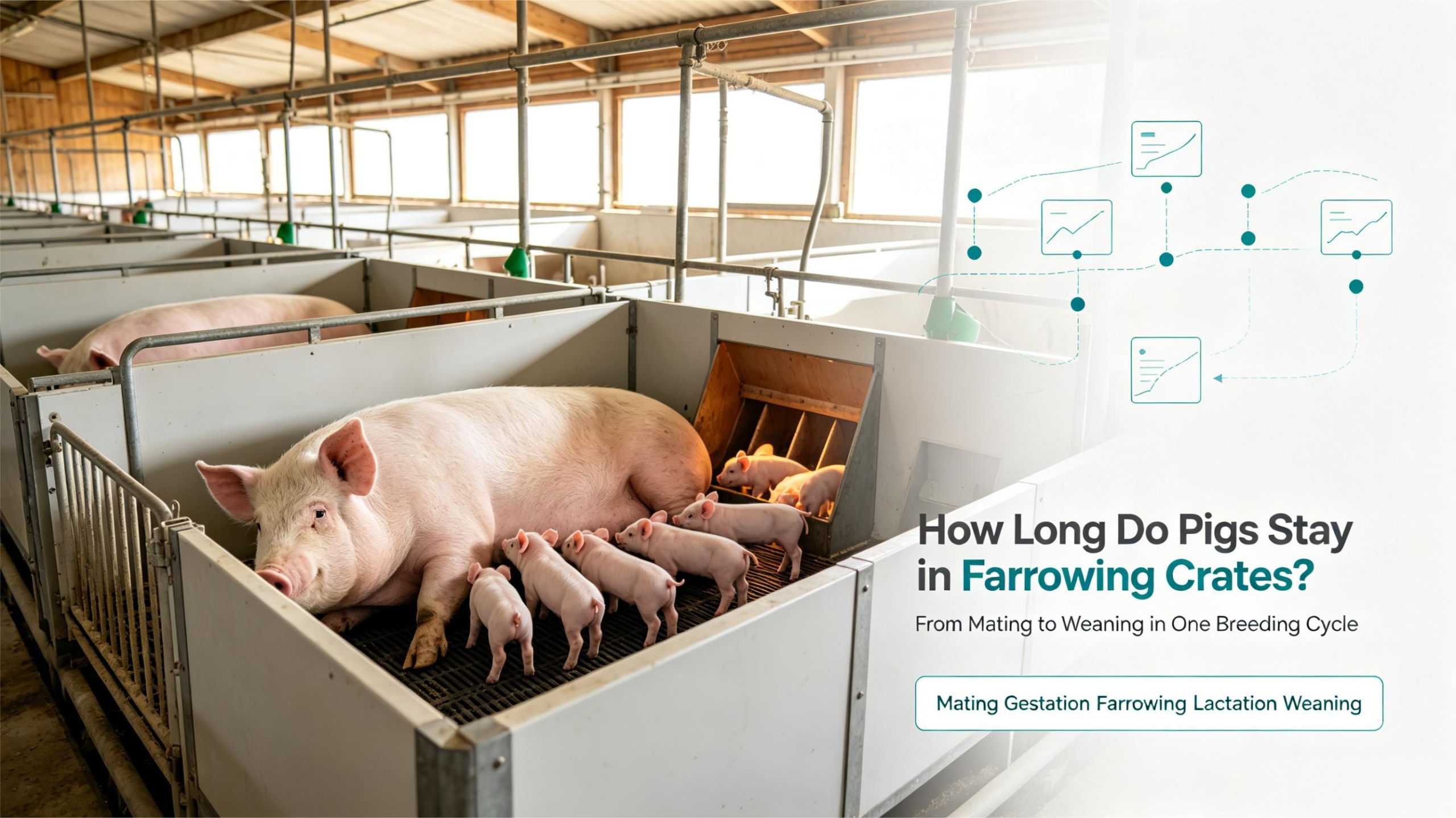
Farrowing crates are the core specialized housing facility in commercial pig farming, dedicated to sow delivery and piglet lactation stages.
- Most pig farmers and industry newcomers frequently ask three core questions:
- How long do pigs stay in farrowing crates?
- When are sows moved to farrowing crates?
- Can sows deliver piglets independently in farrowing crates?
- This article will
- break down the complete pig breeding production timeline
- answer all key questions about farrowing crate usage
- explain why high-quality farrowing crates are indispensable for modern pig farming efficiency and animal welfare
1、Complete Pig Breeding and Farrowing Production Timeline
- After sexual maturity, healthy replacement gilts or empty sows enter the mating stage.
- Farmers conduct artificial insemination or natural mating for sows, and confirm successful pregnancy through pregnancy testing 18-24 days after mating.
The gestation cycle of sows is fixed at 114 days (approximately 4 months).
- During the entire gestation period, sows are raised in gestation pens or group housing areas.
- At this stage, sows only need conventional feeding and daily management, and do not need to enter farrowing crates.
- When do sows get moved to farrowing crates?
- This is a critical time point in pig farming management.
According to global commercial pig farming standards and animal welfare specifications,sows are transferred to farrowing crates 5-7 days before the expected farrowing date.
- This arrangement has two core purposes:
- First, it allows sows to adapt to the new housing environment in advance, reducing stress responses during delivery.
- Second, it facilitates farmers to carry out pre-delivery disinfection, feeding adjustment, and delivery monitoring, ensuring a smooth farrowing process.
- Some regional welfare regulations clearly stipulate that the pre-delivery confinement time of sows in farrowing crates shall not exceed 5 days, forming a standardized industry operation norm.
- Can sows have pigs on their own in farrowing crates?
- The answer is absolutely yes.
- Farrowing crates are professionally designed for independent sow delivery.
- The narrow and independent space
- limits the sow’s excessive movement
- provides a clean and safe delivery environment
- will not interfere with the sow’s natural farrowing behavior
- In actual production, almost all sows complete labor, delivery, and postpartum self-nursing of piglets independently in farrowing crates.
- Farmers only need to provide auxiliary care such as temperature adjustment and weak piglet care, without manual intervention in the sow’s natural delivery process.
- After farrowing, sows continue to stay in farrowing crates to complete the lactation cycle.
- Piglet weaning is the key node for sows to leave farrowing crates.
The standard lactation cycle of commercial pig farms is 21-28 days, and a small number of farms extend it to 30-35 days according to breeding standards.
- After piglets are weaned and separated from their mothers, sows are transferred back to gestation group housing areas to begin a new breeding cycle.
- The vacated farrowing crates will then be thoroughly cleaned and disinfected for the next batch of sows.

- Visual Pig Farrowing Cycle Timeline
- The total farrowing crate residence period covers 5–7 days pre-farrowing adaptation + 21–28 days post-farrowing lactation, with a standard cycle of 26–35 days.
2、How Long Do Pigs Stay in Farrowing Crates in Total?
- Combined with the full-cycle farming timeline, we can summarize the accurate total residence time of sows in farrowing crates:
- The standard total stay time is 26-35 days per cycle, including 5-7 days of pre-delivery adaptation period + 21-28 days of postpartum lactation period.
- In special cases, if sows serve as nurse sows to foster orphaned piglets, the stay time will be appropriately extended by 7-14 days.
- This is the unified standard of global commercial pig farming.
- Short-term and targeted confinement can maximize the survival rate of piglets while ensuring the basic welfare of sows, which is the core reason why farrowing crates are still widely used in modern pig farming.
3、Why High-Quality Farrowing Crates Are Essential for Pig Farming
- Many small and medium-sized pig farms ignore the importance of farrowing crate quality and choose low-cost inferior products.
- In fact, high-quality farrowing crates are directly related to farm output, mortality rate, breeding efficiency and long-term operating costs.
- The core values are reflected in 4 aspects:
3.1 Effectively Reduce Piglet Crushing Mortality
- Newborn piglets are small and weak, and are extremely vulnerable to being crushed or squeezed by sows when sows lie down or turn over.
- High-quality farrowing crates adopt scientific size design and limit the sow’s excessive movement range without restricting their normal standing, lying and feeding behaviors.
- They are equipped with independent piglet creep areas and anti-crush baffles, which can reduce piglet crushing mortality by more than 80%, greatly improving the survival rate of piglets.

Professional Guangxing farrowing crates adopt optimized anti-crush structures and scientific spatial design.
- They effectively avoid piglet crushing incidents, lower nursery mortality, and help farmers secure stable breeding profits.
3.2 Balance Sow Welfare and Production Efficiency
- High-standard farrowing crates comply with international animal welfare breeding specifications.
- The reasonable space design avoids excessive confinement stress of sows, ensures sows have a comfortable resting and lactation environment, and effectively improves the lactation quality and milk yield of sows.
- Healthy sows have shorter estrus recovery cycles after weaning, which can improve the annual breeding parity rate of the farm and increase overall production efficiency.
3.3 Durable and Reduce Long-Term Operating Costs
- Top-tier farrowing crates use hot-dip galvanized steel or high-strength stainless steel materials that deliver strong corrosion resistance, rust protection, and impact resistance.
- They withstand long-term high temperature, high humidity, and manure erosion inside pig houses and serve over 10 years.
- Inferior crates easily deform, rust, and break, which trigger frequent maintenance and replacement costs.
- They also scratch sows and piglets easily and cause bacterial infections that raise breeding losses.
All Guangxing farrowing crates are manufactured with high-standard hot-dip galvanized craftsmanship.
- The superior durability extends equipment service life up to 20 years, cutting long-term farm maintenance and replacement costs significantly.
3.4 Convenient Management and Meet Standardized Breeding
- Professional high-end farrowing crates integrate automatic feed troughs, drinking systems, slatted manure floors, and heated piglet creep areas.

- They simplify farm cleaning, disinfection, feeding, and daily observation and greatly reduce manual management costs.
- Meanwhile, standardized crate configurations meet global pig farming and food safety certification standards, help farms expand overseas sales channels, and increase product added value.
4、Conclusion
- Farmers move sows into farrowing crates 5–7 days before delivery, sows complete independent farrowing inside crates, and sows stay 26–35 days until piglet weaning
- As core equipment linking sow delivery and piglet nursing, farrowing crate quality shapes critical farm indicators, including survival rate, breeding efficiency, and operational cost.
- Standardized, high-quality farrowing crates safeguard basic animal welfare and help modern pig farms achieve standardized, efficient, and sustainable breeding development.
- For global farms pursuing low-loss and high-efficiency pig breeding, Guangxing provides professional and reliable farrowing crate solutions.
- Our premium equipment supports modern pig farming to achieve standardized, stable and sustainable development.
