


Starting a 2,400-layer poultry farm in Nigeria is a practical entry point for many investors who want to enter the commercial egg production business. Compared with backyard poultry farming, a 2,400-bird layer farm already has a clear commercial scale. It requires systematic planning for poultry house construction, cage layout, feeding management, disease prevention, labor arrangement, egg sales and financial calculation.
According to FAO agricultural production statistics, global egg production reached around 100 million tonnes in 2024, with hen eggs accounting for the majority of total production. This shows that eggs remain one of the most stable and frequently consumed agricultural food products in the global market.
For a 2,400-layer poultry farm in Nigeria, the core business goals are to maintain stable egg production, reduce feed waste, control mortality, improve egg collection efficiency and sell eggs consistently to local markets, retailers, wholesalers, hotels, restaurants, schools and food distributors.
A well-managed 2,400-layer farm can also become the first stage of a larger layer farming project. After stable operation, the investor can expand to 5,000, 10,000 or even 20,000 layers by adding more poultry houses or upgrading to an automatic layer cage system.
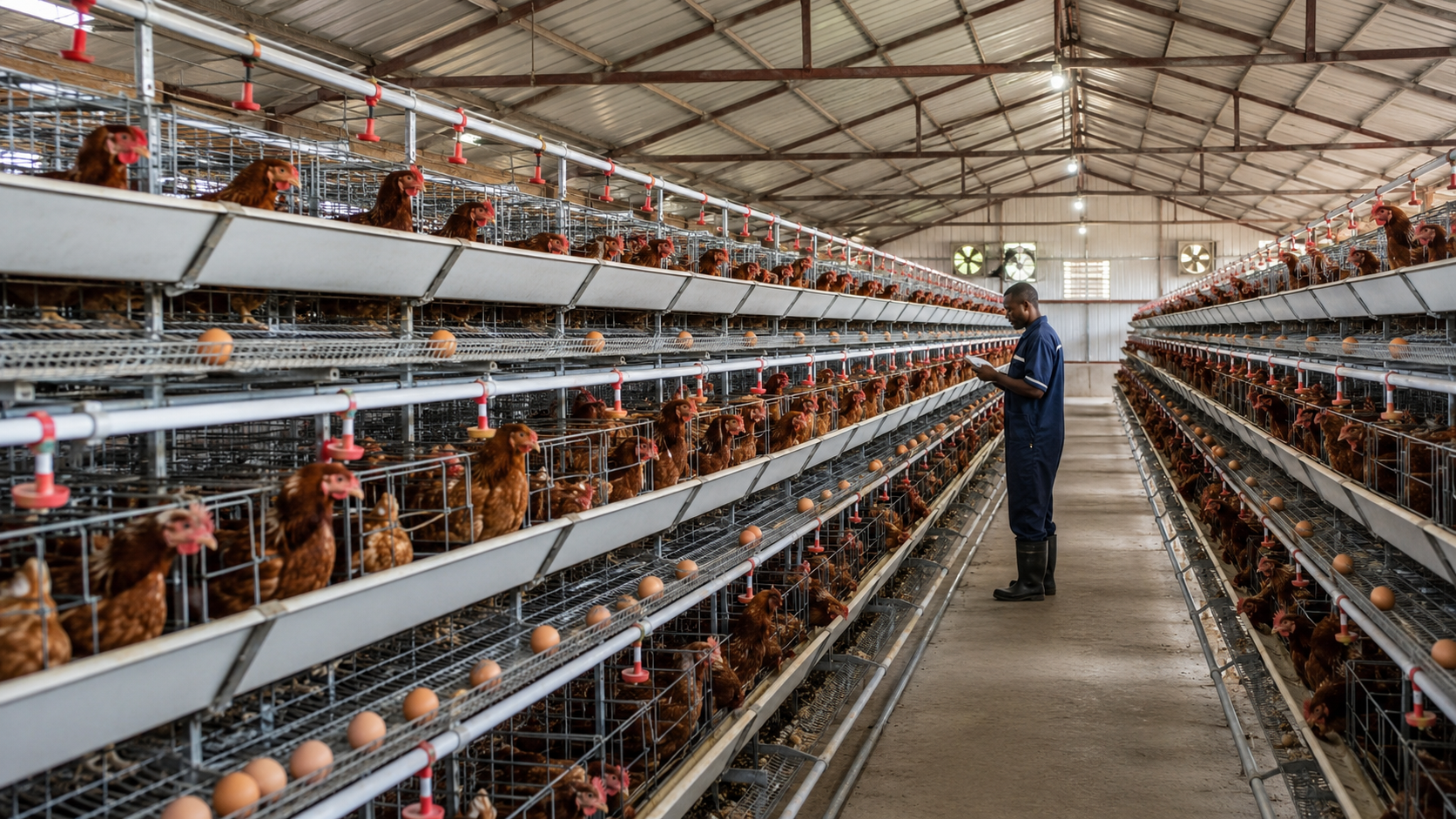
1. Business Objectives
The main business objectives of a 2,400-layer poultry farm include:
- Produce fresh table eggs every day for Nigerian local and regional markets.
- Achieve an average laying rate of 80% to 90% during the main production period.
- Reduce labor pressure through proper cage design, automatic drinking, scientific feeding and efficient egg collection.
- Control feed cost, because feed is usually the largest operating expense in layer farming. University of Maryland Extension notes that feed can represent about 70% of the cost of raising chickens.
- Build a scalable layer farm structure for future expansion.
- Separate the poultry production area from the egg distribution and customer pickup area to reduce biosecurity risks.
2. Market Opportunity for Layer Farming in Nigeria
Eggs are affordable, easy to transport and rich in protein. They are widely consumed by households, bakeries, restaurants, hotels, schools, canteens and food processing businesses. In Nigeria, eggs are an important source of animal protein and are suitable for long-term sales in both urban and township markets.
A 2,400-layer farm is not as small as backyard poultry farming, but it also does not require the same high upfront investment as a large commercial egg farm. This makes it suitable for first-time investors entering the layer farming industry. The farm can supply eggs daily to local open markets, egg wholesalers, grocery stores, small supermarkets, restaurants, hotels, bakeries, food processing businesses, schools, canteens, community retail customers and online fresh food buyers.
The key to profitability is not only producing eggs, but also building stable sales channels before the flock reaches peak production. Farmers should not wait until a large quantity of eggs is produced before looking for customers. Instead, they should start connecting with wholesalers, restaurant buyers, school canteens and local retailers while the birds are still in the pullet stage.
3. Project Scale and Production Assumptions
This Nigeria-focused business plan uses the following basic assumptions:
| Item | Planning Assumption |
|---|---|
| Country | Nigeria |
| Total layers | 2,400 birds |
| Bird type | POL pullets or commercial layers |
| Housing system | Layer cage system |
| Reference poultry house size | About 12m × 25m, adjusted according to final equipment design |
| Reference cage layout | About 20 cage sets, around 120 birds per set |
| Average laying rate | 80% – 85% |
| Daily egg production | About 1,920 – 2,040 eggs |
| Eggs per crate | 30 eggs |
| Daily egg crates | About 60 – 68 crates |
| Monthly egg crates | About 1,800 – 2,040 crates |
| Average feed intake | 100 – 105g per bird per day |
| Monthly feed consumption | About 7 – 7.6 tonnes |
The feed intake assumption is based on common layer feeding references. PoultryHub notes that laying hens may reach a stable feed intake of about 100 to 105 grams per day. Actual feed intake depends on breed, age, climate, feed formula and poultry house management.
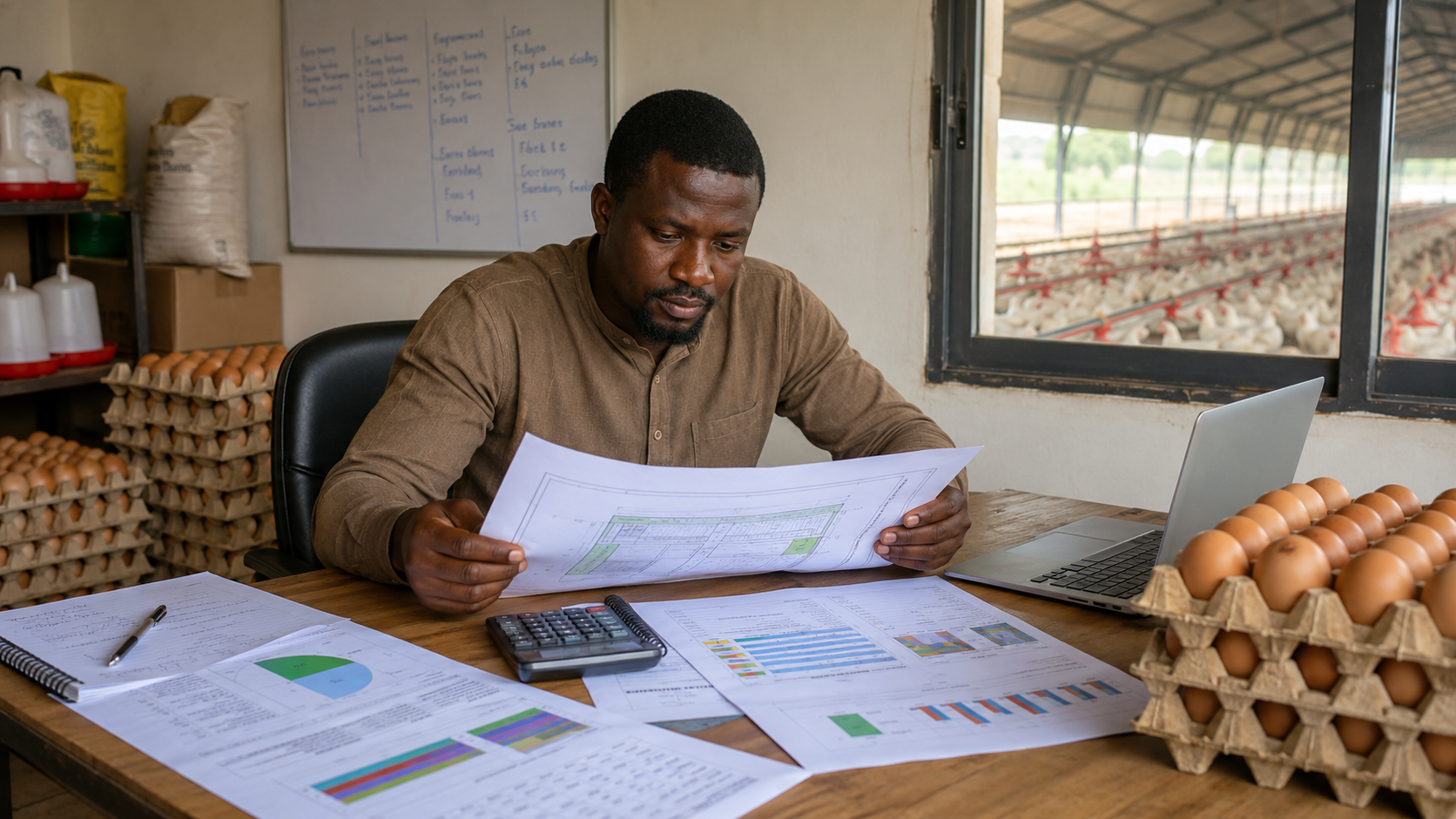
4. Recommended Poultry House and Farm Layout
A 2,400-layer poultry farm in Nigeria needs a house that is dry, well ventilated, easy to clean and protected from wild birds, rodents, snakes and harsh weather. The poultry house design should be adjusted according to local climate. In hot regions, ventilation, roof insulation and air movement are especially important. In humid areas, manure management and disease control become more critical.
A practical 2,400-layer farm layout should include:
- Layer poultry house
- Feed storage room
- Egg collection and temporary storage area
- Water tank and filtration system area
- Manure handling area
- Worker room or guard room
- Disinfection area at the farm entrance
- Road access for feed transportation and egg delivery
- Reserved space for future expansion
For many Nigerian farms, it is important to arrange worker accommodation inside or near the farm. Layer farming requires daily inspection. Water failure, power failure, heat stress, disease symptoms, theft and abnormal mortality must be discovered quickly. Having responsible workers living near the farm can significantly reduce operational risks.
5. Equipment Solution for a 2,400-Layer Farm
A complete poultry farming business plan should not only calculate the number of birds and feed cost. The equipment system directly affects daily labor demand, egg breakage rate, feed waste, manure handling and long-term operating efficiency.
Option A: A-Frame Layer Cage System
For small and medium poultry farms in Nigeria, an A-Frame Layer Chicken Cage is usually a cost-effective choice. Its stepped structure provides better ventilation and makes it easier to observe the flock. It is suitable for open, semi-open and closed poultry houses.
This option is suitable for investors who:
- Have a limited initial equipment budget
- Want simple daily management
- Farm in hot climate areas where good ventilation is important
- Prefer manual or semi-automatic operation at the beginning
- Plan to upgrade to automatic feeding, drinking and egg collection systems later
Option B: Multi-Tier Automatic Layer Cage System
If the investor wants to improve land utilization, reduce long-term labor cost and prepare for future expansion, Multi-Tier Automatic Layer Raising Equipment is a better long-term solution. H-frame layer cages are suitable for farms that plan to expand from 2,400 birds to a larger commercial scale.
This solution is especially suitable for projects where land is limited, labor cost is increasing, or the farm owner wants a more standardized management system.

Recommended Equipment List
| Equipment | Main Function | Recommended Configuration |
| Layer cage system | Houses birds safely and improves space utilization | A-Frame Layer Chicken Cage or Multi-Tier Automatic Layer Raising Equipment |
| Nipple drinking system | Provides clean drinking water | Water tank, filter, pressure regulator, nipple drinkers |
| Feeding system | Reduces feed waste and labor cost | Manual trough, trolley feeding or Automatic Feed Transport and Trolley Feeding System |
| Egg collection system | Reduces egg breakage and labor workload | Manual egg collection or Automatic Egg Collection System |
| Manure removal system | Improves air quality and hygiene | Scraper or manure belt |
| Ventilation system | Controls temperature, humidity and ammonia | Fans, air inlets, curtains or cooling pads |
| Lighting system | Supports laying performance | LED lights and timer control |
| Control system | Improves management standardization | Manual control cabinet or Poultry Farm Automatic Control System |
| Steel structure poultry house | Protects birds and equipment | Steel Structure Poultry House |
6. Startup Cost Estimate for a 2,400-Layer Farm in Nigeria
The following startup cost estimate is based on Nigerian naira and should be used as a planning reference only. Actual costs should be adjusted according to local prices and final equipment configuration.
| Cost Item | Estimated Cost Range |
| Land lease/purchase and site preparation | ₦2,000,000 – ₦8,000,000 |
| Poultry house construction | ₦12,000,000 – ₦28,000,000 |
| Layer cage system and drinking system | ₦15,000,000 – ₦38,000,000 |
| Feeding equipment | ₦2,000,000 – ₦8,000,000 |
| Egg collection equipment | ₦1,500,000 – ₦10,000,000 |
| Manure removal system | ₦2,000,000 – ₦8,000,000 |
| Ventilation, lighting and electrical system | ₦4,000,000 – ₦15,000,000 |
| Water tank, borehole or filtration system | ₦1,500,000 – ₦4,000,000 |
| Generator or backup power | ₦3,000,000 – ₦12,000,000 |
| Worker room, storage and egg temporary holding area | ₦3,000,000 – ₦10,000,000 |
| 2,400 POL pullets | ₦14,400,000 – ₦21,600,000 |
| Initial feed stock | ₦4,000,000 – ₦8,000,000 |
| Vaccines, medicine and biosecurity supplies | ₦1,000,000 – ₦3,000,000 |
| Transportation, installation and miscellaneous cost | ₦3,000,000 – ₦8,000,000 |
| Working capital reserve | ₦6,000,000 – ₦15,000,000 |
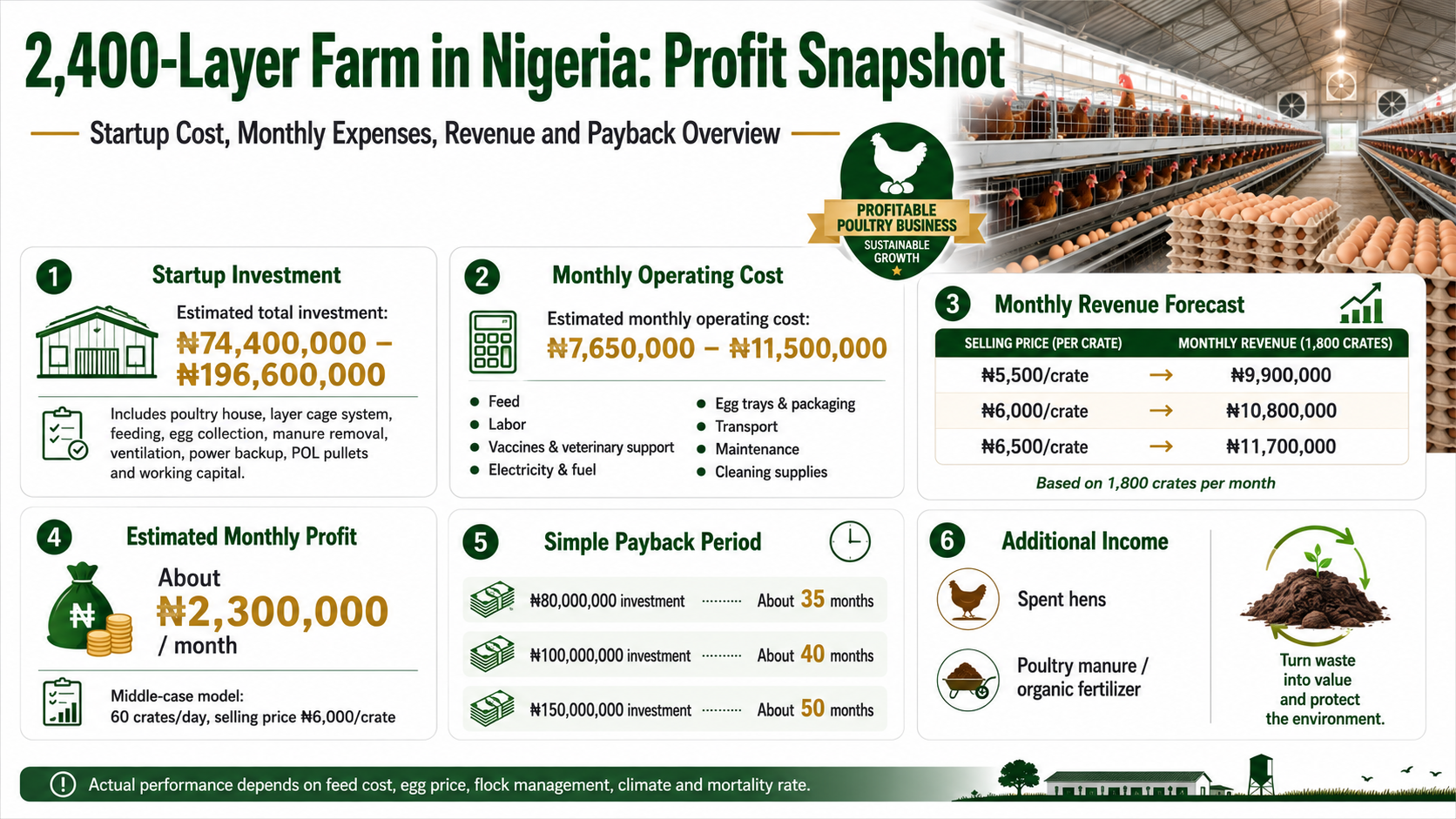
| Estimated total investment | ₦74,400,000 – ₦196,600,000 |
This investment range is wide because a basic A-frame cage farm, a semi-automatic farm and a fully automatic H-frame farm require very different budgets. A low-budget farm can choose A-Frame Layer Chicken Cage, manual egg collection and semi-automatic feeding. If future expansion is planned, it is better to consider stronger cages, automatic feeding, automatic egg collection, manure removal, ventilation and backup power from the beginning.
7. Monthly Operating Cost Estimate
The largest monthly cost of a 2,400-layer farm is usually feed. Based on 105 grams of feed per bird per day:
2,400 birds × 105g = about 252kg feed per day
252kg × 30 days = about 7,560kg feed per month
If the feed is packed in 25kg bags:
7,560kg ÷ 25kg = about 302 bags of feed per month
Example monthly operating cost:
| Operating Item | Monthly Estimate |
| Layer feed | ₦5,900,000 – ₦6,900,000 |
| Labor salary | ₦300,000 – ₦700,000 |
| Vaccines, medicine and veterinary support | ₦200,000 – ₦500,000 |
| Electricity, fuel and generator maintenance | ₦300,000 – ₦800,000 |
| Egg trays, packaging and breakage loss | ₦200,000 – ₦500,000 |
| Transportation and city delivery | ₦300,000 – ₦900,000 |
| Equipment repair and maintenance | ₦150,000 – ₦400,000 |
| Disinfection and cleaning supplies | ₦100,000 – ₦300,000 |
| Miscellaneous and management cost | ₦200,000 – ₦500,000 |
| Total monthly operating cost | ₦7,650,000 – ₦11,500,000 |
From this table, it is clear that the profit of a layer farm in Nigeria depends heavily on feed cost control. Farm owners must reduce feed waste, purchase feed carefully, monitor feed quality and record daily feed intake.
8. Revenue Forecast
Using a conservative production level:
60 crates per day × 30 days = 1,800 crates per month
If eggs are sold at different price levels, monthly revenue can be estimated as follows:
| Egg Selling Price | Monthly Sales Volume | Monthly Egg Revenue |
| ₦5,500/crate | 1,800 crates | ₦9,900,000 |
| ₦6,000/crate | 1,800 crates | ₦10,800,000 |
| ₦6,500/crate | 1,800 crates | ₦11,700,000 |
If flock management is good and daily egg production reaches 65 to 68 crates, monthly revenue can be higher. However, a business plan should not calculate only based on peak production. Heat stress, feed quality, disease, power failure, transportation and market price fluctuations can all affect real profit.
9. Monthly Profit Calculation
Using a middle-case model:
- Daily egg output: 60 crates
- Egg selling price: ₦6,000/crate
- Monthly egg revenue: ₦10,800,000
- Monthly operating cost: about ₦8,500,000
- Estimated monthly operating profit: about ₦2,300,000
If management is strong, egg prices are stable and feed cost is well controlled, monthly profit may be higher. If egg prices fall, feed prices rise or mortality increases, monthly profit will be reduced significantly.
| Total Investment | Monthly Net Profit Assumption | Simple Payback Period |
| ₦80,000,000 | ₦2,300,000 | About 35 months |
| ₦100,000,000 | ₦2,500,000 | About 40 months |
| ₦150,000,000 | ₦3,000,000 | About 50 months |
This calculation does not include loan interest, equipment depreciation, major disease risk, egg price decline, feed price increase or exchange rate changes. A cautious investor should prepare at least three financial models: conservative, normal and optimistic.
10. Additional Income: Spent Layers and Poultry Manure
In addition to egg sales, a 2,400-layer farm can also generate extra income from spent hens and poultry manure.
At the end of the main laying cycle, spent layers can be sold to local traders, restaurants or meat markets. This income can help the farm purchase the next batch of POL pullets and reduce financial pressure during flock replacement.
Poultry manure can also be sold to vegetable, maize, cassava and fruit farmers. If the farm expands in the future, Guangxing’s 11FFG-100 Fermentation Composting Machine can help turn poultry manure into organic fertilizer, reduce environmental pressure and improve added value.

11. Marketing and Sales Plan
One valuable idea from the 2,400-layer business plan sample is that eggs can be transported to a city sales point for distribution. This model is suitable for the Nigerian market because it reduces the number of customers entering the farm directly. It also keeps buyers away from the poultry house, lowers biosecurity risks and improves delivery and pickup efficiency.
Recommended sales channels include:
- Local egg wholesalers
Sell eggs by crate to local market distributors. - Restaurants and hotels
These buyers need stable egg supply. If the egg quality is consistent, they may accept better prices. - Grocery stores and supermarkets
These channels may require better packaging, stable egg size and regular delivery. - Bakeries and food processing businesses
These customers use eggs regularly and value long-term supply stability. - Schools and canteens
These buyers usually need predictable supply and fixed delivery schedules. - Community direct sales
Small farms can build loyal customers through fresh eggs and reliable delivery.
If the farm plans to sell branded eggs in the future, it can consider an egg washing, grading and packaging system. For larger egg handling needs, Guangxing’s Egg Washing, Grading and Packaging System can help improve standardization, reduce manual sorting and enter higher-value sales channels.

12. Daily Operation Plan
A 2,400-layer farm should have a fixed daily operation process. A typical daily routine includes:
- Workers change into farm clothes and boots before entering the poultry house.
- Workers pass through the footbath or disinfection area.
- The farm supervisor checks flock condition, feed intake and water intake.
- Sick birds, dead birds and abnormal droppings are recorded.
- The drinking line is checked to ensure that nipple drinkers are working properly.
- Feed is distributed evenly according to the feeding plan.
- Eggs are collected, counted and placed into trays or crates.
- Broken eggs and dirty eggs are recorded separately.
- Eggs are transferred to the temporary storage area or city sales point.
- Manure is cleaned or handled according to the cleaning schedule.
- Temperature, ventilation and lighting are checked.
- Daily records are updated, including egg production, feed use, mortality, sales data and expenses.
Good records help farmers detect problems early. For example, a sudden drop in egg production may be caused by disease, heat stress, poor feed quality, water shortage, lighting problems or management mistakes.
13. Staffing Plan
A 2,400-layer farm does not need a large team, but the team must be disciplined and stable. A basic staffing plan is as follows:
| Position | Number | Main Responsibilities |
| Farm owner/project manager | 1 | Investment, purchasing, sales, finance and major decisions |
| Farm supervisor | 1 | Daily management, records, biosecurity and worker supervision |
| Poultry workers | 1–2 | Feeding, water checking, egg collection, cleaning and manure handling |
| Sales/delivery staff | Part-time or 1 | Customer contact, delivery and payment follow-up |
| Veterinary consultant | External support | Vaccination program, disease diagnosis and medication advice |
The farm owner should not manage the project completely from a distance. Feed inventory, egg sales, mortality, medicine use and customer payments should be checked regularly. Poor supervision can quickly damage farm profitability.

14. Key Success Factors
14.1 Prepare Enough Working Capital
Layer farming requires continuous investment before and during egg production. Investors should prepare at least two to three months of operating capital. If feed supply is interrupted, egg production and flock health will be affected quickly.
14.2 Strictly Control Feed Waste
Feed is the largest cost. A good feeding system, proper feed level control and daily monitoring can directly improve profit. Choosing suitable poultry farming equipment can help reduce uneven feeding and labor pressure.
14.3 Maintain Stable Drinking Water
Insufficient water intake can quickly reduce egg production. Nigerian farms should consider borehole water, water tanks, filters and regular pipeline cleaning.
14.4 Improve Ventilation
Good ventilation can reduce heat stress, ammonia and respiratory disease risks. This is especially important in hot and humid regions.
14.5 Reduce Egg Breakage
Proper cage slope, standardized egg collection and careful egg handling can reduce breakage and improve revenue.
14.6 Build Stable Buyers Before Peak Production
Eggs are produced every day. The farm must build buyer relationships before the flock reaches peak laying performance to avoid unsold eggs and cash flow pressure.
15. Expansion Plan
A 2,400-layer farm can be the first stage of a larger layer farming project. A practical expansion path is as follows:
| Stage | Farm Scale | Main Goal |
| Stage 1 | 2,400 layers | Build the management system, sales channels and cash flow |
| Stage 2 | 5,000 layers | Increase egg supply and improve equipment utilization |
| Stage 3 | 10,000 layers | Introduce more automation and reduce labor cost |
| Stage 4 | 20,000 layers | Build a standardized commercial egg production and distribution system |
If expansion is planned, land, water, electricity, roads, manure handling space and egg storage space should be reserved from the first stage. Otherwise, future expansion will become more expensive.
16. Why Choose Guangxing Poultry Equipment?
Guangzhou Guangxing Poultry Equipment Group provides poultry cage systems, automatic feeding systems, automatic egg collection systems, manure removal systems, environmental control systems, egg processing equipment and turnkey poultry farming solutions.
For a 2,400-layer farm in Nigeria, Guangxing can help investors choose between A-Frame Layer Chicken Cage and Multi-Tier Automatic Layer Raising Equipment. Based on the project requirements, Guangxing can also match the cage system with feeding, drinking, egg collection, manure removal, ventilation and poultry house design.