


For many small farms, backyard egg businesses, free-range poultry farms, and local egg producers, egg processing starts as a simple daily job. Eggs are collected by hand, wiped or washed manually, checked under light, sorted by size, and packed into trays or cartons. At the beginning, this process may seem manageable. But as the flock grows and daily egg production increases, manual egg handling quickly becomes slow, inconsistent, and highly labor-intensive.
This is where small scale egg processing equipment becomes valuable. It helps small and medium egg producers clean, inspect, grade, and pack eggs more efficiently without investing in a large industrial production line. The right equipment can reduce labor pressure, improve egg appearance, lower breakage rates, and help farms sell more professional products to local markets, restaurants, supermarkets, and distributors.
Small scale does not mean low standard. Today, even small farms need better hygiene, consistent packaging, and reliable egg quality. Whether you process a few hundred eggs per day or scale up to several thousand, a well-designed egg processing system can help your farm move from manual operation to a more stable, scalable, and profitable business model.

What Is Small Scale Egg Processing Equipment?
Small scale egg processing equipment refers to machines and systems designed for farms and egg producers that do not require a full industrial egg processing plant. These machines are usually compact, easy to operate, and suitable for limited space. They can be used as single, standalone units or combined seamlessly into a small egg handling line.
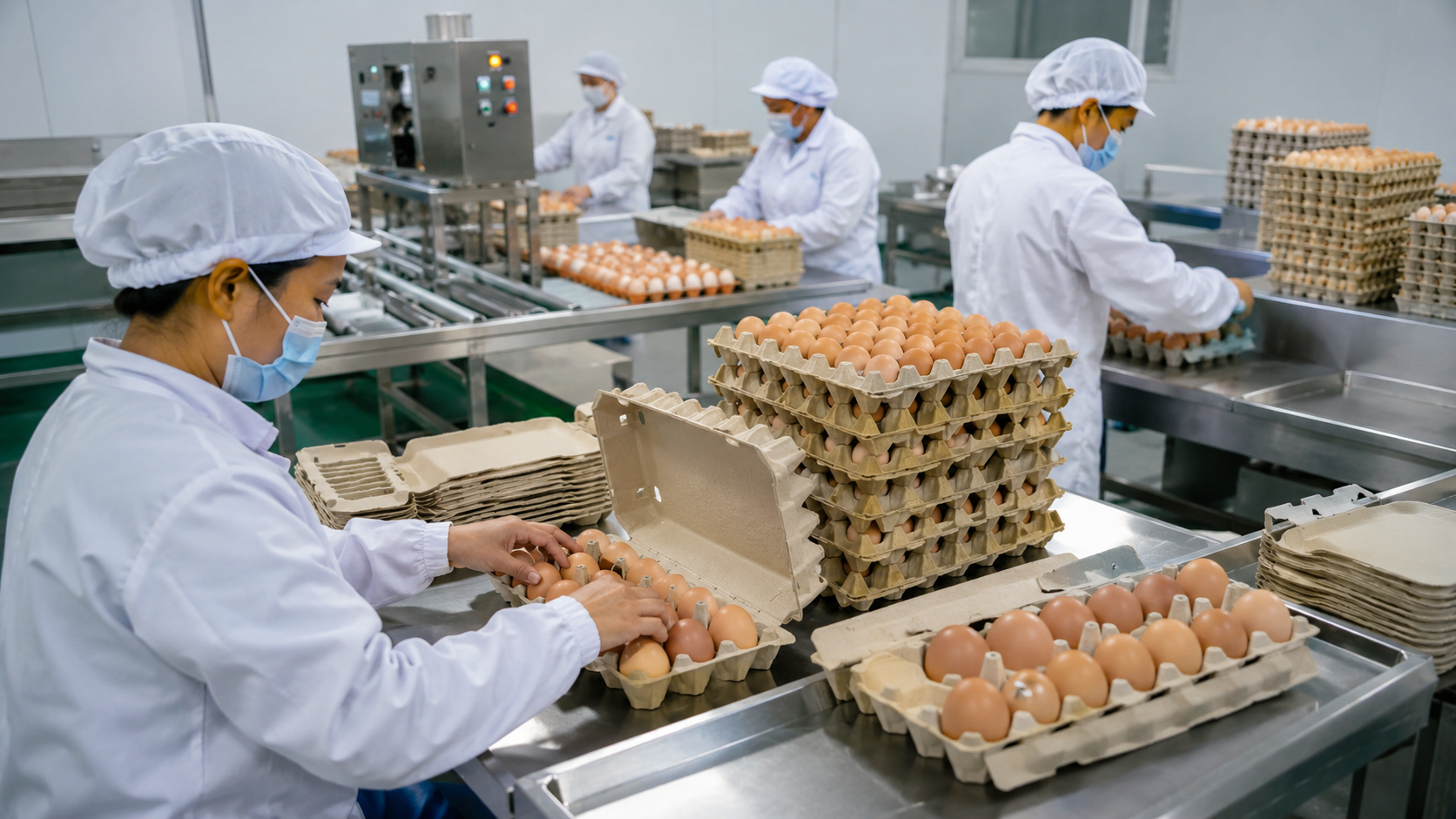
A basic small egg processing setup may include an egg washing machine, an egg drying section, a candling device, an egg grading machine, and a simple packing table. A more advanced setup may feature automatic feeding, electronic weighing, sorting lanes, tray packing, and conveying systems.
The purpose is simple: help producers handle eggs faster, cleaner, and more consistently. Depending on your farm size, daily egg volume, labor availability, packaging method, and sales channel, a standard line consists of:
-
Egg washing and drying machines
-
Egg candling lights and inspection tables
-
Egg grading and sorting machines
-
Egg conveyors and packing tables
Who Needs Small Scale Egg Processing Equipment?
Small scale egg processing equipment is engineered to fit several types of users across the global poultry industry:
-
Small and Medium Layer Farms: Farms holding thousands of hens that produce thousands of eggs daily. Manual handling takes too much time and creates a bottleneck in daily operations.
-
Free-Range, Organic, and Premium Egg Producers: These farms often command a higher market price. Egg cleanliness, flawless shell appearance, and professional packaging are crucial to building premium customer trust.
-
Local Market Suppliers: Businesses supplying local farmers’ markets, grocery stores, restaurants, bakeries, or community hubs that require improved efficiency without massive capital expenditure (CapEx).
-
New Agricultural Investors: Entrepreneurs setting up a small-to-medium egg production business who want to establish standardized, biosecure workflows from day one.
Why Manual Egg Processing Becomes a Problem
Manual egg handling looks simple, but it quickly hits a bottleneck when production scale increases.
-
The Labor Trap: Workers spend hours collecting, wiping, sorting, and boxing. When daily volume grows, labor costs skyrocket and eat into thin agricultural margins.
-
Inconsistent Grading: Human eyes can misjudge weight and quality under fatigue. This results in inconsistent packaging, leading to customer complaints or pricing losses.
-
High Breakage Rates: Eggs are fragile. The more times they are manually picked up, moved, and placed down, the higher the percentage of hairline cracks and waste.
-
Biosecurity & Hygiene Risks: If eggs are cleaned by hand without a stable, temperature-controlled process, cross-contamination can occur, jeopardizing food safety standards.
Main Equipment Used in Small Egg Processing
1. Small Egg Washing Machine (with Thermal Control)
An egg washing machine is often the first upgrade small farms consider to eliminate tedious manual scrubbing. However, food safety in engineering matters. A professional small-scale egg washer must feature SUS304 food-grade stainless steel construction to withstand high humidity and prevent bacterial harbor.
More importantly, professional systems integrate a water temperature regulation module. Washing warm, freshly laid eggs with cold water causes the egg contents to contract, pulling dirty water and Salmonella through the porous shell. A reliable washer maintains water temperature at 35°C–40°C (approx. 10°C warmer than the egg) alongside custom nylon brushes to sweep away feces and stains gently without micro-cracking the shell.
2. High-Efficiency Egg Drying System
Placing wet eggs directly into cardboard cartons creates a breeding ground for mold and compromises structural packaging integrity. In a streamlined line, the washing section connects immediately to a specialized drying module. Utilizing high-pressure, ambient-temperature air blowers, this system strips moisture from the shell surface within seconds, preparing the eggs flawlessly for candling and date-coding.
3. Semi-Automatic Egg Candling Equipment
Before eggs hit local supermarket shelves, internal quality inspection protects your brand reputation. For operations handling 3,000 to 5,000 eggs per hour (OPH), an integrated LED candling booth or an under-roller light conveyor allows a single operator to instantly spot hair-line cracks, blood spots, enlarged air cells, and internal defects that are completely invisible under regular ambient room lighting.
4. Precision Small Egg Grading Machine
Egg grading machines sort your daily yield by weight into market standard sizes (e.g., Small, Medium, Large, Extra Large). While massive packing plants rely on complex acoustic or electronic sensors, a practical small-scale grader utilizes highly durable, mechanical balance scales.
A compact grader offers a weight sorting accuracy within ±1 gram, ensuring each carton meets local regulatory weights precisely. This prevents “over-packing” (giving away heavy eggs for a medium-grade price) and directly protects your profit margins.

5. Flexible Egg Packing Table & Systems
The final stage bridges your processing line to transport. For small-scale operations, a manual packing table at the end of the sorting lanes offers the highest flexibility. Operators can quickly pivot between filling 10- or 12-count retail pulp cartons for local grocery stores, and stacking 30-egg plastic trays for regional wholesale B2B distributors.
Manual, Semi-Automatic, or Automatic: Which Fits Your Farm’s ROI?
Investing in processing technology is not about buying the largest machinery available; it is about matching your Daily Egg Volume and Labor Allocation to achieve the fastest return on investment (ROI).
To help you evaluate, we break down small-scale operations into three realistic technology Tiers:
| Processing Type | Capacity Range (OPH) | Labor Required | Best For |
| Tier 1: Manual Baseline | < 1,500 eggs/day | 2-3 workers | Backyard flocks, direct local nest sales |
| Tier 2: Semi-Automatic Sweet Spot | 3,000 – 5,000 OPH | 1 worker | Growing free-range farms, local grocery suppliers |
| Tier 3: Fully Automatic Compact Line | 5,000 – 10,000 OPH | 1 worker (monitoring) | Small commercial layer houses, regional distribution |
-
The Tier 2 Semi-Automatic Sweet Spot is typically the most profitable option for expanding family farms and localized egg brands. A single operator can comfortably manage the entire flow from washing to sorting. This setup slashes daily labor hours by up to 70%, standardizes product presentation, and drastically reduces egg handling contact, cutting cracks to less than 0.5%.
How to Choose the Right Capacity
Capacity is the ultimate factor when choosing small scale egg processing equipment. A machine that is too small will become an operational bottleneck, while a system that is too large wastes upfront capital and floor space.
Before contacting an industrial equipment supplier, make sure you have calculated:
-
Your exact daily egg production volume.
-
The specific hours per day allocated to egg processing.
-
Your available footprint inside the sorting facility.
-
Future expansion plans for the flock over the next 2 to 3 years.
The goal is not to buy the biggest machine on the market. The goal is to buy the most scalable and suitable system for your operational flow.

New Equipment vs. Used Equipment
Some small farms consider buying used egg processing machinery to reduce immediate costs. While tempting, used machines frequently hide severe operational risks: worn-out conveyor gears, outdated control components, missing calibration tools, or a lack of replacement spare parts.
Investing in new, customized equipment gives farms ultimate flexibility. Modern small-scale systems can be custom-configured based on your precise facility layout, local electricity constraints, and exact packaging formats, providing highly reliable long-term performance.
Why Choose Guangxing for Small Egg Processing Solutions
Guangxing provides poultry farming and egg handling equipment engineered for farms of all sizes. For small and medium egg producers, Guangxing specializes in designing practical, high-performance egg processing solutions tailored to your real-world production needs.
Instead of only offering massive, high-volume industrial systems, Guangxing provides modular equipment options for growing farms—including compact SUS304 egg washing, precision grading, and flexible conveying lines. Our systems are designed to grow with your business: you can start with a basic grading setup and integrate automated washing or loading modules later as your production increases.
Our mission is clear: help egg producers minimize labor dependencies, eliminate egg breakage losses, and achieve premium quality standards.
Get a Customized Solution for Your Farm
For farms planning to connect egg collection with downstream processing, Guangxing also provides an Automatic Egg Collection System that helps reduce manual handling before eggs enter the washing, grading, and packing workflow.