Generator Sizing, Ventilation Loads, Fuel Storage and Equipment Planning for Commercial Poultry Farms
A poultry farm can lose an entire flock even when its feeding and drinking equipment is working perfectly.
Imagine 30,000 broilers approaching market weight on a hot afternoon in northern Nigeria. The exhaust fans are running, cooling equipment is operating and the birds are producing considerable body heat.
Then the grid voltage drops. A few moments later, the ventilation fans stop.
The farmer has a backup generator, but it cannot restart all the motors at once.
This is why choosing a generator for a poultry farm involves more than counting birds or adding up equipment wattages.
A 20,000-bird farm does not automatically need a 50 kVA generator, nor does a 30,000-bird farm automatically need 100 kVA. The correct capacity depends on the running loads, motor-starting requirements and equipment that must remain operational during an interruption.
Before buying a generator, understand five things:
- Which equipment must keep running to protect the flock
- Why motor-starting current can be much higher than running current
- How transfer switches and staged starting affect generator selection
- How much diesel the farm needs during a prolonged outage
- What electrical information the poultry equipment supplier must provide
Contents
- Why Backup Power Matters for Nigerian Poultry Farms
- Which Poultry Farm Equipment Needs Emergency Power?
- How to Calculate Poultry Farm Generator Capacity
- Automatic Transfer Switches and Low-Voltage Protection
- Planning Backup Power for a 30,000-Broiler Farm
- What Should a Backup-Power Quotation Include?
- How Guangxing Helps with Electrical Planning
- Frequently Asked Questions
1. Why Backup Power Matters for Nigerian Poultry Farms
A naturally ventilated poultry house and a mechanically ventilated poultry house face different risks during a power failure.
In a mechanically ventilated building, fans move air through the house. When the fans stop during hot weather, temperature and humidity can rise quickly, especially when birds are close to market weight.
Large farms with tunnel ventilation also depend on pumps, environmental controllers and alarms. If several systems stop together, farm workers have little time to respond.
The danger is not limited to complete blackouts.
Low voltage, often called a brownout, can also damage equipment.
A motor may continue operating even when incoming voltage falls below an acceptable level. Under certain operating conditions, it draws additional current and its windings can overheat.
This is particularly important for Nigerian poultry farms where the quality of grid supply can vary between locations.
Auburn University’s Emergency Power for Poultry Production (Newsletter No. 8, November 2000) explains why standby-power arrangements must protect poultry houses against both blackouts and unacceptable voltage drops.
The important point for farm owners is that installing a generator is not enough. The generator, transfer switch, motor controls and ventilation system must operate together when the normal supply becomes unreliable.
2. Which Poultry Farm Equipment Needs Emergency Power?
The first step is deciding what must keep running when the electricity fails.
During extreme heat, ventilation takes priority. The environmental controller and alarms also need dependable power, while drinking water must remain available throughout the interruption.
Feeding and manure removal can often wait until the essential systems stabilise.
| Poultry equipment | Emergency priority | What the buyer should check |
|---|---|---|
| Exhaust ventilation fans | Critical | Number of fans required under worst-case conditions |
| Environmental controller and alarms | Critical | Backup supply, fault alerts and restart behaviour |
| Drinking-water supply and pumps | Critical | Water storage and pump starting current |
| Cooling-pad pumps | Critical when cooling is required | Water flow during hot weather |
| Automatic feeding | Can often be scheduled | Motor power and restart sequence |
| Essential lighting | Required circuits first | Safety and operating needs |
| Manure removal | Usually schedulable | Whether operation can wait |
| Egg collection | Usually schedulable | Relevant to layer farms |
Water supply deserves particular attention. A flock cannot wait for water simply because the generator is powering the ventilation fans.
A farm with sufficient elevated water storage may maintain drinking-water pressure temporarily without an electric pump. Another farm may depend on continuous pumping.
The electrical engineer should understand that difference before deciding which circuits need immediate backup power.
Workers also need clear instructions. If the generator cannot supply every system simultaneously, they should know which equipment starts first and which operations must wait.
3. How to Calculate Poultry Farm Generator Capacity
The calculation begins with a complete electrical load schedule.
Ask the equipment supplier for each motor’s rated power, running current, supply voltage, phase, starting method and operating sequence.
Step 1: Calculate the running electrical load
Consider a hypothetical broiler house with the following requirements:
| Equipment | Illustrative running load |
|---|---|
| Exhaust ventilation fans | 24 kW |
| Cooling and water pumps | 4 kW |
| Environmental controls and alarms | 1 kW |
| Essential lighting | 1 kW |
| Total running load | 30 kW |
Assume a power factor of 0.8 for this simplified example.
The apparent power is:
30 kW ÷ 0.8 = 37.5 kVA
That gives the apparent power associated with the assumed running load. It does not establish the required generator rating.
An electrical engineer must also consider motor starting, voltage regulation, generator derating and the combinations of equipment that can operate simultaneously.
Step 2: Account for motor-starting loads
When an electric motor starts, it can draw much more current than it needs during normal operation.
Auburn University’s Emergency Power for Poultry Production (Newsletter No. 8, November 2000) reports that poultry-house electric motors can draw 2–12 times their normal running current during starting.
Ventilation fans starting under relatively light load can sit towards the lower end of that range. Motors starting under heavier loads, such as some feed conveyors, can draw much more.
This is why a generator that supports the 30 kW running load in our example may still struggle when several motors start together.
Starting-current multiples cannot simply be multiplied by running kW to calculate generator capacity. The result also depends on starting power factor, motor characteristics and generator voltage response.
Auburn provides a useful comparison from a four-house broiler farm.
| Operating condition | Auburn example |
|---|---|
| Total normal running demand | 74.04 kW |
| Maximum starting demand with two-house transfer stages but no fan-start staging | 158.22 kW |
| Maximum starting demand with additional ventilation-fan staging | 110.22 kW |
The same farm equipment produces a very different peak demand when the starting sequence changes.
The figures also show why two generator quotations cannot be compared fairly unless both suppliers understand how the farm’s motors will start.
Step 3: Use staged starting where appropriate
A properly designed controller can start essential fans first, followed by other ventilation motors and pumps in an approved sequence.
Instead of asking the generator to start every motor simultaneously, the control system reduces the load applied at any one moment.
Staging can lower the generator capacity required, but it does not eliminate the need for adequate power.
The electrical engineer must verify the proposed starting sequence and the generator’s response using the actual motor and generator specifications.
Step 4: Compare the calculation with a published reference
Auburn’s No. 8 newsletter reports that generator sets with nameplate capacities of approximately 25 kW per broiler house often proved adequate for the US poultry houses examined in its publication.
That reference assumes suitable time-delayed transfer switches and staged ventilation controllers.
Without properly coordinated starting, a farm may need substantially greater capacity.
The 25 kW figure is a comparison from a particular production arrangement, not a sizing recommendation for a Nigerian farm.
Auburn’s guidance is clear that a qualified engineer or technician should determine the generator capacity required for each poultry operation.
4. Automatic Transfer Switches and Low-Voltage Protection
A generator that works during a manual test may still fail to protect the flock during an unattended power interruption.
The automatic transfer switch (ATS) is one of the most important parts of the emergency system.
When the incoming supply falls outside permitted limits, the automatic arrangement can start the generator, allow the power to stabilise and transfer designated circuits to backup power.
When the utility supply returns, the system transfers back according to its configured sequence.
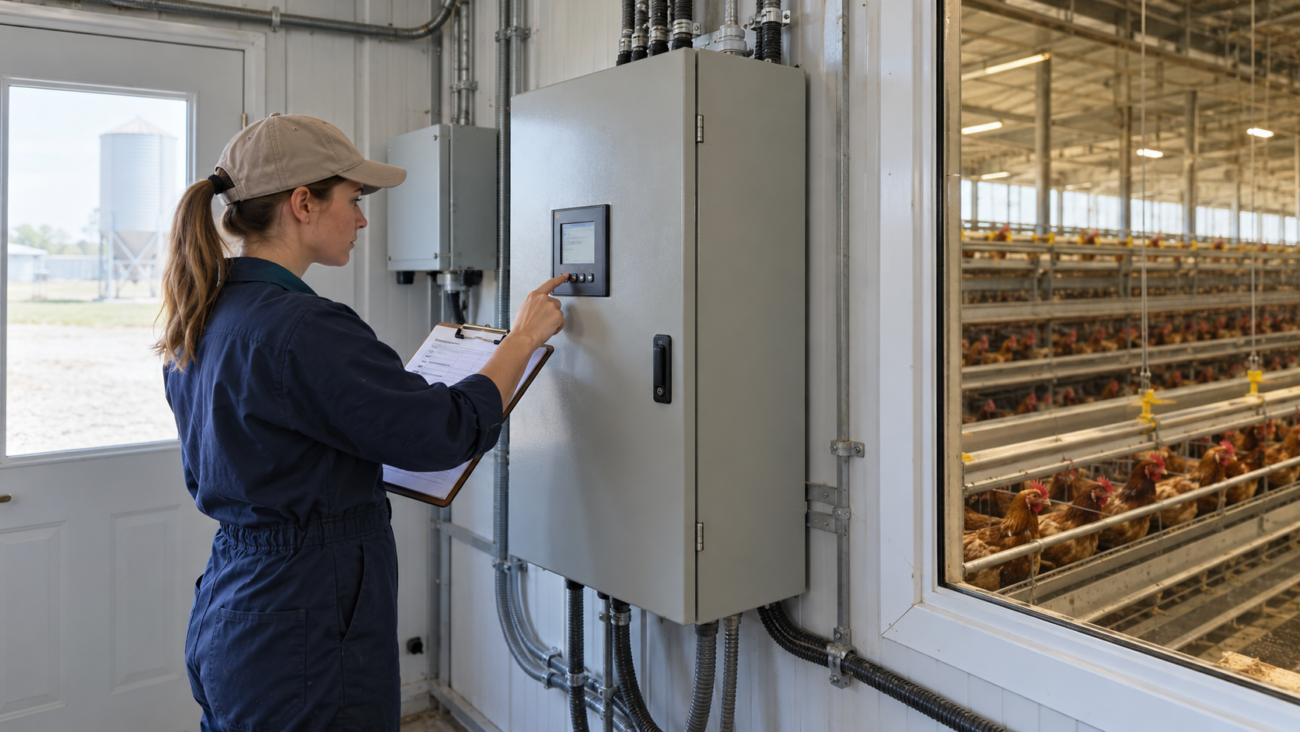
Brownout protection: when should the generator start?
Auburn’s Emergency Power for Poultry Production discusses a transfer setting that brings standby power online when utility voltage falls below 90% of nominal.
In practice, the threshold must be confirmed against the local electrical supply, generator, transfer switch and connected equipment.
Buyers should ask the electrical contractor whether the proposed ATS monitors voltage, how it responds to prolonged low voltage and whether the generator can restart essential equipment safely.
The transfer system must also prevent unsafe backfeeding into the public electricity network.
What happens if the automatic controls fail?
Automatic systems can fail too.
Auburn’s later publication, Will Your Standby Generator Stand Up? (Newsletter No. 74, December 2011), recommends considering a manual bypass key switch that allows trained personnel to start a generator when electronic controls malfunction.
The publication reported that such installations could cost well under US$1,000 at the time.
The buyer should ask a qualified installer whether a suitable manual override arrangement is available for the proposed generator and transfer system.
A manual override must be designed to maintain the necessary electrical interlocks and safety protections. It should not allow workers to bypass those protections or backfeed the utility supply.
5. Planning Backup Power for a 30,000-Broiler Farm
Consider an investor planning a commercial poultry operation in Nigeria with a capacity of 30,000 broilers.
One preliminary arrangement is two poultry houses accommodating 15,000 birds each.
The final cage system, ventilation equipment and building dimensions are still under discussion.
Suppose the initial electrical schedule shows approximately 15 kW of ventilation running load per house.
Together, the two houses would draw around 30 kW of ventilation load. Water pumps, environmental controls and lighting would add to that figure, so the complete running load is larger than the 30 kW used in the worked example. That is why the load schedule has to be built up line by line rather than estimated from bird numbers.
The investor can now ask more useful questions.
Will one generator serve both houses? Can the control system start one house’s fans before those in the second? What happens if a water pump starts while the fans are operating?
The answers will determine the motor-starting sequence and help the electrical engineer select suitable generator equipment.
A farmer planning to expand from two houses to four also needs to think ahead.
A future expansion may require additional generator capacity, separate backup equipment or changes to the electrical distribution system.
The electrical layout and the building plan have to be settled together.
This avoids installing the generator in the wrong position or discovering later that the switchgear and cable routes cannot support another poultry house.
Investors considering the broader operational challenges of commercial broiler production can also read Guangxing’s Astral Foods case study on broiler farm equipment in Africa.
That article examines feed costs, infrastructure reliability and equipment planning from a different perspective.
6. What Should a Backup-Power Quotation Include?
Generator capacity is only one part of the quotation.
A complete backup-power system may include the generator set, automatic transfer equipment, electrical distribution, protection devices, fuel storage, installation and commissioning.
| Quotation item | What the buyer should confirm |
|---|---|
| Generator rating | Continuous load and motor-starting performance |
| Standby or prime rating | Correct rating for the intended operating duty |
| Automatic transfer switch | Voltage monitoring, transfer sequence and protection |
| Manual override arrangement | Safe operation if electronic controls fail |
| Electrical installation | Cables, earthing and protective devices |
| Diesel fuel storage | Capacity for the planned outage duration |
| Generator enclosure | Cooling airflow and safe exhaust routing |
| Commissioning | Testing under the intended operating loads |
| Maintenance and spare parts | Local service support and replacement components |
A supplier quoting only the generator set may appear cheaper than another offering a complete installed system.
The buyer needs both quotations to cover the same scope before comparing prices.
How much diesel should the farmer store?
Fuel can become the limiting factor during a prolonged electricity outage.
Auburn University’s Will Your Standby Generator Stand Up? provides a practical reference for a typical 100 kW generator.
Depending on load, the publication reports diesel consumption of approximately 3–5 US gallons per hour.
| Running period | Reference diesel consumption |
|---|---|
| 1 hour | 3–5 US gallons |
| 24 hours | 72–120 US gallons |
| 48 hours | 144–240 US gallons |
The actual fuel requirement depends on the generator’s load and consumption characteristics, so buyers should use the selected manufacturer’s fuel-consumption data for final planning.
Fuel storage also needs to meet local safety requirements.
During a regional outage, nearby fuel stations may be without power themselves. Even when diesel is available, delivery delays can leave a farm without backup electricity.
A farmer should therefore calculate how much fuel the generator needs for the planned emergency operating period and arrange suitable storage.
Auburn also highlights the importance of keeping spare fuel filters.
When workers refill a nearly empty fuel tank, sediment can enter the supply line and block the filters.
For a poultry farm, having the correct spare filter available can mean the difference between a working house and a stopped one.
Do not overlook generator-room ventilation
The generator needs cooling during prolonged operation.
In its 2011 publication, Auburn discusses radiator-air discharge and fresh-air intake for generators housed in enclosed sheds.
For the arrangements examined, it recommends an outlet approximately 1.5–2 times the radiator area, with an incoming-air opening approximately twice the exhaust outlet area.
It also warns against allowing hot air or engine exhaust to return towards the generator’s air intake.
The final ventilation arrangement must follow the actual generator manufacturer’s installation requirements.
A generator can have enough electrical capacity and still shut down because its engine overheats.
7. How Guangxing Helps with Poultry Equipment and Electrical Planning
Guangzhou Guangxing Poultry Equipment Group supplies commercial poultry housing and automation equipment, including cage systems, automatic feeding, drinking, manure removal and environmental controls.
When a buyer plans a new farm, selecting this equipment also establishes the electrical loads that the project must support.
The proposed ventilation arrangement determines the number and type of fan motors. Water-supply equipment introduces pump loads, while feeding systems and manure conveyors add further electrical requirements.
Guangxing’s poultry house environmental control system provides a starting point for discussing the farm’s ventilation and automation configuration:
https://guangxiniot.com/product/poultry-house-environmental-control-system/
Before the buyer orders a generator, the equipment supplier should provide the relevant motor and control-system information needed for the electrical design.
The project’s qualified electrical engineer then uses the complete load schedule to calculate the generator rating, starting sequence, transfer arrangement, cabling and protective devices.
This division of responsibilities is important.
A poultry equipment manufacturer can coordinate equipment specifications and operating requirements. It should not replace the electrical professional responsible for generator sizing and installation safety.
Buyers preparing a wider equipment budget can also consult Guangxing’s poultry farm equipment price guide:
https://guangxiniot.com/poultry-farm-equipment-price-buying-guide/
The guide explains why quotations with different equipment scopes can be difficult to compare.
Planning a 20,000-, 30,000- or 50,000-broiler farm in Nigeria?
Share your intended bird capacity, location, housing method and available site dimensions.
Contact Guangxing for the equipment load schedule, poultry-house layout and equipment quotation. The project’s electrical engineer should complete the final generator sizing and installation design.
https://guangxiniot.com/contact-us/
8. Frequently Asked Questions
What size generator does a 20,000-chicken farm need?
There is no fixed generator rating based only on chicken numbers. The electrical designer needs the fan and pump specifications, other critical loads and motor-starting data. The ventilation arrangement often has a greater influence on emergency-power requirements than bird numbers alone.
Is a 100 kVA generator enough for a poultry farm?
A 100 kVA generator may be suitable for some poultry houses but inadequate for others. At an assumed power factor of 0.8, 100 kVA corresponds to 80 kW. However, that calculation does not establish whether the generator can start the connected motors. The manufacturer’s ratings and an engineering assessment are essential.
How much fuel does a poultry farm generator use?
Auburn University’s 2011 poultry engineering newsletter reports approximately 3–5 US gallons of diesel per hour for a typical 100 kW generator, depending on load. That represents about 72–120 gallons over 24 hours. Buyers should check the consumption data for their selected generator.
Can solar panels replace a diesel generator?
Solar power can reduce electricity costs and dependence on the public grid. However, panels alone cannot provide dependable backup power during an outage. A system supporting critical ventilation needs appropriate energy storage, inverter capacity, controls and an engineered backup arrangement.
Does a poultry farm need an automatic transfer switch?
Mechanically ventilated poultry houses need a dependable way to transfer essential equipment to backup power. An appropriately specified ATS can respond automatically to power failure or unacceptable voltage, reducing the delay before ventilation resumes.
How often should a poultry farm test its generator?
Follow the manufacturer’s maintenance schedule and the farm’s emergency procedures. Testing should cover starting, transfer switching, alarms and the generator’s ability to carry the required load. Short routine runs do not replace comprehensive maintenance or readiness checks.
Should the generator be purchased before the poultry equipment?
Establish the poultry equipment arrangement first. The supplier’s electrical specifications provide the information needed to select the generator. Otherwise, the buyer risks purchasing a unit that cannot support the required starting loads or paying for unnecessary capacity.
Technical and Editorial Note
The 30 kW running-load calculation, 15 kW-per-house ventilation example and proposed two-house farm are hypothetical planning scenarios. They are not verified Guangxing equipment specifications or approved electrical designs.
The Auburn University figures come from US poultry engineering publications released in 2000 and 2011. They provide useful technical comparisons, but they are not current Nigerian generator quotations or automatic sizing rules.
Qualified electrical professionals must confirm generator capacity, motor starting, transfer arrangements, safety protection and commissioning using actual equipment data and applicable local requirements.
Technical References
1. Auburn University — Emergency Power for Poultry Production
Alabama Poultry Engineering and Economics Newsletter, No. 8, November 2000.
https://ssl.acesag.auburn.edu/poultryventilation/documents/Nwsltr-8.pdf
2. Auburn University — Will Your Standby Generator Stand Up?
National Poultry Technology Center, Poultry Engineering, Economics & Management Newsletter, No. 74, December 2011.
https://ssl.acesag.auburn.edu/dept/poultryventilation/documents/Nwsltr-74StandbyGenerators.pdf