


Current Poultry Equipment Prices in Nigeria
- Poultry equipment prices in Nigeria vary greatly, depending on automation level, farming scale and material quality.
- Below is a clear breakdown of mainstream market price ranges for common poultry farming equipment.
Equipment Type and Farm Scale | Naira Price (₦) | USD Price ($) |
Basic manual small-scale equipment (drinkers, feed troughs, small slaughter tools) | 8,000 – 250,000 | 800 – 2,200 |
Semi-automatic A-type cage system (1,000 birds capacity) | 2.8 million – 3.5 million | 10,000 – 35,000 |
Fully automatic H-type layer system (5,000 birds capacity) | 15 million – 22 million | 40,000+ |
Large full-set automated turnkey breeding and processing line | Over 58 million | 40,000+ |

1、Key Factors Affecting Poultry Equipment Prices in Nigeria
- Multiple local factors create continuous price fluctuations in Nigeria’s poultry equipment market, making local pricing less stable than global markets.
- Exchange rate volatility is the biggest price driver.
- Almost all commercial-grade poultry equipment is imported and traded in US dollars.
- Frequent fluctuations in the Naira parallel market rate directly reshape retail prices, leaving local farmers facing unstable procurement costs.
- Automation level and material quality also create obvious price gaps.
- Low-cost electro-galvanized equipment rusts easily in Nigeria’s hot, humid climate and requires frequent replacement.
- In contrast, high-quality hot-dip galvanized equipment costs 20%–30% more but delivers strong corrosion resistance and longer service life.
- Fully automatic systems for feeding, egg collection and manure cleaning cost 15%–28% more than manual versions but effectively reduce long-term labor expenses.
- In addition, import tariffs, logistics and distributor markups raise final market prices.
- Import duties, port clearance fees and inland transportation add 18%–35% extra cost to factory prices.
- Small-scale buyers without bulk purchasing power also face 40%–80% profit margins charged by local distributors.
2、Local Manufacturing vs Imported Equipment in Nigeria

- Nigeria’s domestic poultry equipment manufacturing sector remains underdeveloped.
- Local workshops can only produce simple, low-tech tools such as basic feed troughs, uncoated cages and manual slaughter tools.
- These locally made items are 20%–30% cheaper, suitable only for small backyard farms with tight budgets.
- However, local products have obvious limitations.
- Most use low-grade thin steel that rusts quickly in tropical weather.
- Without unified production standards and professional after-sales support, quality consistency cannot be guaranteed.
- Most importantly, local manufacturers lack the technology to produce automated breeding systems, intelligent incubators and large-scale processing equipment.
- For medium and large commercial poultry farms, imported equipment is the only viable option.
- Over 90% of high-end commercial poultry equipment in Nigeria comes from overseas.
- European equipment offers reliable performance but carries a 30%–50% premium, which is unaffordable for most local operators.
- As a result, Chinese poultry equipment has become the most popular import choice across Nigeria, balancing quality, durability and budget.
3、Advantages of Importing Poultry Equipment from China
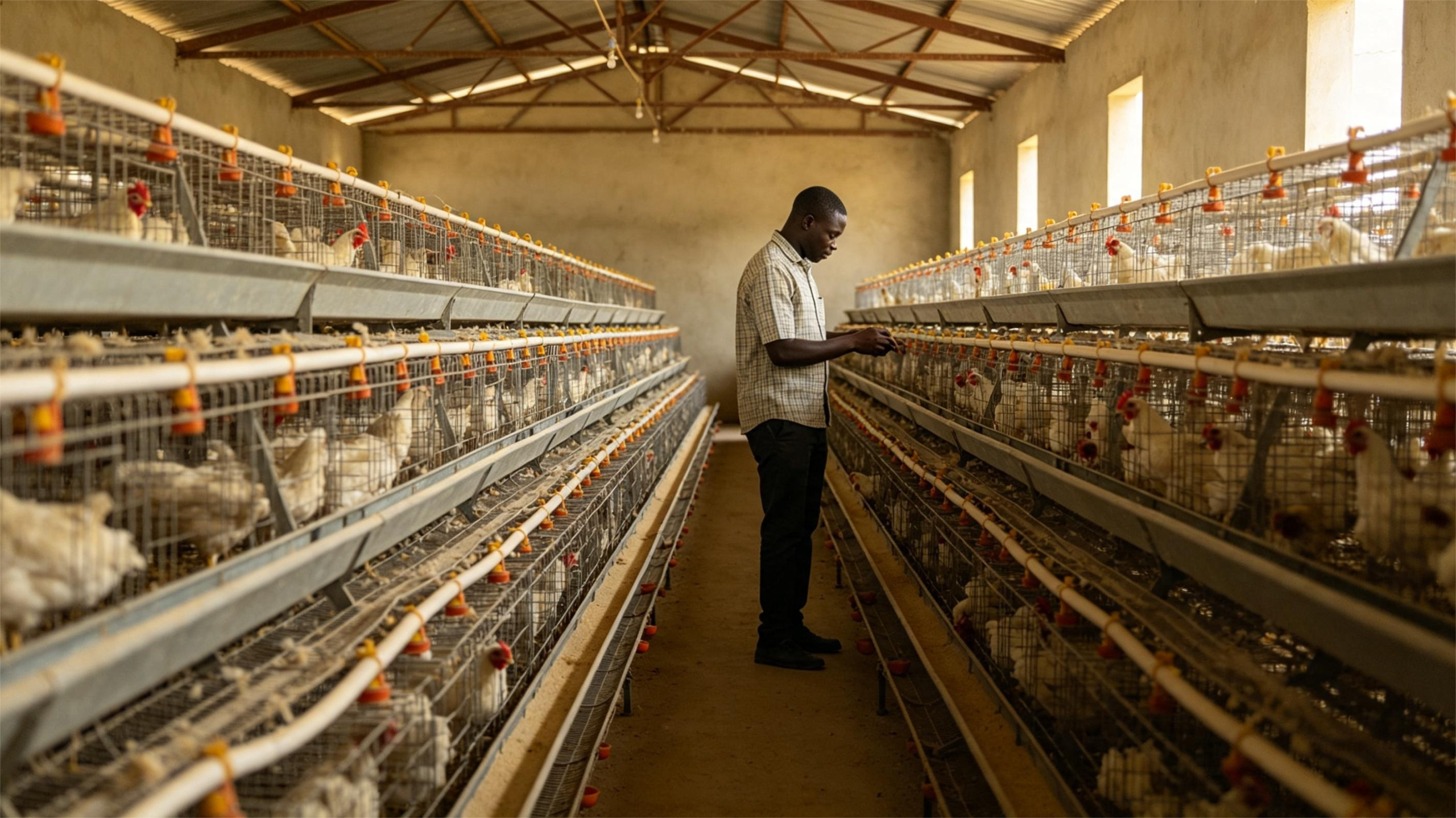
Chinese poultry equipment dominates Nigeria’s import market for practical, cost-effective reasons that fit local farming conditions.
High cost performance
- Chinese manufacturers adopt direct factory sales models with no intermediate markups.
- Equipment with equivalent automation and quality costs 30%–50% less than European alternatives.
- All core structures adopt upgraded hot-dip galvanized technology, specially optimized for Nigeria’s high humidity and high temperature, ensuring long-term durability.
Localized environmental adaptability
- Considering Nigeria’s unstable power supply and tropical climate, mainstream Chinese poultry equipment supports solar power compatibility and efficient ventilation cooling systems.
- Simplified operation and maintenance designs also lower technical barriers for local workers.
One-stop customized solutions
- Suppliers provide complete turnkey project packages, including cages, automatic feeding, drinking, manure cleaning and egg collection systems.
- Modular design allows phased procurement and gradual capacity expansion, effectively reducing initial investment pressure for farmers.
Mature supply chain and after-sales service
- Chinese poultry equipment brands have long-term stable export channels to Lagos and Port Harcourt.
- Professional after-sales support, including remote guidance, video debugging and long-term spare parts supply, solves the common local pain point of difficult equipment maintenance.
4、Conclusion
- Small-scale Nigerian family farms can choose low-cost local simple equipment to control early investment, while commercial-scale farms require stable, durable imported automated systems to guarantee long-term breeding profits.
As an experienced supplier serving numerous Nigerian poultry projects, Guangxing provides climate-adaptive poultry equipment solutions and customized pricing plans based on farm scale, site conditions and actual budgets, delivering reliable and cost-effective support for local poultry development.
If you have any related needs, please feel free to contact us for consultation.

