


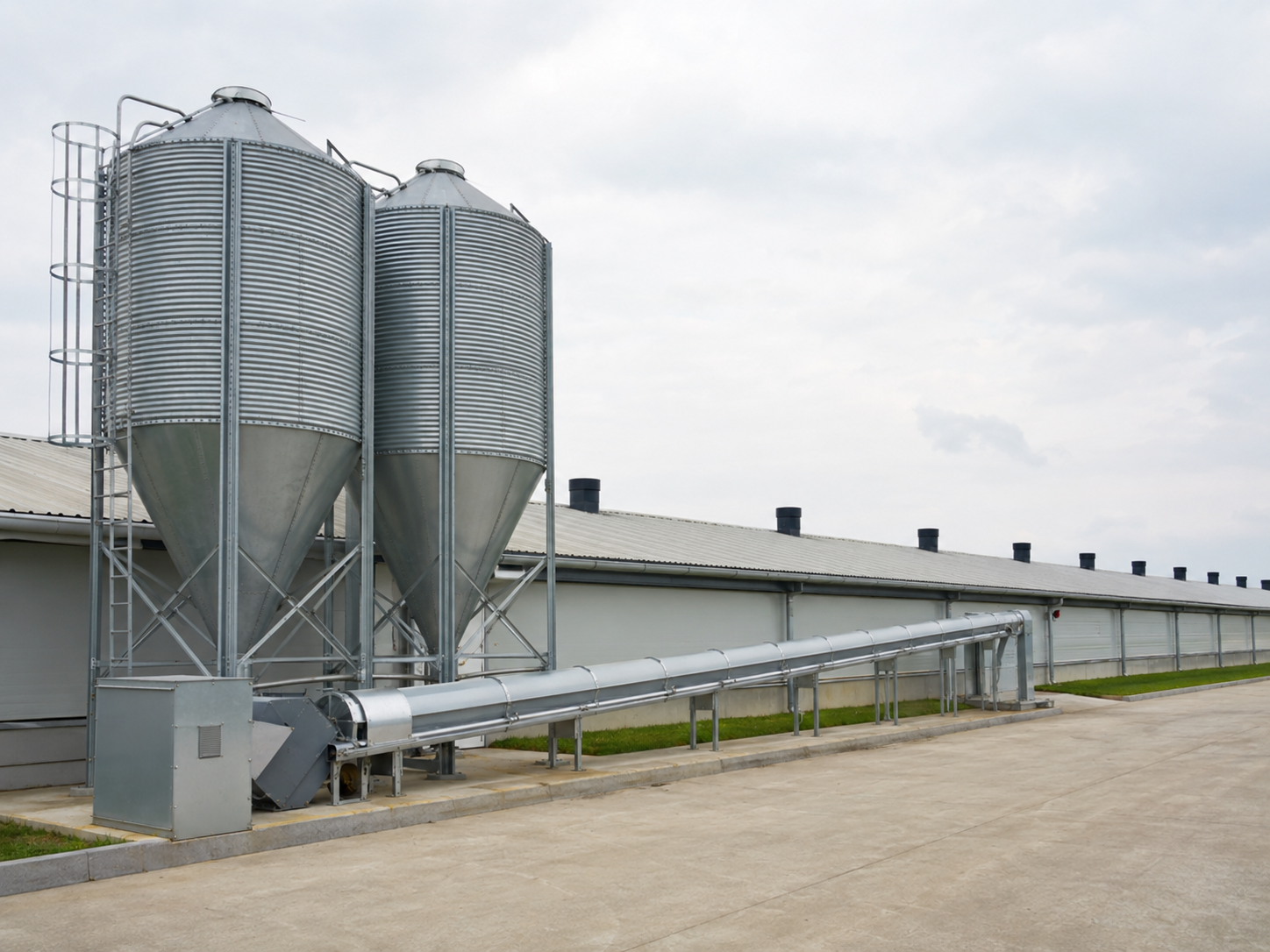
A poultry feed conveyor system moves feed from storage to the poultry house and then connects with the equipment that distributes feed to the birds.
On a small farm, this may involve only a feed bin and a short auger. On a commercial poultry farm with several houses and tens of thousands of birds, feeding becomes a much larger system.
A typical feed route looks like this:
Feed truck → feed silo → feed conveyor → poultry house hopper → feeding line → chickens
The right system depends on the farm layout, conveying distance, number of birds, feed type and level of automation.
For farmers planning to reduce manual feeding, the conveyor should also be considered together with the poultry automatic feeding system, rather than treated as a separate machine.
This guide explains the main poultry feed transport methods, their applications, common problems and the information you should prepare before requesting a quotation.

What Is a Poultry Feed Conveyor System?
A poultry feed conveyor is equipment used to move dry poultry feed from one point to another.
In most commercial farms, the system starts at an outdoor feed silo.
Feed leaves the silo through a bottom outlet and enters a conveyor. It then travels toward the poultry house and is discharged into a hopper or another feeding unit.
The final distribution method depends on the farming system.
In a layer cage house, feed may be transferred to a feeding trolley that moves along the cage rows and fills the feed troughs.
In a floor-raised broiler house, the main conveyor normally supplies a hopper. An auger inside the feeding line then carries feed along the house and fills individual feeding pans.
This is an important distinction:
Feed transport equipment moves feed between locations. Feeding equipment delivers feed to the birds.
They work together, but they are not always the same piece of equipment.
How Does Feed Move From the Silo to the Chicken House?
Before selecting a conveyor, it helps to look at the entire feeding process.
1. Feed Storage
Commercial poultry farms commonly use outdoor silos for bulk feed storage.
The size and number of silos depend on factors such as:
- bird capacity
- daily feed consumption
- feed delivery frequency
- number of poultry houses
- different feed formulations
- available farm space
A farm with several houses may use separate silos for different buildings or production stages.
Silo location is also important. Installing it too far from the poultry house increases the conveying distance and may increase equipment and energy requirements.
2. Main Feed Transport
Feed leaves the silo and enters the main conveyor.
Common options include:
- flexible auger conveyors
- rigid auger conveyors
- chain conveyors
- cable-disc feed transport systems
The conveyor carries the feed from the storage area toward the poultry house.
The equipment should be selected according to actual route length, capacity and layout—not simply according to the number of chickens.
3. Intermediate Hopper
After the feed reaches the poultry house, it is usually discharged into a hopper.
The hopper acts as a buffer between the main conveyor and the in-house feeding equipment.
Level sensors can also be used to control when the main transport system starts or stops.
This helps avoid unnecessary operation and reduces the risk of overfilling.
4. Feed Distribution
The final stage depends on how the chickens are raised.
A layer cage system may use a travelling feeding trolley.
A floor broiler house may use auger lines with feeding pans.
A breeder or pullet project may require another configuration.
For this reason, a complete feeding design should consider:
storage + transport + distribution
as one system.

Main Types of Poultry Feed Conveyor Systems
There is no single conveyor that is best for every poultry farm.
The following systems are commonly considered.
Flexible Auger Feed Conveyor
The flexible auger is one of the most common solutions for poultry feed transport.
A rotating spiral runs inside an enclosed tube and pushes feed forward.
It is often used to transport feed from an outdoor silo into a poultry house.
Typical applications include:
- layer farms
- broiler farms
- pullet farms
- breeder farms
- single-house feeding systems
- simple multi-house layouts
Advantages of an Auger Conveyor
A well-designed auger system has several practical advantages:
- relatively simple structure
- enclosed feed transportation
- easy connection with feed silos
- relatively simple maintenance
- suitable for many commercial poultry farms
- flexible installation for straightforward routes
For farms with a simple silo-to-house route, an auger is often the first option worth considering.
When an Auger May Not Be Enough
A simple auger may become less practical when the conveying route is very long or contains many turns.
Steep elevation changes can also affect capacity.
Before choosing the system, check:
- total conveying distance
- horizontal distance
- vertical lift
- feed type
- required output
- number of bends
- motor power
This is more reliable than selecting a conveyor only according to poultry house length.
Chain or Cable-Disc Feed Transport System
Large poultry farms sometimes require a more flexible feed distribution route.
A chain or cable-disc system can be useful where feed needs to travel longer distances or reach several locations.
It may be considered when:
- several poultry houses are supplied from one feed area
- the conveyor route requires multiple turns
- the farm uses centralized feed distribution
- the project has a large capacity
- future expansion is planned
These systems generally require more careful design than a basic auger installation.
For a new large-scale farm, the feed transport route should ideally be planned together with poultry house locations, roads, feed silos and electrical systems.
Trying to add a complex transport system after all buildings have been completed can make installation more difficult.
Poultry Feeding Trolley for Layer Cage Farms
The feeding trolley performs a different job from the main feed conveyor.
Its purpose is to distribute feed along the cage rows.
The complete feed path may look like this:
Feed silo → main feed conveyor → trolley hopper → feeding trolley → cage trough
As the trolley moves through the poultry house, it delivers feed to each cage row or tier.
This type of system is especially useful for commercial layer farms where manual feed distribution would require significant labor.
The design can be used together with different layer housing systems.
For smaller and medium-sized farms using an A-frame layer cage, the feeding system can be configured according to the required automation level.
For larger commercial projects, an H-Type Automatic Layer Cage System can integrate feeding with drinking, manure removal and egg collection equipment.
Auger vs Chain or Cable-Disc Conveyor
The best choice depends on the feed route rather than on a single equipment specification.
| Factor | Auger Conveyor | Chain / Cable-Disc System |
|---|---|---|
| Farm layout | Simple routes | More complex routes |
| Conveying distance | Short to medium | Medium to long |
| Multiple turns | More limited | Better suited |
| Installation | Relatively simple | More planning required |
| Multi-house projects | Possible | Often more flexible |
| Maintenance | Relatively straightforward | More components |
| Initial cost | Usually lower | Usually higher |
| Typical application | Silo-to-house transport | Large or complex farms |
This comparison is only a starting point.
Actual selection should be based on the farm layout, feed capacity and operating requirements.

Which Feed Conveyor Is Better for a Layer Farm?
Layer farm feeding systems vary greatly according to bird capacity and cage type.
A relatively small farm may use:
Feed silo + auger conveyor + feeding trolley
This configuration keeps the system straightforward while reducing the amount of manual feed handling.
For a larger automated layer farm, the system may include:
- multiple feed silos
- main feed conveying equipment
- intermediate hoppers
- automatic feeding trolleys
- cage feed troughs
- level sensors
- timing controls
Uniform feed distribution becomes more important as the number of cage rows and tiers increases.
The objective is not simply to move feed quickly.
A good system should deliver the required amount consistently while reducing labor and avoiding unnecessary feed handling.
Farmers who are still deciding between cage configurations can also review Guangxing’s layer chicken cage systems before selecting the final feeding arrangement.
What About Broiler Feeding Systems?
Broiler farms may use floor raising or cage raising, and the feeding system changes accordingly.
For floor-raised broilers, the feed route commonly looks like:
Feed silo → main auger → hopper → in-house auger line → feeding pans
The in-house auger distributes feed along the building while individual pans provide access for the birds.
Broiler cage farms require another arrangement because feeding equipment must match the cage tiers and house layout.
A modern automatic multi-tier broiler cage system can integrate feeding with nipple drinking, manure removal and other poultry house equipment.
Before asking for a quotation, tell the supplier clearly whether your farm is designed for:
- floor-raised broilers
- cage-raised broilers
- layers
- breeders
- pullets
This prevents the supplier from recommending a feeding configuration that does not match the actual farming method.
How to Choose the Correct Feed Conveyor Capacity
Bird capacity is important, but it should not be the only calculation.
Several other factors affect the required conveyor capacity.
Daily Feed Consumption
Different poultry types and ages have different feed requirements.
A layer farm and a broiler farm with the same number of birds may therefore require different feeding schedules.
Feeding Time
Consider how quickly feed needs to reach the poultry house.
A system designed to refill the house over several hours may require less capacity than one expected to complete the same work in a much shorter period.
Number of Poultry Houses
Supplying one house is different from supplying four or ten houses.
For a multi-house farm, the supplier needs to understand whether each building has a separate feed line or whether a centralized system will be used.
Actual Conveying Distance
Do not measure only the poultry house length.
The important measurement is the real route from:
silo outlet → conveyor route → receiving hopper
Include bends and height changes.
Feed Type
Poultry farms may use:
- mash feed
- crumble feed
- pellet feed
Feed characteristics can affect how easily the material moves through the conveyor.
The equipment manufacturer should know the feed type before finalizing the system.
Common Poultry Feed Conveyor Problems
A feed conveyor works every day, so maintenance directly affects farm operation.
Several problems are worth watching.
Feed Blockage
Blockage may occur when:
- feed absorbs moisture
- foreign material enters the line
- the conveyor is overloaded
- a mechanical component is damaged
Silos and transport pipes should be protected from rainwater and moisture.
Uneven Feed Distribution
If some rows or feeding pans receive feed much later than others, inspect:
- hopper feed level
- feeding-line adjustment
- conveyor output
- level sensors
- control settings
The problem may not always be caused by the main conveyor.
Auger Wear
The auger is continually exposed to friction during operation.
Long-running systems should be inspected periodically, particularly around bends and other high-wear areas.
Motor Overload
Frequent motor overload should not be solved by repeatedly resetting the system.
Possible causes include:
- blocked feed
- excessive system loading
- mechanical resistance
- worn components
- incorrect motor configuration
The cause should be identified before normal operation resumes.
Feed Moisture
Moisture can affect both feed quality and conveyor performance.
Outdoor silos, outlets and pipe connections should therefore be properly sealed and maintained.
How Much Does a Poultry Feed Conveyor System Cost?
There is no useful fixed price for every poultry feed conveyor system.
A short auger supplying one poultry house is very different from a centralized system serving several large commercial houses.
The quotation normally depends on:
- conveyor type
- conveying distance
- conveying capacity
- feed silo size
- motor configuration
- number of poultry houses
- number of turns
- hoppers
- sensors
- automatic controls
- electrical requirements
- installation conditions
- shipping destination
This is why a very low conveyor price found online may not represent the actual cost of a complete feeding project.
Compare what is included in the quotation rather than comparing only the final number.

What Information Should You Send to the Supplier?
If you want a more useful quotation, prepare the following information first:
Poultry type
Layer / Broiler / Breeder / Pullet
Bird capacity
For example: 10,000 / 30,000 / 50,000 / 100,000 birds
Number of poultry houses
Poultry house dimensions
Length × Width × Height
Feed silo position
Distance from silo to poultry house
Feed type
Mash / Crumble / Pellet
Existing feeding equipment
Required automation level
Country and project location
If you already have a poultry farm layout or building drawing, provide it as well.
For larger projects, you can also review Guangxing’s complete poultry equipment range before deciding which systems need to be integrated.
If you already have a poultry house drawing, farm layout or equipment list, you can send it together with your inquiry. This will help us understand the feed route and recommend a more suitable system.
For projects that also require poultry cages, drinking systems, manure removal, egg collection, ventilation or environmental control, these systems can be considered together during the farm planning stage.
Contact Guangzhou Guangxing to discuss your poultry feeding project.
A practical feeding system starts with the farm layout—not with a single conveyor specification. Send us your project information and we can help you determine a suitable feed transport and feeding configuration for your poultry farm.