Building a commercial broiler farm involves more than choosing cages and deciding how many birds a house will hold. Feed delivery, drinking water, ventilation and reliable electricity all influence production costs long after the equipment has been installed.
South Africa’s Astral Foods offers a useful example. Its published results show how closely poultry production depends on feeding performance and dependable infrastructure.
For investors planning a 20,000-, 30,000- or 50,000-broiler farm in Africa, these lessons are relevant from the first building plan. They affect the choice of housing, the equipment specification and the quotation a farm owner needs from a supplier.
What Can Farm Investors Learn from Astral Foods?
Astral Foods is a major South African poultry producer with operations covering animal feed, broiler farming and processing.
According to the company’s FY2025 results booklet (p. 1), Astral processed an average of 5.8 million broilers per week during the financial year ended 30 September 2025.
Two aspects of its operations deserve attention from investors building new broiler farms.
Feed Costs Deserve Serious Attention
Astral reported that feed represented approximately 66% of the live cost of a broiler in FY2025 (FY2025 results booklet, p. 2).
The same report describes improved farming performance supported by the genetic potential of Ross 308 broilers, feeding practices and farm management.
This distinction matters. Feed accounts for a large share of production costs, but efficient feed conversion also depends on genetics, nutrition, housing conditions and daily management.
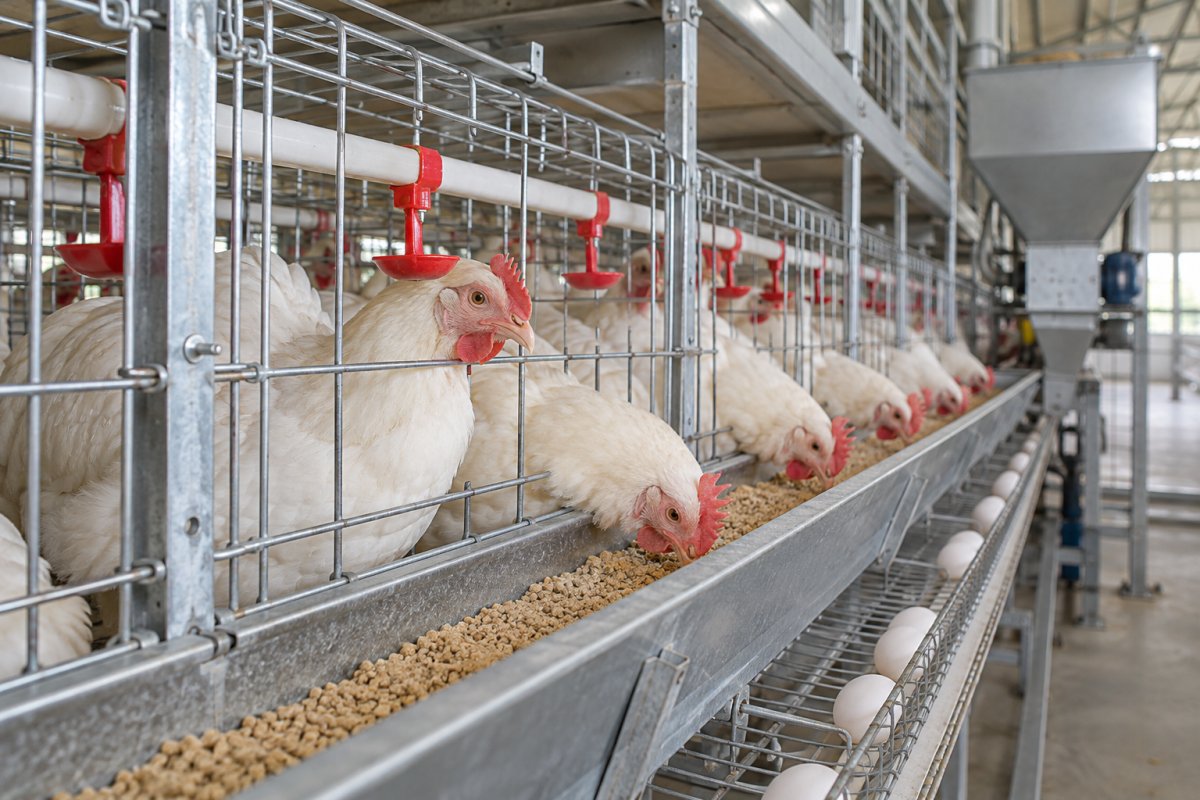
For a new broiler farm, the feeding system needs to deliver feed reliably, minimize unnecessary spillage and allow workers to inspect equipment without disrupting the flock.
When comparing quotations, check:
- Feed delivery: Where does the silo discharge, and how does feed reach each row or cage tier?
- Maintenance: Can workers inspect, clean and maintain the feeding equipment easily?
- Supply scope: Are the conveyors, drives and controls included in the quotation?
An attractive price for individual feeders does not necessarily mean the complete feeding system is less expensive.
Reliable Power and Water Are Just as Important
Astral’s FY2025 Integrated Report (p. 23) records average emergency power and water provision costs of approximately R10 million per month across its operations.
The company also reported commissioning solar photovoltaic installations at a Goldi farm in Standerton and its Festive processing facility in Olifantsfontein during FY2025.
These investments highlight a problem familiar to many poultry farms: unreliable electricity and water can interrupt production even when the housing equipment itself is operating properly.
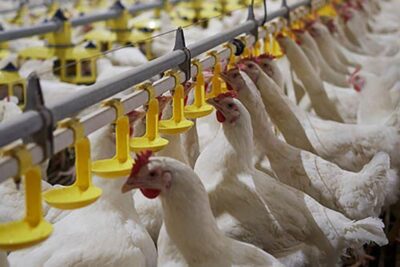
In a mechanically ventilated broiler house, fans need to continue operating during hot weather. Drinking systems also depend on adequate water storage, suitable filtration and consistent pressure.
Solar generation can reduce purchased electricity, but emergency ventilation requires a properly designed backup arrangement. Generators, batteries where appropriate, electrical protection and switching equipment need to be considered together.
For a new farm, reliable water and electricity infrastructure belong in the construction budget from the beginning.
Floor Rearing or Cage Rearing: Which Is Better?
The housing method is one of the first decisions a farm investor needs to make.
In floor rearing, broilers live on one level, generally on managed litter. Feeding and drinking lines run across the broiler house, while workers handle litter management, cleaning and bird catching.
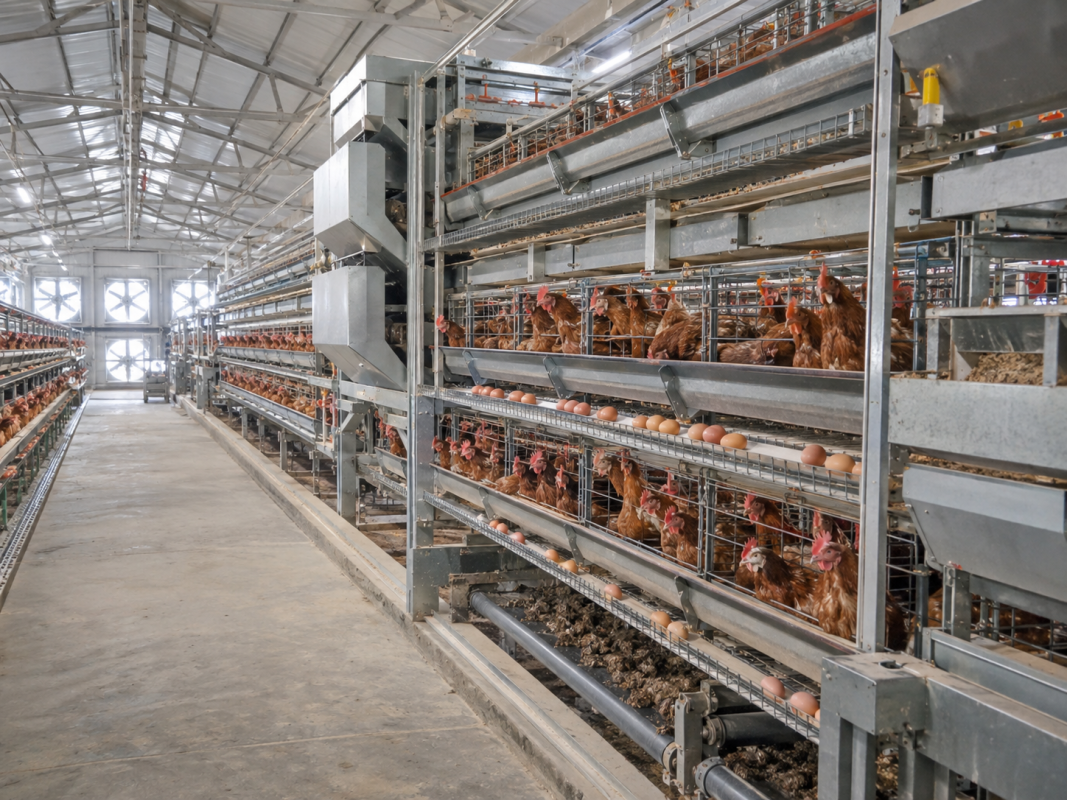
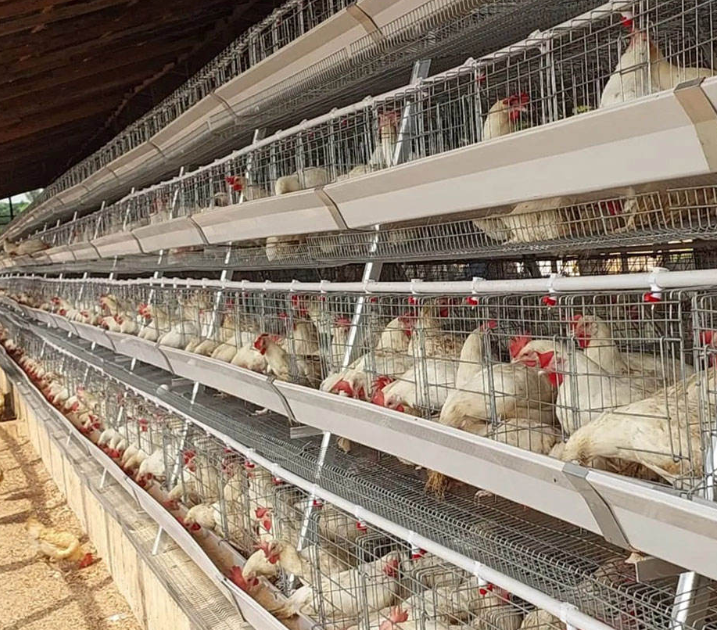
In cage rearing, broilers occupy several levels. Feeding, drinking and manure removal equipment are arranged around the cage rows, using more of the building’s vertical space.
Floor rearing generally requires less investment in housing structures. Cage systems involve additional frames, mechanical equipment and maintenance requirements, but offer a different approach to space use and manure management.
The better choice depends on local regulations, labor availability, final bird weight, customer requirements and the experience of the farm management team.
Our floor versus cage comparison explains the differences in more detail.
How Guangxing Helps Plan a Commercial Broiler Farm
Guangxing manufactures poultry housing equipment and automation systems for commercial farms.
Our multi-tier broiler cage system combines H-frame housing with feeding, nipple drinking, manure removal and bird unloading equipment.
The published design includes galvanized steel components, flexible plastic-mesh flooring, adjustable drinking lines and manure belts beneath the cage tiers.
The value of a well-planned multi-tier layout becomes clear during daily operation. Feeding equipment needs to be accessible, drinking lines require regular inspection, and manure removal must operate without interfering with the flock.
For farms operating several broiler houses, consistent layouts also make training, inspection and maintenance easier to organize.
Our company history records that Guangxing began supplying complete automatic broiler cage equipment to Henan Shuanghui in 2020. It also records an ISO 9001:2015 quality-management certification milestone.
Is Ventilation Included in the Cage Price?
This is an important question to settle before ordering.
A cage quotation and a complete broiler-house equipment quotation do not always cover the same systems. Fans, cooling pads, environmental controllers, electrical installation and water-treatment equipment may be quoted separately.
Ask for an itemized offer identifying the equipment Guangxing supplies, the work handled by local contractors and responsibility for installation and commissioning.
Ventilation also affects the building layout. Fan walls, cooling-pad openings and air-inlet positions need to be coordinated with cage rows and maintenance aisles before equipment installation begins.
Example: Planning a 30,000-Broiler House
Consider a farm designed for 30,000 broilers using a multi-tier cage system.
The following example uses assumed compartment dimensions to explain how a layout is calculated. A real project requires the selected cage drawing, target market weight and applicable stocking requirements.
Step 1: Calculate the Number of Compartments
Suppose the arrangement uses four cage tiers, six rows and a planning allowance of 12 broilers per compartment.
The minimum number of compartments is:
30,000 ÷ 12 = 2,500 compartments
With six rows and four tiers, the building has 24 row-and-tier positions.
2,500 ÷ 24 = 104.17
Rounding up to 105 compartments per position gives:
105 × 6 × 4 × 12 = 30,240 nominal bird places
The additional 240 places represent a 0.8% layout allowance, not permission to exceed the approved stocking capacity.
Step 2: Estimate the Building Length
Assume each compartment occupies 1.2 metres along the cage row.
105 × 1.2 m = 126 m
Adding two metres of clearance at each end gives:
126 m + 4 m = 130 m
Actual equipment drives, unloading arrangements, access points and service clearances affect the final building length.
Step 3: Estimate the Building Width
For this simplified example, assume six cage rows at 0.9 metres each, five internal aisles at 0.9 metres each and two outside clearances of 0.55 metres.
(6 × 0.9) + (5 × 0.9) + (2 × 0.55) = 11 m
The calculated building footprint is:
130 m × 11 m = 1,430 m²
This is an example of space planning, not an approved construction drawing. The final footprint depends on the actual cage frames, structural columns, access requirements and equipment layout.
Step 4: Check Stocking Density
Suppose one compartment provides 1.08 m² of usable floor area and each broiler reaches a final live weight of 2.5 kg.
For 12 broilers per compartment:
12 × 2.5 kg ÷ 1.08 m² = 27.8 kg/m²
This demonstrates how to calculate live-weight stocking density. The actual number of birds must comply with applicable requirements and suit the selected cage system and environmental conditions.
Step 5: Match the Equipment to the Layout
Once the cage rows and building dimensions are established, feeding lines, drinking equipment, manure discharge and maintenance access can be arranged.
Ventilation requires a separate engineering calculation based on the total bird load, outdoor climate, insulation, airflow distribution and fan performance.
The sequence is practical: establish the target flock capacity, calculate compartments and cage rows, determine the building dimensions, then design the supporting systems.
This gives farm investors a stronger basis for reviewing a supplier’s proposal than a quotation based only on the number of birds.
What Affects Broiler Cage Equipment Prices?
Two broiler farms with the same target capacity can have different equipment costs. Much of the difference comes from the specification and supply scope.
- Cage tiers and dimensions: The number of tiers and length of each row affect the quantity of frames, flooring, feeders and manure belts.
- Materials and corrosion protection: Steel thickness, galvanizing specifications and flooring materials influence manufacturing cost and maintenance requirements.
- Bird capacity: Compartment dimensions and the approved stocking arrangement determine how much cage equipment is required.
- Automation: Automatic feeding, manure removal, unloading equipment and environmental controls affect the cost of the complete system.
- Order quantity and delivery scope: The number of broiler houses, packing, freight, installation and spare parts influence the final project investment.
To compare quotations, divide the equipment price by the agreed bird-place capacity, using the same supply scope for each supplier.
A cage-only quotation is not directly comparable with a package that includes feeding, drinking, ventilation and installation.
For a fuller breakdown, see our poultry equipment price buying guide.
What Should African Buyers Check Before Ordering?
For overseas buyers, factory equipment prices are only part of the project cost.
Before ordering, confirm the destination port, Incoterms, container requirements and local transportation. Installation responsibilities need to be clear, particularly when local contractors handle electrical work, ventilation connections or commissioning.
Water quality deserves attention before the drinking system is selected. Farms using groundwater or untreated sources should arrange testing and suitable treatment planning.
Where power interruptions are frequent, the farm needs an emergency electricity plan for ventilation and other essential equipment.
Written delivery milestones, spare-parts arrangements and warranty terms make it easier to coordinate equipment purchases with construction.
What Information Should You Send Guangxing?
If you are planning a new broiler farm or expanding an existing one, the following information helps us understand your project:
- Farm location: Country, region and destination port, if known.
- Bird capacity: Broilers per house and total planned capacity.
- Number of houses: Existing buildings and proposed new houses.
- Building dimensions: Length, width and clear internal height.
- Housing method: Floor rearing or multi-tier cage rearing.
- Market weight: Planned live weight at the end of the growing cycle.
- Equipment requirements: Feeding, drinking, ventilation, manure removal and bird unloading.
- Utilities and project stage: Electricity, backup power, water supply and construction status.
With these details, we can review the proposed equipment arrangement, identify the main systems required and discuss the information needed for a preliminary layout and itemized quotation.
Frequently Asked Questions
How much space is needed for a 30,000-broiler farm?
The required space depends on the housing method, stocking requirements and equipment arrangement. The calculation example in this article produces a 1,430 m² broiler-house footprint under its stated assumptions. The complete farm also needs land for access roads, utilities, storage and supporting facilities.
Is cage rearing cheaper than floor rearing?
Floor rearing normally requires less investment in housing equipment, while cage rearing involves additional structures and automation. Compare total project investment, labor, manure management and operating requirements rather than cage prices alone.
Does Guangxing supply ventilation equipment?
Guangxing offers poultry housing equipment with environmental-control options. The actual quotation identifies the fans, cooling equipment, controllers and installation work included in the proposed package.
Can a broiler farm use solar power?
Yes. Solar generation can help reduce purchased electricity. Essential farm equipment still needs a suitable backup arrangement during power interruptions.
Final Thoughts
Astral Foods’ experience highlights two important pressures in commercial broiler farming: feed costs and reliable infrastructure. Both influence how a poultry house needs to be designed and operated.
For a new farm, selecting the housing method, calculating equipment requirements and coordinating water, ventilation and electricity from the beginning creates a stronger foundation for daily production.
Guangxing supplies automatic broiler cage equipment and supporting systems for commercial poultry farms.
If you are planning a 20,000-, 30,000- or 50,000-broiler project, send us your building dimensions, target market weight and equipment requirements. We can review the proposed configuration and discuss what is needed for an itemized equipment proposal.
About Guangxing
Guangxing manufactures poultry cage systems and supporting automation for commercial poultry farms.
Our product range includes layer and broiler housing, feeding, drinking, manure removal and environmental-control equipment for overseas poultry projects.
Contact: WhatsApp +852 4609 0144 · No. 2 Guangxing Road, Shating, Taihe Town, Baiyun District, Guangzhou, China.
Astral Foods is cited as a published industry example and is not presented as a Guangxing customer.