


EC Poultry Farm Cost for 5,000 Birds in India: Complete Budget, Shed Design & Subsidy Guide
Planning a 5,000-bird environmentally controlled (EC) broiler farm in India? Before arranging a bank loan or purchasing equipment, you need to understand the difference between the shed construction cost, climate-control equipment, backup power and working capital.
Quick answer: A 5,000-bird EC broiler shed in India may require approximately:
Indicative fixed investment for an insulated, mechanically ventilated shed with basic feeding and drinking equipment. This estimate assumes land is already available and excludes land purchase, the diesel generator, major external utilities, financing costs and first-batch working capital.
1. How Much Does a 5,000-Bird EC Poultry Farm Cost in India?
For initial investment planning, a 5,000-bird EC broiler shed with insulated construction, tunnel ventilation, evaporative cooling, feeding, drinking and basic brooding equipment can be budgeted at approximately ₹30–38 lakh.
The following allocation is an illustrative planning model based on the total market benchmark. These are not independently verified component quotations and should be replaced with local civil-contractor and equipment-supplier offers before submitting a bankable project report.
| Cost component | Budget (INR) | What it covers |
|---|---|---|
| PEB shed, insulated roof/walls and floor | ₹21–24 lakh | Basic structure, enclosure and flooring within the assumed scope |
| Tunnel fans and cooling pads | ₹3–4.5 lakh | Ventilation and evaporative cooling equipment allowance |
| Feeding and drinking systems | ₹2–3 lakh | Feeder lines, nipple drinkers and associated equipment |
| Brooding equipment | ₹0.8–1.2 lakh | Basic chick heating and brooding accessories |
| Controls, sensors and basic electrical components | ₹0.7–1.3 lakh | Temperature control, basic sensors and associated components |
| Installation and minor commissioning allowance | ₹2.5–4 lakh | Basic on-site assembly and installation allowance |
| Indicative EC shed investment | ₹30–38 lakh | Before exclusions listed below |
The low and high totals are illustrative allocations, not quotations from individual suppliers. An integrated EPC bid may allocate these costs differently. Avoid adding a separate ₹700–900/sq. ft. shell cost to this table: doing so would double-count construction.
A farmer financing the complete project should therefore not treat ₹38 lakh as an unconditional maximum investment. A full project budget may be higher after site infrastructure and the first operating cycle are included.
2. What Shed Size Is Needed for 5,000 Broiler Birds?
A commonly published planning assumption for an EC broiler shed is 0.85 sq. ft. per bird. On that basis:
5,000 birds × 0.85 sq. ft. = 4,250 sq. ft.
One possible rectangular footprint is approximately 25 ft × 170 ft. This is a space-planning example, not an approved construction drawing.
Actual stocking density must be confirmed against the final live weight, breed management requirements, local regulations, integrator specifications, effective ventilation and welfare standards. An 0.85 sq. ft. allowance should never be used to justify overcrowding.
The gross building area may also need adjustment for access, equipment clearance and internal service space. A poultry engineer should calculate minimum and maximum ventilation needs before confirming the house width and length.
How does EC housing differ from an open-sided shed?
| Feature | Open-sided broiler shed | EC broiler shed |
|---|---|---|
| Air management | Natural airflow assisted by fans | Controlled ventilation with designed inlets and exhaust |
| Temperature control | More dependent on outdoor climate | Fans, insulation and cooling pads |
| Initial investment | Generally lower | Generally higher |
| Power dependency | Lower but still important | High; reliable backup essential |
| Best fit | Budget-conscious farms with suitable conditions | Farms able to operate and maintain reliable climate control |
3. How India's Climate Changes EC Poultry Farm Cost
India is not one uniform poultry-growing environment. A 5,000-bird house in dry inland Telangana may need a different ventilation and water strategy from one in humid coastal Andhra Pradesh or monsoon-exposed Kerala.
Inland Telangana, Rajasthan and similar locations
High summer temperatures increase demand for insulation, ventilation and cooling water. Evaporative pads may be effective when outdoor air is dry enough, but the available water must be tested and the design must consider peak summer conditions.
Coastal Andhra Pradesh, Tamil Nadu and Kerala
High humidity can limit evaporative cooling performance. Air speed, ventilation volume, litter moisture control and drainage become especially important. Larger cooling pads alone do not guarantee suitable indoor conditions.
Heavy-rainfall districts
Check roof-water drainage, site elevation, flood risk, pad protection and litter moisture. Land that looks dry in January may require substantial drainage work during the monsoon.
Northern and inland regions
Chicks need reliable brooding heat and minimum ventilation during cooler periods. Reducing airflow without monitoring humidity and air quality can create problems even when the house feels warm.
Do not underestimate India's rural electricity risk
In a mechanically ventilated EC shed, an extended power failure during extreme heat can rapidly become a flock-welfare emergency. A diesel generator (DG Set), transfer arrangement and alarm system should be included in the engineering plan.
Do not choose generator capacity from bird count alone. The electrical engineer must calculate fan and pump loads, simultaneous operation, motor-starting current, starting sequence and the generator's continuous operating rating. The design should also include periodic load testing and a reliable diesel supply.
4. Three Investment Options for a 5,000-Bird Farm
At 5,000 birds, a fully equipped EC house can carry a high fixed cost per bird. The right investment is not necessarily the system with the most automation.
Improved Open-Sided Broiler House
Consider a conventional house with suitable roof insulation, ventilation support, brooding equipment and reliable water supply where climate and integrator rules allow.
Best for: New farmers with restricted capital or uncertain batch income.
Trade-off: Less control over extreme outdoor conditions.
5,000-Bird EC House with Selective Automation
Retain the engineered ventilation, insulation, controls and emergency backup. Evaluate semi-automatic or basic feeding arrangements if they reduce investment without compromising daily operation.
Best for: Farmers with a committed integrator or a credible operating plan.
Trade-off: Fixed ventilation and backup costs remain significant.
Start with 5,000 Birds, Plan for 10,000+
Design the site, roads, drainage, electrical distribution and utilities so future houses can be added. Expand when cash flow, demand and management results justify it.
Best for: Farmers with land and a longer-term growth strategy.
Trade-off: Some enabling infrastructure may require earlier investment.
Contract Growing vs Independent Farming
Under a contract-growing model, the integrator may provide chicks, feed and veterinary inputs, but payment terms and farmer responsibilities vary. Independent farmers generally bear these operating costs and market-price risk themselves.
Ask for: A written contract or a conservative selling-price forecast before committing to construction.
For many 5,000-bird projects, it is sensible to compare the economics with a 10,000-bird alternative. Larger capacity can spread fixed costs across more birds, but it also requires additional funding, stronger management and sufficient market demand. It does not guarantee higher profitability.
5. How Guangxing Can Help Indian Farmers Choose the Right Equipment
Guangzhou Guangxing Poultry Equipment Group is a Chinese manufacturer of automated poultry equipment. For Indian buyers, an important advantage of sourcing from a specialized manufacturer is the ability to compare different equipment configurations against a defined farm layout and technical specification.
For a 5,000-bird project, Guangxing's involvement should begin with capacity and equipment planning rather than automatically recommending the most expensive system.
| Equipment | Suggested approach | Buyer decision |
|---|---|---|
| Feeding | Evaluate automatic feeding against lower-cost feeding options | Labour availability, feed distribution and servicing |
| Drinking | Nipple drinkers with pressure regulation and filtration | Water quality, line flushing and maintenance |
| Ventilation | Engineered exhaust fans, air inlets and suitable cooling pads | Local temperature, humidity and required air movement |
| Environmental control | Temperature sensors, ventilation stages and emergency alarms | Operational reliability and backup procedures |
| Housing structure | Coordinate structural and insulation requirements with local contractors | Site conditions, fabrication, local installation and compliance |
| Future expansion | Reserve capacity and space for additional houses | Long-term business plan and available capital |
Should a 5,000-bird Indian farm use broiler cages?
Not necessarily. This guide's 4,250 sq. ft. example assumes floor-reared broilers, not a multi-tier cage installation. The two housing models require different area calculations, equipment, manure management and investment estimates.
Guangxing also manufactures automatic multi-tier broiler cage systems, but these should be evaluated as a separate project option only after checking the buyer's farm model, local requirements and expected financial returns.
For a detailed explanation of cage housing components, see the Guangxing broiler cage farming system guide.
Water, litter and manure management
A good EC shed also needs a practical plan for drinking-water treatment, litter handling, used bedding and farm drainage. Poor water quality can affect nipple performance and flock health, while wet litter increases management and disposal problems.
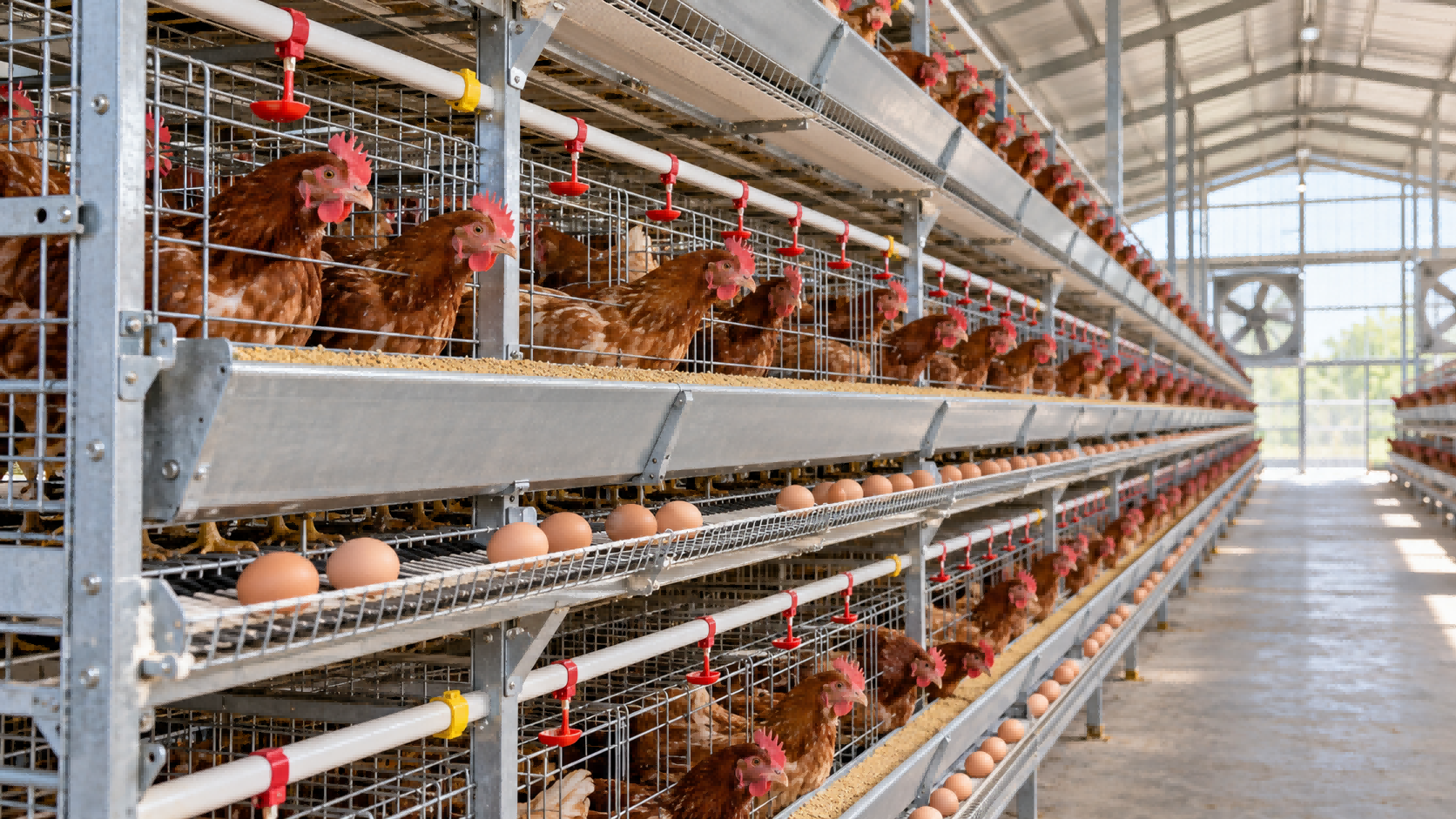
A dedicated industrial manure-processing system is not automatically economical for a single 5,000-bird farm. Begin with compliant litter collection, storage and local disposal arrangements; assess larger treatment equipment only when farm scale and waste volume justify it.
6. Working Capital: How Much Does One Broiler Batch Cost?
Fixed investment (CAPEX) builds the farm. Working capital pays for each production cycle. These numbers must remain separate in both your business plan and bank loan documents.
The following example uses published Indian project-cost assumptions: 5,000 chicks at ₹35 each, 3.5 kg feed per placed bird and feed at ₹35/kg. The actual budget must be updated with hatchery, feed-mill and integrator quotations.
| Operating item | Illustrative per-batch cost |
|---|---|
| Day-old chicks: 5,000 × ₹35 | ₹1.75 lakh |
| Feed: 5,000 × 3.5 kg × ₹35 | ₹6.13 lakh |
| Labour, electricity and water | ₹0.30 lakh |
| Medicine, vaccines and other allowance | ₹0.25 lakh |
| Illustrative operating allowance | ₹8.43 lakh |
This is a basic working-capital example, not a guaranteed total production cost. Actual expenses may include diesel, litter, transport, finance charges, repairs, insurance and additional labour. Working capital of about ₹9–11 lakh or more per batch may be a more practical initial sensitivity range for an independent farmer, subject to current local quotations.
Why is 5,000-bird EC farming financially sensitive?
Consider an EC installation costing ₹35 lakh. Straight-line allocation over ten years would represent ₹3.5 lakh per year before financing interest and repairs. At six completed batches per year, that is roughly ₹58,300 per batch, or ₹11.67 per bird placed, solely as a simplified capital-cost allocation.
The calculation does not represent accounting depreciation for every farm, and it excludes generator investment, interest and replacement costs. It illustrates why fixed costs matter greatly at this capacity.
Check three numbers before estimating profit
- Saleable output: Birds sold × average live weight, allowing for mortality and rejected birds.
- Batch contribution: Revenue or contract-growing payment minus variable operating costs.
- Annual cash flow: Batch contribution × feasible yearly batches, less maintenance, loan servicing, fixed overhead and other cash expenses.
For independent farms, test a lower selling price, a higher feed price and a worse mortality scenario. For contract growers, use the integrator's actual growing-charge formula, deductions and guaranteed placement terms rather than assuming the farmer receives the full chicken selling price.
7. NABARD Poultry Farm Loan, NLM Subsidy and Bank Project Reports
Farmers searching for the cost of a 5,000-bird EC shed are often also preparing a Detailed Project Report (DPR) for a lender. Cost estimates alone are not sufficient: the bank will also assess ownership or lease documents, project viability, borrower contribution, repayment capacity and applicable approvals.
Does NABARD provide a loan directly?
NABARD publishes unit-cost references and plays a role in rural finance and refinancing. Farmers commonly apply through eligible banks and financial institutions, which assess the individual loan proposal. A NABARD unit-cost table does not by itself approve a loan or guarantee a subsidy.
Can a 5,000-bird EC farm receive a 50% subsidy?
Do not assume so. The National Livestock Mission (NLM) includes support for specified rural poultry breed-development and related qualifying projects. A standard commercial broiler grow-out EC shed is not automatically eligible merely because it houses 5,000 birds.
Likewise, the Animal Husbandry Infrastructure Development Fund (AHIDF) supports specified infrastructure activities such as meat processing, animal-feed plants and other eligible categories. Eligibility for a standalone broiler grow-out shed must be verified rather than presumed.
State-specific poultry support programmes may also exist. Check the current rules with the relevant State Animal Husbandry Department, District Industries Centre and financing bank before entering any expected subsidy in the project cash flow.
What should a bankable poultry project report contain?
- Farmer details, site ownership or valid lease documentation
- Capacity, farming model and integrator agreement where applicable
- Shed drawing, construction quotation and equipment schedule
- Fixed capital, working capital and contingency shown separately
- Utilities, DG backup, water supply and biosecurity plan
- Monthly or batch-wise income, expenses and repayment projection
- Sensitivity analysis for feed prices, mortality and selling prices
- Applicable local permissions and environmental compliance
Environmental permissions also matter
India's Central Pollution Control Board (CPCB) poultry-farm guidelines include provisions for site location, waste management and consent requirements. The published guidelines refer to consent requirements for farms handling more than 5,000 birds at a single location under the cited NGT direction. A project planned at exactly 5,000 birds should still confirm its current position with the relevant State Pollution Control Board, especially before future expansion.
Environmental consent is not the only possible requirement; local land-use, building, water and other permissions must also be checked.
8. What Should You Send to an Equipment Supplier Before Requesting a Quote?
Two farms with the same bird capacity may need different equipment because of regional climate, utilities, house design and farming arrangements. A useful quotation must therefore be based on a clear technical scope.
Farm and site details
- Indian state, district and nearest city
- 5,000 birds per batch and planned market weight
- New build or existing shed renovation
- Available site area and proposed house dimensions
- Local summer temperature and humidity conditions
Engineering and commercial details
- Grid voltage and history of power outages
- Water source, water quality and storage
- Automatic or semi-automatic feeding preference
- Contract-growing or independent production
- Required delivery scope, local installer and target budget
Ask the supplier to show whether fans, cooling pads, controllers, sensors, feeding lines, drinking lines, electrical cabling, installation, commissioning, warranties and spare parts are included. For a bank loan, request quotations that can be mapped directly to the DPR cost categories.
Planning a 5,000-Bird Poultry Farm in India?
Share your state, available shed area, target bird weight, power conditions and intended budget. Guangxing can discuss suitable poultry equipment configurations, capacity planning and the information needed for a technical quotation.
For a small EC project, we recommend comparing the proposed equipment scope with local construction, electrical and backup-power quotations before committing to investment.
Contact Guangxing for Equipment Planning & Quotation9. Frequently Asked Questions
What is the cost of an EC poultry farm for 5,000 birds in India?
An indicative 2026 benchmark is ₹30–38 lakh for an EC broiler shed with basic equipment under a defined scope. Land, DG backup, major external utilities and the first batch of operating expenses may increase total funding needs.
How much shed area is needed for 5,000 broilers?
At an illustrative stocking allowance of 0.85 sq. ft. per bird, the floor area is 4,250 sq. ft. Confirm the final area against market weight, housing layout, integrator requirements and applicable standards.
Is a 5,000-bird EC poultry farm profitable?
It can be profitable under favourable operating and commercial conditions, but the fixed cost per bird may be relatively high. Compare annual batch contribution with financing, generator, repairs, overhead and replacement costs. A contract-growing agreement can change the risk profile significantly.
Can I get a NABARD loan or government subsidy?
Eligible banks may finance poultry projects subject to appraisal. NABARD unit costs can assist planning, but subsidies depend on specific central or state scheme conditions. Do not assume the NLM rural poultry breeding subsidy applies to an ordinary commercial broiler EC shed.
Is a diesel generator necessary for an EC poultry shed?
Reliable emergency ventilation backup is essential. A DG Set is a common solution, but its capacity must be engineered from the actual connected loads and motor-starting requirements, not merely the number of birds.
Should I choose automatic feeding or a semi-automatic system?
At 5,000 birds, compare equipment price, labour requirements, operational consistency and repair support. Essential environmental control and emergency ventilation should take priority over non-critical convenience features.
Research Sources and Cost Assumptions
The estimates above are planning references, not a binding quotation or a guaranteed return on investment. Local rates, scheme eligibility and engineering requirements must be verified before financing or construction.
- Kishore Industries — Poultry Farm Shed Cost 2026
- Arasfirma — Poultry Farming Cost in India
- NABARD — Unit Cost 2025–26, including 5,000-broiler model
- Department of Animal Husbandry & Dairying — NLM eligibility information
- Press Information Bureau — Government livestock scheme clarification, February 2026
- Central Pollution Control Board — Environmental Guidelines for Poultry Farms
- ICAR — 2025 Seasonal Agricultural Advisories
Editorial note: The ₹30–38 lakh benchmark is derived from an external South India market-cost estimate. The component allocation and financial illustrations are planning examples. No Guangxing project in India or Guangxing-specific equipment price is claimed without supporting project evidence or a formal quotation.